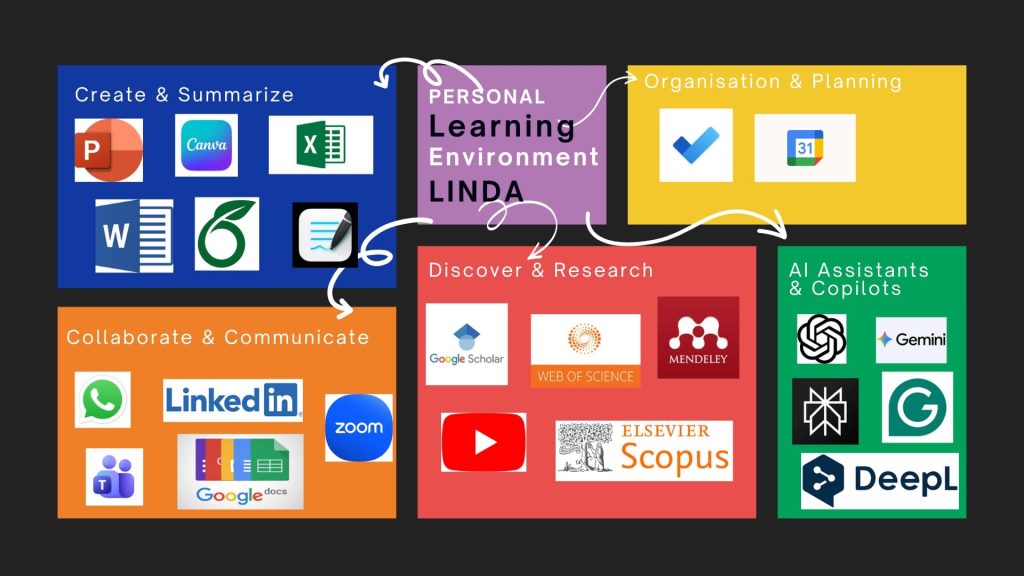
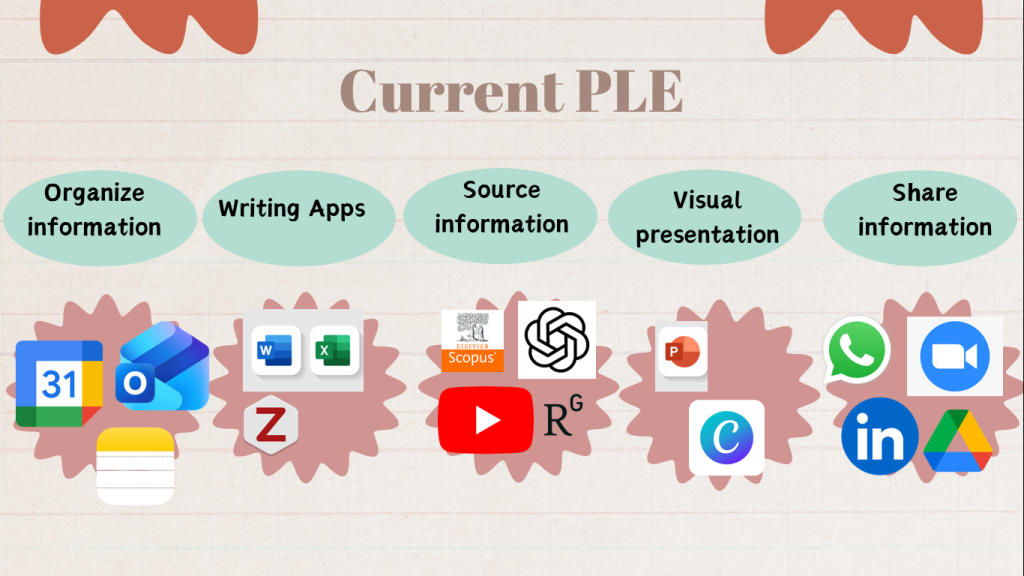
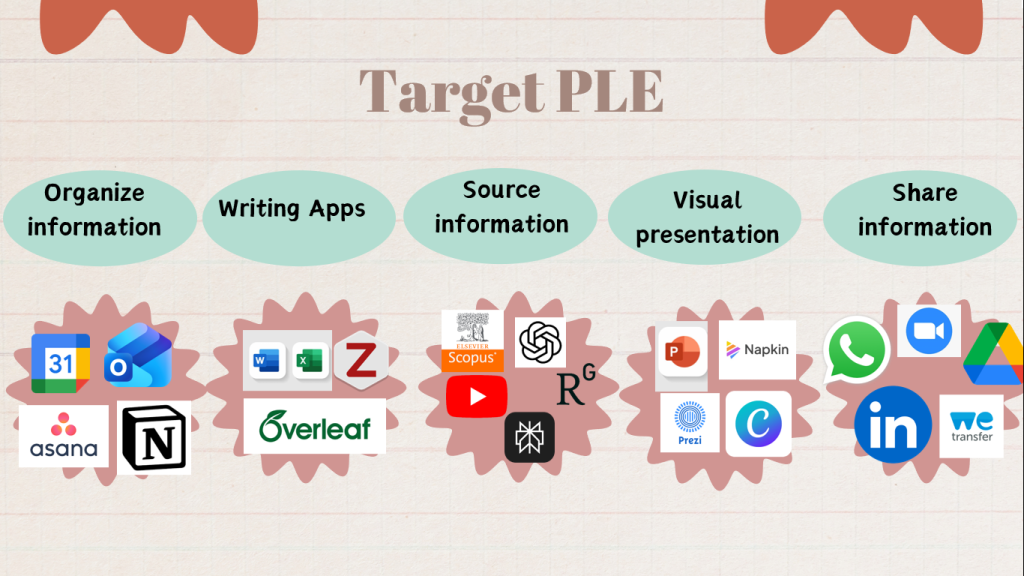
Lately I’ve been taking a closer look at the way I learn, research, and manage my digital world. For a long time, my Personal Learning Environment was basically a giant collection of apps I liked… but not a real system. I had tools for everything: writing, planning, researching, communicating. However, they were all doing their own thing, living in separate little digital islands.
It worked, but only in the way that keeping all your notes in different bags “works.” You can make it happen, but should you?
So I decided to give the whole thing a proper upgrade.
The old setup was full of great resources: Scholar, Scopus, Google Docs, Teams, Canva, Mendeley, calendars everywhere… all useful, but not connected. With AI becoming such a big part of how we work and learn, I realized I wasn’t taking advantage of it in any meaningful, structured way.
That’s what I’m fixing now.
My new approach is all about using AI intentionally! Not just as a cool extra feature, but as a core part of how I organize information, make decisions, and produce work. That means smarter planning apps, AI-supported research tools that actually surface relevant studies, and creative platforms that help me produce things faster (and better) without drowning in options.
I’m not trying to add more tools. I’m trying to make the ones I use work together, so the whole system feels lighter, more focused, and a lot more “me.”
It’s a slow, slightly nerdy process… but honestly? Kind of exciting. A cleaner, smarter PLE is definitely in the making.
Hello I am Linda. I am currently a MSc student in Advanced Materials and Innovative Recycling in UPM Madrid. During my bachelor in Vienna I studied Chemical and Process Engineering (TU Wien) and Business and Economics (WU Wien). I am passionate about developing novel solutions in the field of sustainability, circular economy or renewable energy. In my free time, I am always looking for the next dopamine or adrenaline rush. Let’s get in touch and discuss contemporary challenges.
Hi! I am Shah. Professionally, I like to exist in the intersection of materials and circularity. Currently pursuing a Master’s in Advance Materials Innovative Recycling at Universidad Politécnica de Madrid (UPM). Outside my professional sphere, you will find me chasing sunsets, travelling to lesser-known destinations and making a mean carrot cake.
Welcome to a little tour inside my learning world!
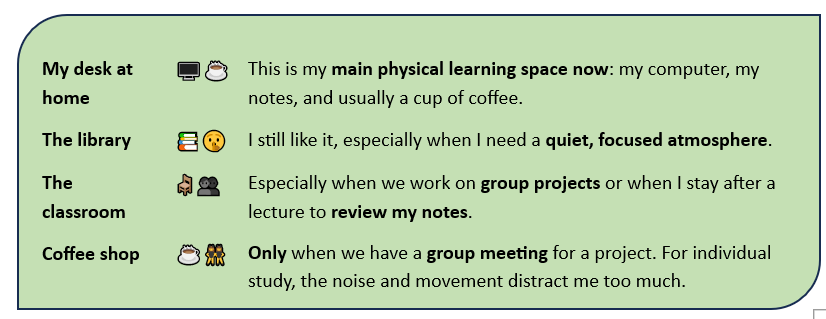
“Most of my learning doesn’t happen in a single classroom or library anymore. It happens between my desk at home, my laptop, a list of digital tools, and the people I collaborate with every day. All of this together forms what we call a “Personal Learning Environment (PLE).”
🏡 Where my learning actually happens:
🔔 This is a good reminder that learning environments are very personal: what works for one student might not work for another.
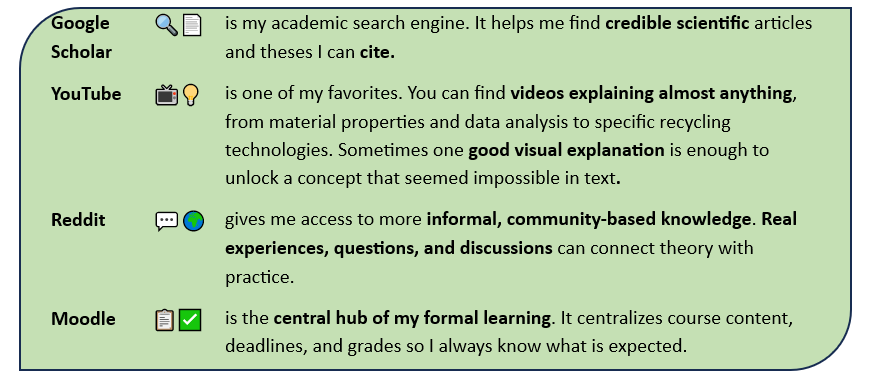
🛠️ What’s Inside My PLE?
(Beyond these physical spaces, my PLE also includes a set of digital tools that I rely on every day.)
1. Learning & Research
When I start exploring a new topic:
Together, these tools let me move between academic literature, visual explanations, and real-world discussions.
2. Note-Taking & Organization
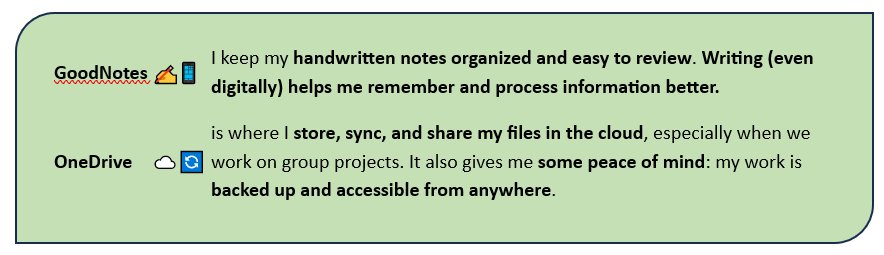
Collecting information is only useful if I can organize it:
3. Creation & Productivity
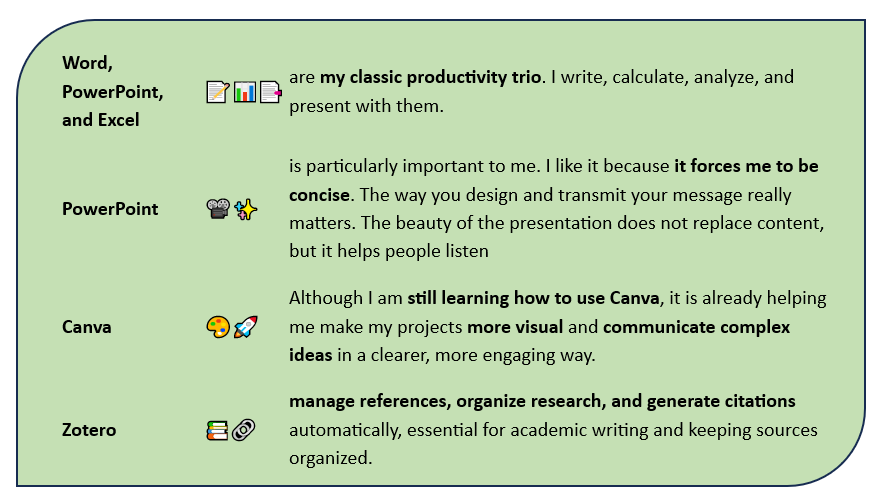
In my Master, a lot of our learning happens through presentations and reports:
4. AI & Digital Support
We are now fully in the AI era, and my PLE is starting to reflect that.
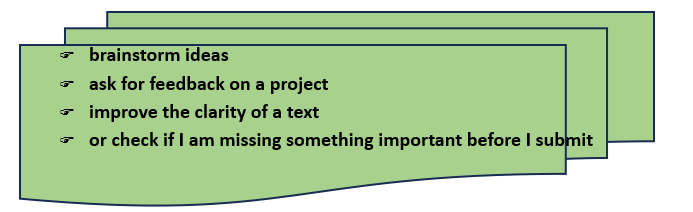
I use AI tools to:
For example, when I finish a report or a presentation, I like to discuss it with an AI and ask for suggestions: “Is my structure clear? Did I forget any obvious limitation? Can this slide be explained better?”
For me, AI is not about letting a tool think instead of me, it is more like having a critical friend who looks at my work and helps me polish it.
5. Social Media & More
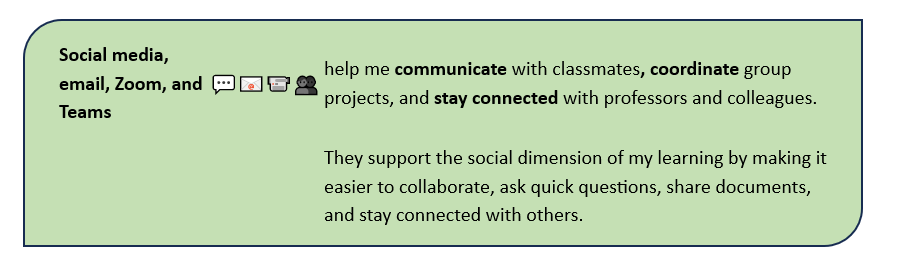
Finally, my PLE also includes communication tools:
Hi! I’m an Industrial & Environmental Chemist (B.Sc. + M.Sc., Albania) with five years experience in the mining industry. In 2024 I began a Master in Advanced Materials & Circular Economy in Madrid to go deeper into life-cycle assessment, materials recovery, and circular process design. I combine careful lab work with a practical mindset and I’m excited to keep growing. My goal is simple: use solid data to improve efficiency and build more circular, real-world solutions. Open to collaborations and roles where analytical excellence meets circular innovation.
Note: The blog’s storage is almost full. Which is why I had to reduce the size of my PLE images to upload them, thereby reducing the quality of the images. If you want to view the high-resolution images, you can find them here: PLE-Shah Saud
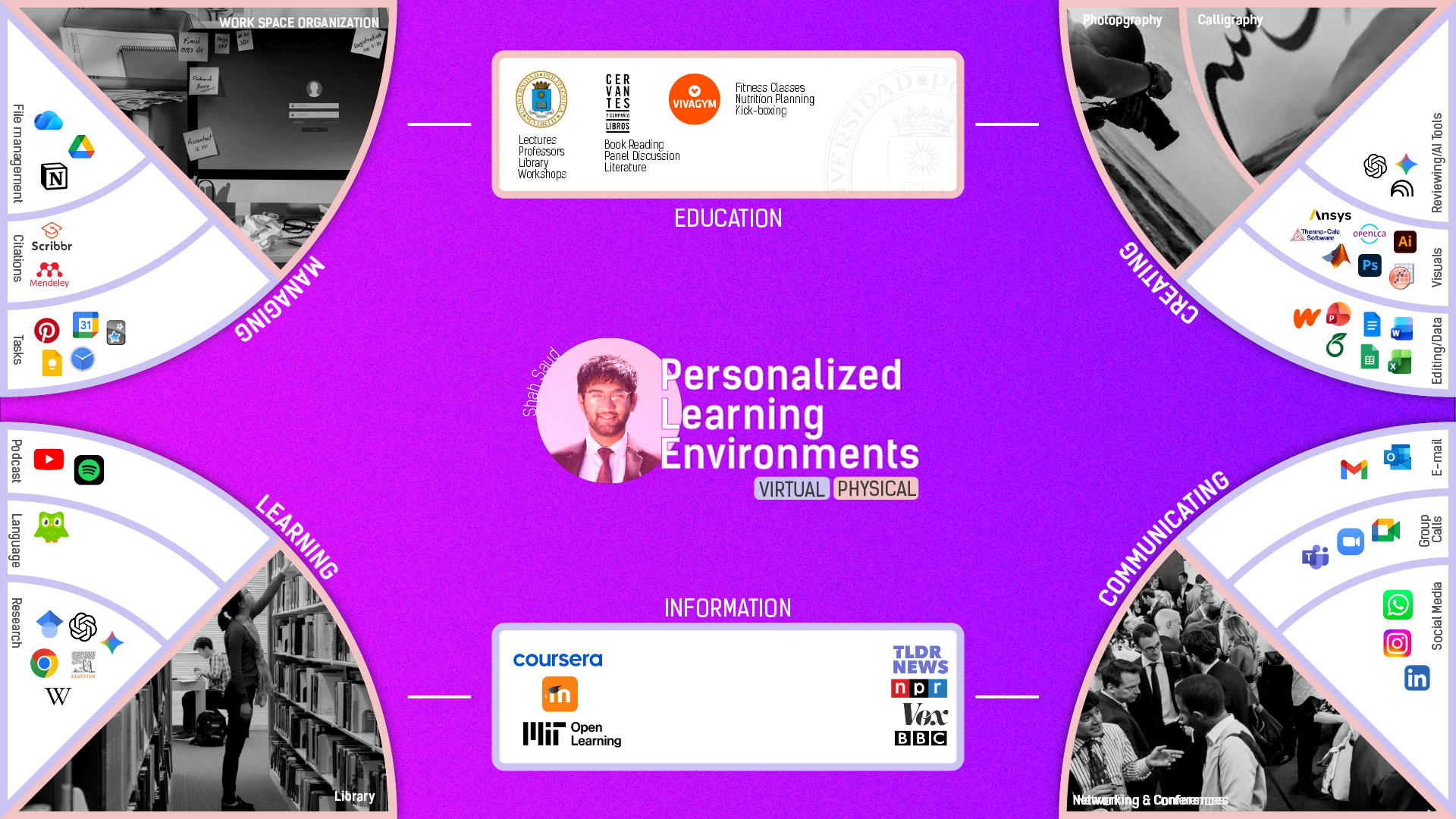
My existing Personalized Learning Environment (PLE) is organized around four major domains of my daily academic, personal, and professional life: Learning, Managing, Communicating, and Creating. Each domain highlights the physical spaces, activities, and digital tools that support how I acquire knowledge, stay organized, connect with others, and produce content.
Learning
This area represents the different ways I engage with new knowledge—through libraries, podcasts, online platforms, research tools, and language-learning apps. It shows the diverse inputs I rely on to expand my understanding and learn new skills.
Managing
Here, I capture the systems and tools I use to organize my work and personal life, such as file-management platforms, citation managers, calendars, and task-tracking applications. This quadrant reflects how I maintain structure and efficiency in both physical and virtual environments.
Communicating
This domain maps out how I stay connected with others across both formal and informal channels. It includes email platforms, social media, group-call tools, and in-person networking environments. Together, these support my collaboration, communication, and relationship-building.
Creating
The creating section showcases the tools I use to design, edit, and express my ideas visually or through multimedia. It encompasses software for writing, designing, analyzing data, photography, and exploring new creative AI tools.
Overall, the existing PLE presents a holistic snapshot of my everyday practices and the digital ecosystems that support my learning, productivity, and creativity.
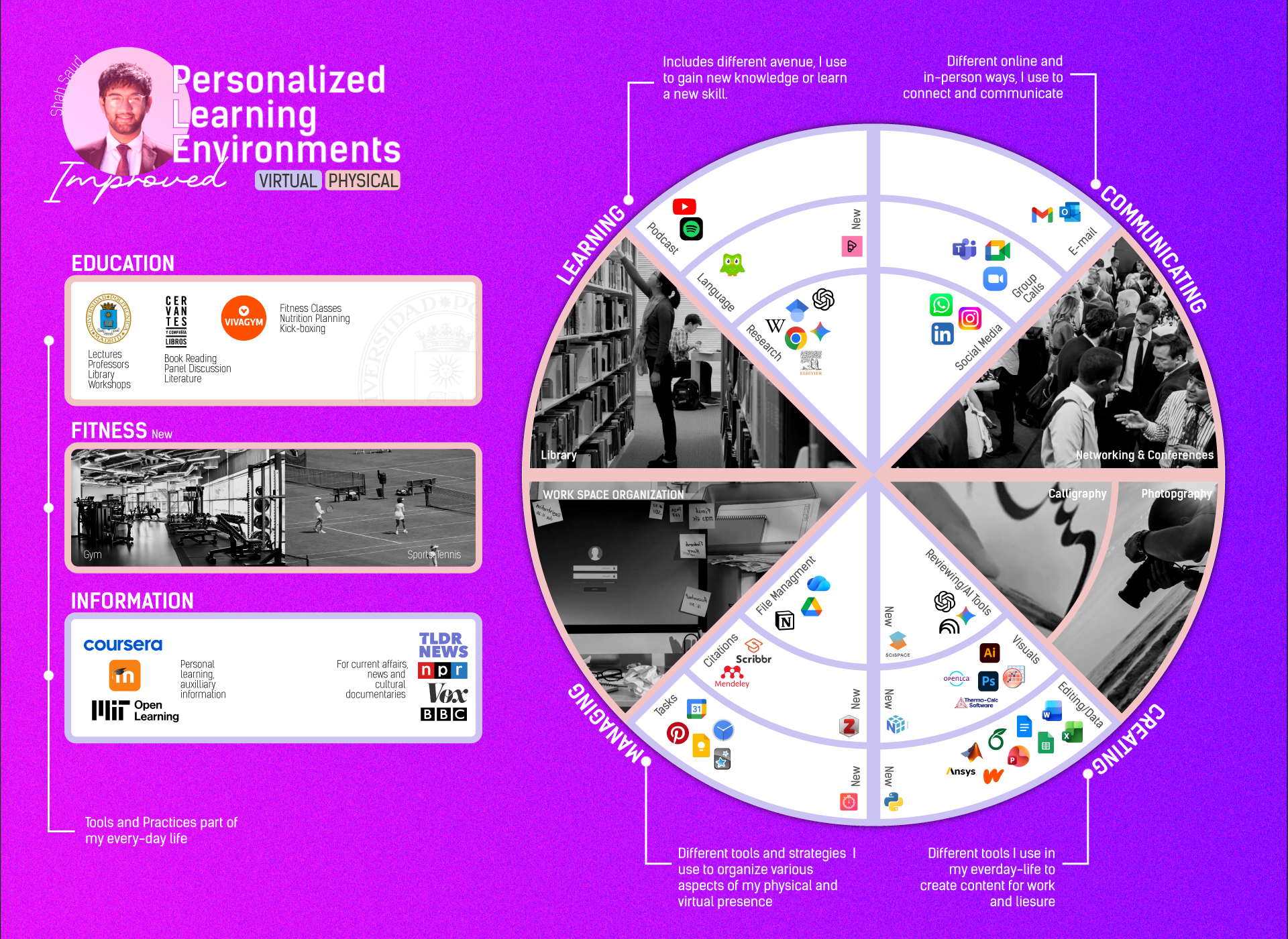
My improved PLE builds upon the original by expanding tool categories, adding new platforms, and restructuring the visual layout for greater clarity. The update makes my learning environment more comprehensive, modern, and aligned with my current goals.
Enhanced Visual Structure
This was an intentional change to show the existing PLE connecting in a circular with the additions of improved PLE. This symbolizes how learning from all differet tools in inter-connected and that I don’t solely rely on these environments seperately to accomplish a task but they all help in different ways in achievening a common end goal.
More Detailed Categorization
The improved PLE introduces clearer subdivisions within each quadrant—for example, breaking down learning tools into podcasts, language learning, research, and new-skills development. This increases specificity and highlights the variety of methods I use.
New Tools Across Domains
Several new tools appear across the updated model, particularly in the areas of:
AI-assisted learning and creation: Such as more advanced AI research and generation tools like scispace. A tool I have heard good things about but never incorporated it into my daily tasks. I would like to use it and see if it workds well for academic research as compared to conventional LLMs which I already use.
Creative platforms: Covering visuals, editing, simulations, and engineering-related software. I have a strong background in numerical coding and design but I am currently learning tools like numpy.
Language Learning: I have used Dualingo as long as I remember. It offers a very passive way of learning a new language. In the end you’re able to speak a few very basic sentences and words. However, I am still not able to speak any German, even after my 1000 day streak 😅. Am I bad learner? I don’t know. Is Dualingo ineffective, I would say yes. Therefore, I incorporated the use of another platform, preply, that places itself as a competitor to Dualingo while offering real-time progress in learning a new language.
These additions reflect the evolution of my workflow toward more sophisticated, technology-enhanced solutions.
Integration of Physical & Virtual Environments
The improved PLE explicitly acknowledges both physical and virtual elements of my learning ecosystem, including:
Physical learning spaces such as libraries, workshops, and fitness environments.
Virtual spaces such as online courses, digital information sources, and cloud-based tools.
This dual emphasis shows a more holistic approach to personal development.
Expanded Education, Information, and Fitness Sections
New panels highlight:
Education: academic environments, workshops, literature activities, and fitness programs.
Information: reliable news, educational platforms, and current-affairs sources.
Fitness: gym routines and sports, representing the role of well-being in my PLE.
Hi! I am Shah. Professionally, I like to exist in the intersection of materials and circularity. Currently pursuing a Master’s in Advance Materials Innovative Recycling at Universidad Politécnica de Madrid (UPM). Outside my professional sphere, you will find me chasing sunsets, travelling to lesser-known destinations and making a mean carrot cake.
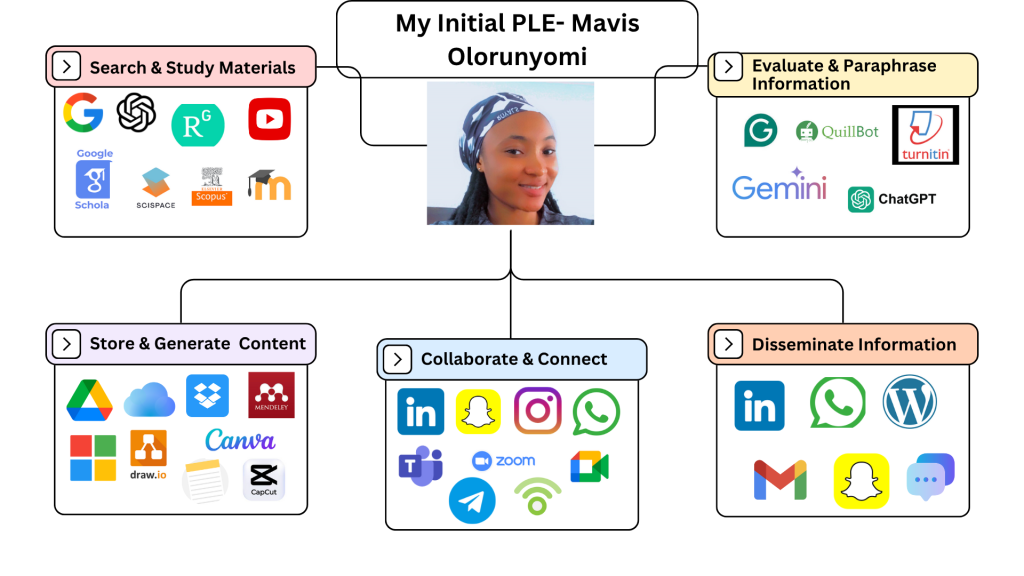
My Initial/current PLE reflects the digital tools I already use in my daily learning process. It focuses mainly on searching for information, storing documents, and basic collaboration. Tools like Google Scholar, ResearchGate, Chatgpt, Dropbox, Email, WhatsApp, and LinkedIn play a central role in helping me manage coursework, communicate, and access reliable academic content. Although useful, my original PLE was limited and did not fully support deeper learning, creativity, or language development. Below is the visual identity of my current PLE.
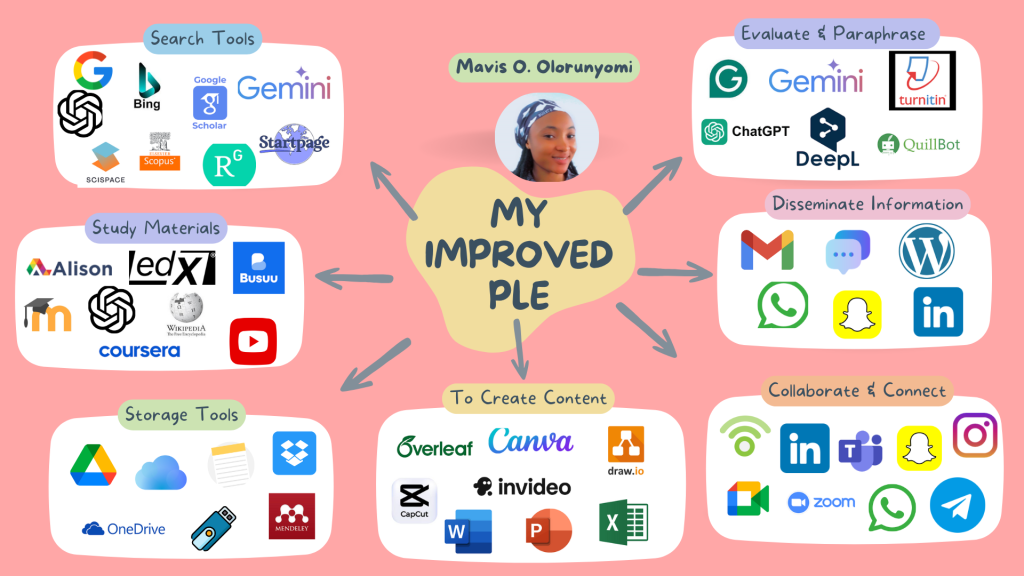
In my improved/target PLE, it entails previous and new tools that would make my learning environment much richer and more versatile. New tools such as edX, Busuu, Alison, InVideo, Overleaf, and DeepL now support areas like language learning, academic writing, creative content generation, and advanced research. This expanded structure also organizes my tools more clearly across stages: searching, evaluating, storing, collaborating, and disseminating information. This improved PLE will make my learning more active, efficient, and balanced. It gives more ways to access knowledge, verify information, collaborate with others, and produce high-quality academic content. It also supports my personal and professional growth by helping me communicate better, stay organized, and develop new digital skills that are essential in both academic and real-world contexts. Here’s the visual identity of my target/improved PLE.
Hello everyone! My name is Mavis O. Olorunyomi, and I am passionate about sustainability, circular economy, materials innovation, and green technologies.
I am currently pursuing a Master’s degree in Advanced Materials and Innovative Recycling (AMIR) through the Erasmus Mundus program, where I study at Universidade NOVA de Lisboa and Universidad Politécnica de Madrid.
My academic journey began with a Bachelor’s in Industrial Chemistry from the University of Cape Coast in Ghana. Over time, I have developed a strong interest in creating sustainable materials and exploring how scientific research can drive environmental resilience and circular design.
Beyond academics, I enjoy taking on new challenges, learning continuously, and contributing to projects that make a positive environmental impact. I am deeply motivated by the idea of building a greener and more sustainable future through innovation and practical action.
Hello everybody! I’m sharing my Personal Learning Environment (PLE) here. I’ve divided it into several categories and chose to show it in Venn diagrams to best represent the intersections between the different uses of the apps I use to learn, study and improve myself. I added in full color the tools I already use and in transparent the ones I would like to implement in the future.
Here are the categories I’ve divided it into, along with some comments:
Connecting: For social networks and communication. This also includes Moving, with two social apps for connecting while exercising and traveling, and Google Maps, which I use on a daily basis (yes, I should work on my orienteering skills 😅). A social network I’ve never used but think could be useful to add is X.
Meeting: This has become a bigger part of my life especially since the COVID pandemic.
Researching, AI, and Academia: I find it very interesting to look for AI tools that can help us do better and more efficient literature research. If you have any suggestions other than SciSpace, let me know! As for other AI apps, I’d definitely like to get used to using more Gemini and Copilot, for example for images and graphic generation.
Writing and Analysing: I’ve included software to create text files, reports, notes, and spreadsheets, but also to work on LCA. I’d like to learn to use Overleaf, as it would help me present better-looking reports or a final thesis, for example. I already know a bit of HTML and CSS, but getting used to Overleaf could help me improve more.
Pictures and Presentations/Videos: The tool I use the most is definitely PowerPoint, but I’d like to improve in using Canva and learn Adobe and CapCut.
Organization: I already use quite a lot of tools, but I’d like to improve with Notion, which I still find pretty messy, but I believe it can be of great help if properly managed.
And last but not least, I’ve added Languages and Music, since I’m very passionate about these topics. I’d like to improve playing some instruments like guitar and piano, so I’ve added Yousician, which could guide me with both.
Let me know if you have any other suggestions and see you soon!
Hello everybody, here are my current and target PLE. For my target AI i am currently trying Napkin.ai, so far my favorite, you can create visual helps for your slides, as we know pictures talk more than words. I Hope you enjoy, and comment my post to explain you more about some apps if you haven’t seen them before.
Hello, my name is Maria Jose, but you can call me Majo. I studied mechanical engineer in Ecuador (back home). I worked in the plastics and metals recycling industry, where I discovered I wanted to continue my studies in materials science, which is why I'm here in this master's program. Outside of my professional life, I love animals, desserts, and hiking.
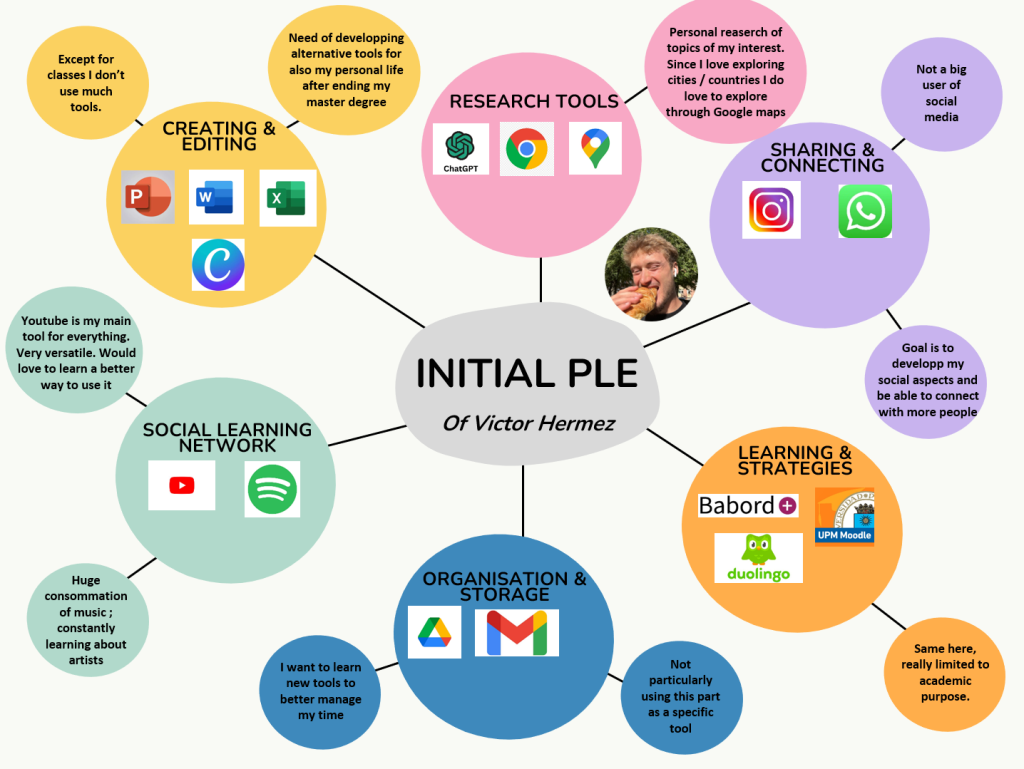
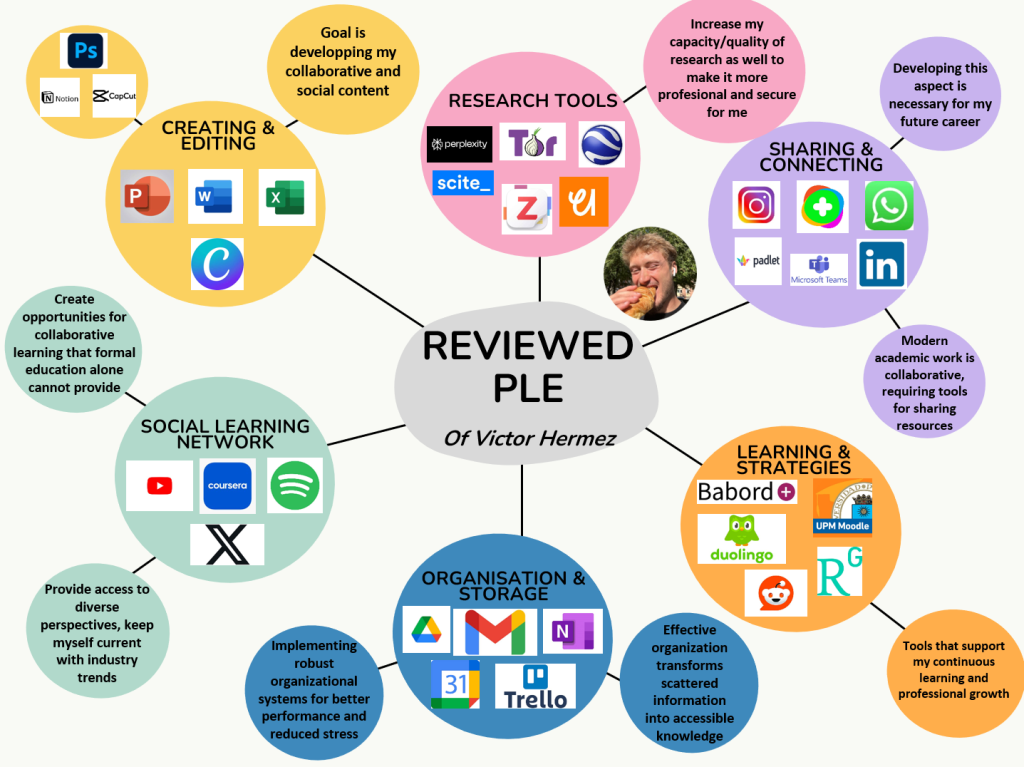
As a Master’s student in Advanced Materials Recycling and Innovation, building a robust Personal Learning Environment (PLE) is essential for academic success and professional development. I aimed six critical domains of my learning ecosystem and after a first draft (Initial PLE) I checked interesting tools from my classmates, past students, or even internet to actually learn about new tools that would be useful for my future. That’s where I came with my Reviewed PLE. Hope you enjoyed and let me know !
Hey ! I am Victor Hermez from Bordeaux, France. I hold a bachelor's degree in Chemistry. Currently, I am pursuing my Master in Advanced Materials and Innovative Recycling (AMIR). My academic and research interests focus more on metals for automotive and aeronautic industry, hydrometallurgy for recycling of batteries, new processes and innovations. Outside academics, I am found of hiking, traveling and challenging myself through sports. Through my travels, I love discovering nature and animals.
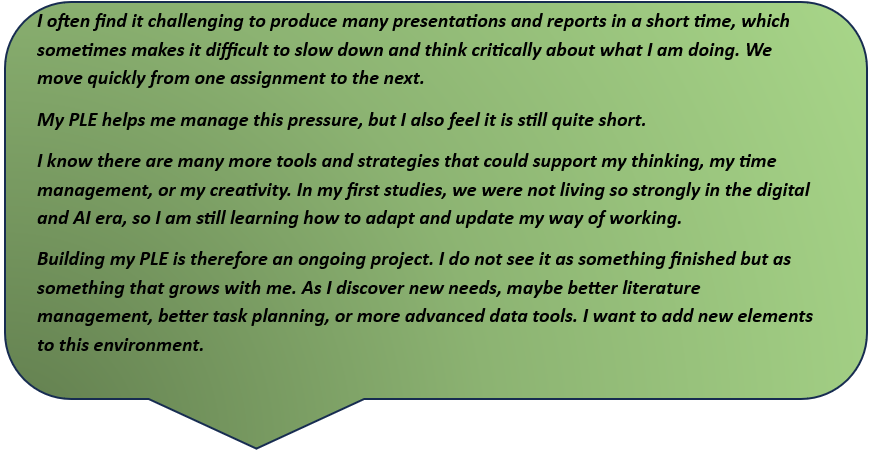
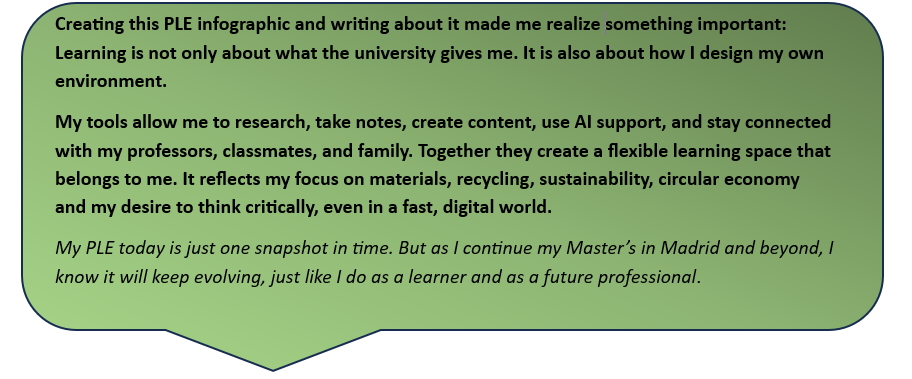
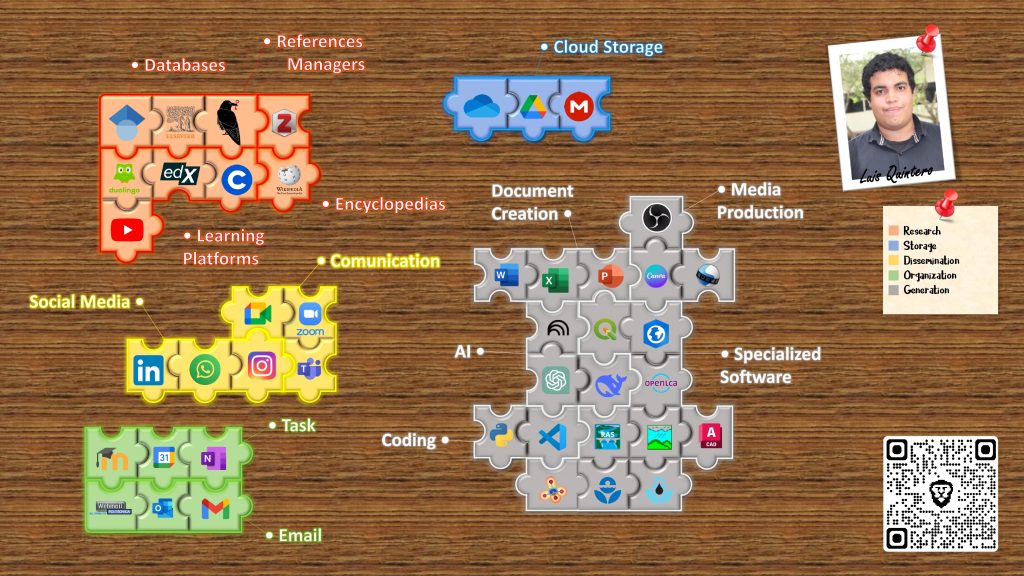
Creating my Personal Learning Environment (PLE) has been a meaningful process to reflect on how I learn and how I want to keep growing. My initial PLE represents the tools I currently use to research, organize, create, and share information. It includes resources that have supported my studies and projects so far, helping me stay informed, manage my work, and collaborate effectively.
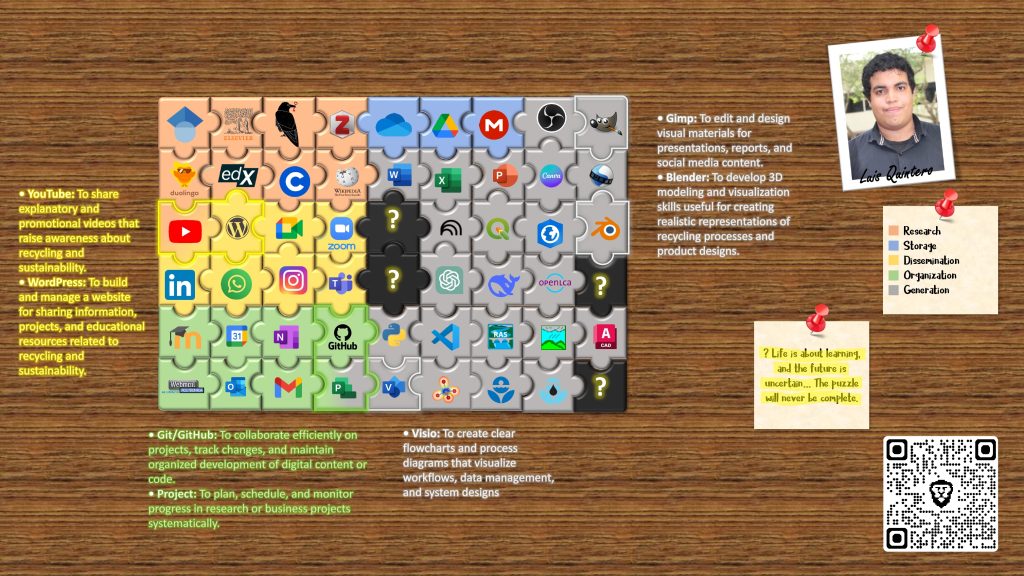
However, as I thought about my long-term academic and professional goals, I realized that my PLE could evolve to better align with the skills I want to develop and the projects I want to build. With this in mind, I redesigned my objective PLE to include tools that will strengthen my technical, creative, and organizational abilities.
For instance, I added Blender to learn 3D modeling and visualization for illustrating recycling processes, and GIMP to create and edit visuals for presentations and social media. WordPress and YouTube will help me share information and raise awareness about recycling through a website and video content. To improve project management and collaboration, I incorporated Git for version control, Microsoft Project for planning and tracking progress, and Visio for creating clear diagrams and workflows.
Environmental engineer passionate about creating innovative solutions that promote circular economy to drive positive change in society. My professional trajectory has focused on research, proposal development, and computational modeling in various areas of environmental engineering, especially in water resources and solid waste. I am convinced that addressing environmental challenges requires interdisciplinary collaboration and the formation of a strong network of professionals with deep knowledge in science and technology. My goal is to actively contribute to this collective effort, applying my skills and experience to generate positive impact on the environment and society as a whole.
I’m excited to share a glimpse of my Personal Learning Environment (PLE), highlighting both its current structure and my aspirations for future growth.
At its core, my PLE is centered around four essential areas: Learning, Communication, Management, and Creation. These focus areas shape how I acquire knowledge, collaborate with others, stay organized, and produce meaningful content.
A materials engineer specializing in advanced recycling and circular economy, currently pursuing a Master's in Circular Economy for Minerals and Construction Products at Universidad Politécnica de Madrid.