My Actual PLE 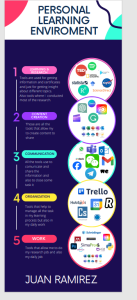
My Intended PLE
The role of sustainability is more important than ever in the dynamic landscape of Industry 4.0, where technological innovation is reshaping the way we work, live, and interact. Because of the convergence of technology and sustainability, there is a growing demand for professionals who can bridge the gap between progress and environmental responsibility. Furthermore, the integration of the circular economy approach with Industry 4.0 creates a powerful synergy, akin to a dynamic partnership in the industrial landscape. The circular economy, which promotes the perpetual use and optimization of resources, fits in perfectly with Industry 4.0’s transformative advancements. Industry 4.0 serves as the technological enabler in this collaborative narrative, improving resource management and fostering a closed-loop system in which products are designed with longevity, reusability, and recyclability in mind. Professionals who understand both sustainability principles and the intricacies of Industry 4.0 technologies will be in high demand. Data analytics, comprehensive AI comprehension, and effective communication emerge as critical skills for forming and using information to support decision making not only in the corporate sector but also in other areas such as policy development, demonstrating a commitment to economic and social development, industrial progress, and environmental stewardship.
The synergies of sustainability, circular economy and Industry 4.0
As we enter the era of Industry 4.0, sustainability roles emerge as critical pillars, ensuring that technological progress not only achieves cutting-edge prowess but is also environmentally conscious. There is increased demand, particularly in domains such as energy efficiency and renewables sources, resource and material optimization, reuse and recycle, waste reduction and product service. Professionals trained in sustainability and circular economy practices are evolving into outside-the-box thinkers, innovation and developing technologies, strategies and services that capitalize on the potential of Industry 4.0. The synergies can result in a holistic approach that not only advances technology development but also aligns with the sustainability and climate change goals.
A Changing Landscape for Skills and Expertise
Jobs in the circular economy and sustainability require a diverse skill set. Professionals must now navigate and comprehend the realms of data analytics, artificial intelligence, and the internet of things, in addition to traditional knowledge of sustainability practices and technical expertise. The ability to incorporate sustainability metrics into digital systems and use them as a tool for system improvement and increasing the circularity of materials in the economy. Furthermore, effective communication and collaboration skills are non-negotiable, serving as a link between sustainability goals and future digital innovations.
Challenges and Risks: Navigating the Uncharted
While Industry 4.0 promises limitless opportunities, it also introduces challenges and risks. One of the primary concerns is the potential environmental impact of increased electronic device production and disposal, and the demand for critical raw materials, including metals needed in the tech industry. Special considerations will be required to ensure that the stated principle of circular economy is applied in practice with social considerations.
Ethical considerations also take center stage. The ethical use of data and artificial intelligence is a pressing issue that requires sustainability professionals to walk a fine line between technological innovation and responsible practices, addressing issues such as data privacy and algorithmic biases.
Jobs, Technology, and the Future of Automation
Automation, a key tenet of Industry 4.0, raises concerns about job displacement. However, because of the unique interdisciplinary nature of sustainability jobs, they are less susceptible to automation. While routine tasks may be automated, the complex decision-making, creative problem-solving, and ethical considerations inherent in sustainability roles remain indispensable.
Toward Sustainable Development Goals
The undeniable truth is that in Industry 4.0, sustainability jobs are about more than just navigating challenges; they are about charting a course toward a more sustainable future. These roles, which are aligned with the United Nations’ Sustainable Development Goals, serve as change agents. Sustainability professionals play an important role in shaping a resilient, responsible, and equitable global economy, from championing clean energy and responsible consumption to fostering inclusive innovation and reducing inequality.
Finally, as Industry 4.0 takes shape, sustainability jobs are more than just jobs; they are a commitment to a greener, more sustainable future. As we embrace the challenges, mitigate the risks, and champion the Sustainable Development Goals, sustainability professionals in Industry 4.0 become the architects of a future where technology and sustainability are not at odds but rather partners in progress.
Hi everyone ! ,
This is my Personal Learning Environment. The first is my current one with all the tools, applications and websites that I use almost every day. It is divided into several categories: News, Search, Organize, Education, Communication and Creativity. The tools I use most regularly are Google, WhatsApp, Linkedin and Youtube.
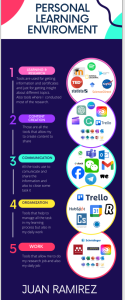
Hello Everyone, My name is Shubhanshu.
This is my Personal Learning Environment. These are my most used tool, which helps me in learning things. My first PLA had some problems like the categories was not appropriately organised and the organization of all application was not good.

In my Improved PLA, I tried to Organize the categories in the proper way and have also added some new applications.
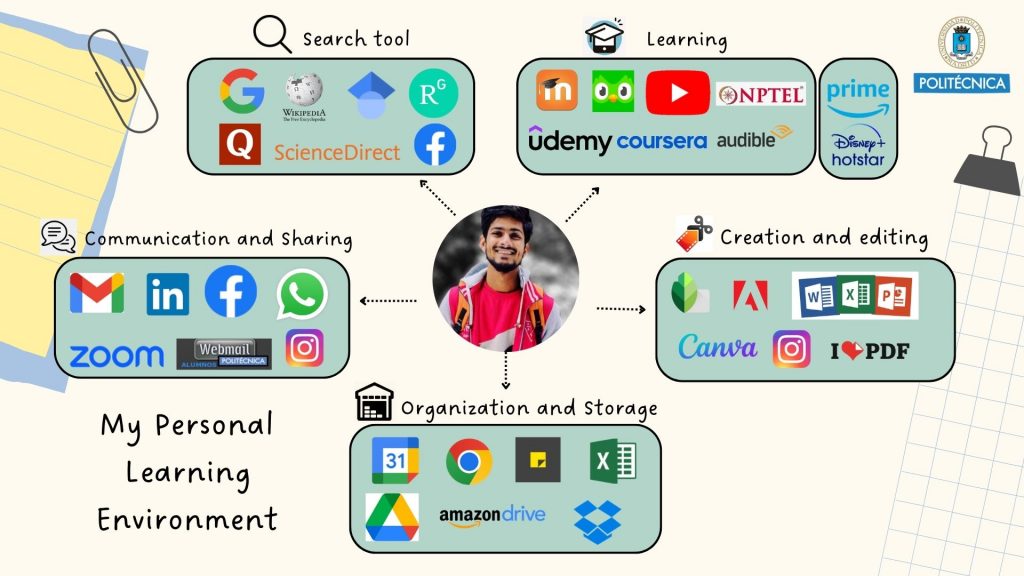
Currently, my PLE is based on the tools that I have heard about, tested and use regularly, I wanted to place the image of the brain with the camera and organize the tools that I use in photographs, since this represents a part of my way of thinking. learning that photographic memory is, which I consider important to identify when choosing which tools or applications to use. I have left out of these photographs, the tools which I have tried but, with which I do not feel comfortable working or even take advantage of.
For my future PLE, I want to improve some aspects. As for the search, I want to start using a reference manager, to make the most of the articles and sources I reach and get quality academic articles. For learning, I will insist on duolingo for better in a second language, you will include spotify to discover new podcasts. In creativity, I will try to use Adove’s resources more since it has several applications that may be more effective than the ones I already use.

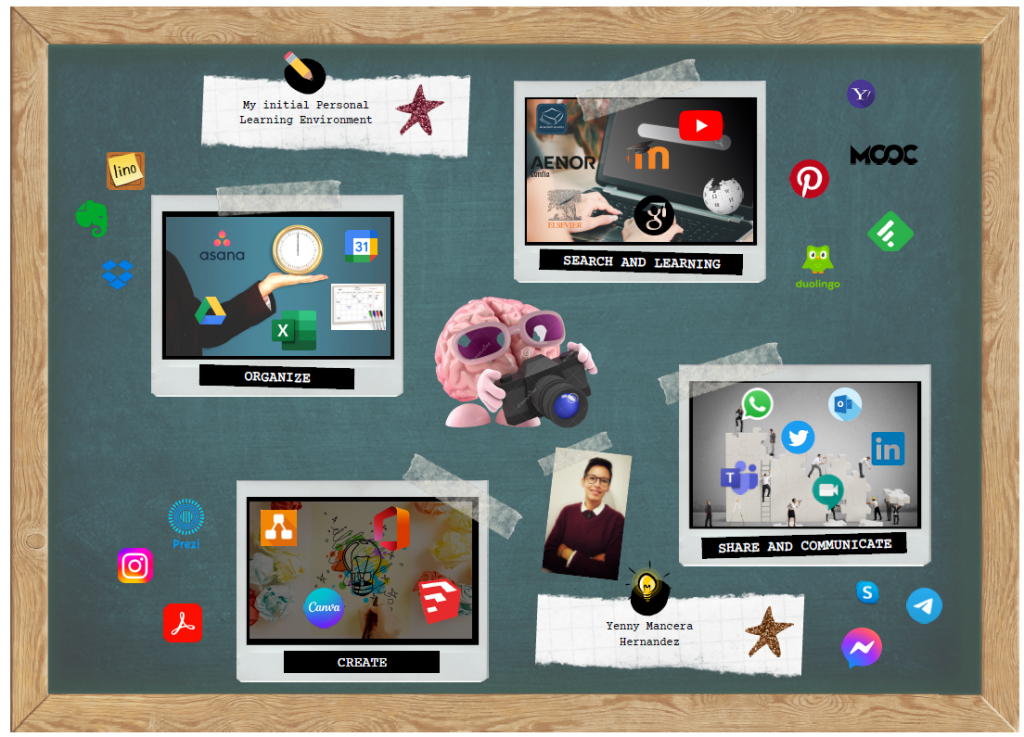
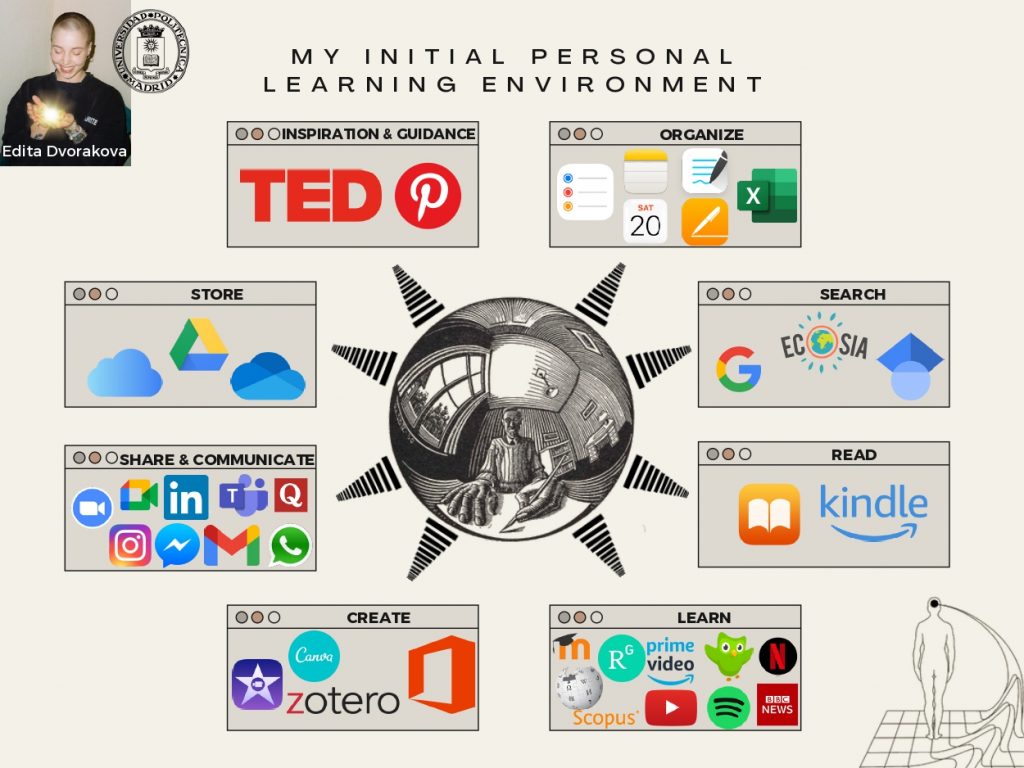
While preparing the structure for my initial PLE, I decided to organize the tools I usually use in 8 categories, chronologically and clockwise, with the optional preliminary inspiration/guidance step.
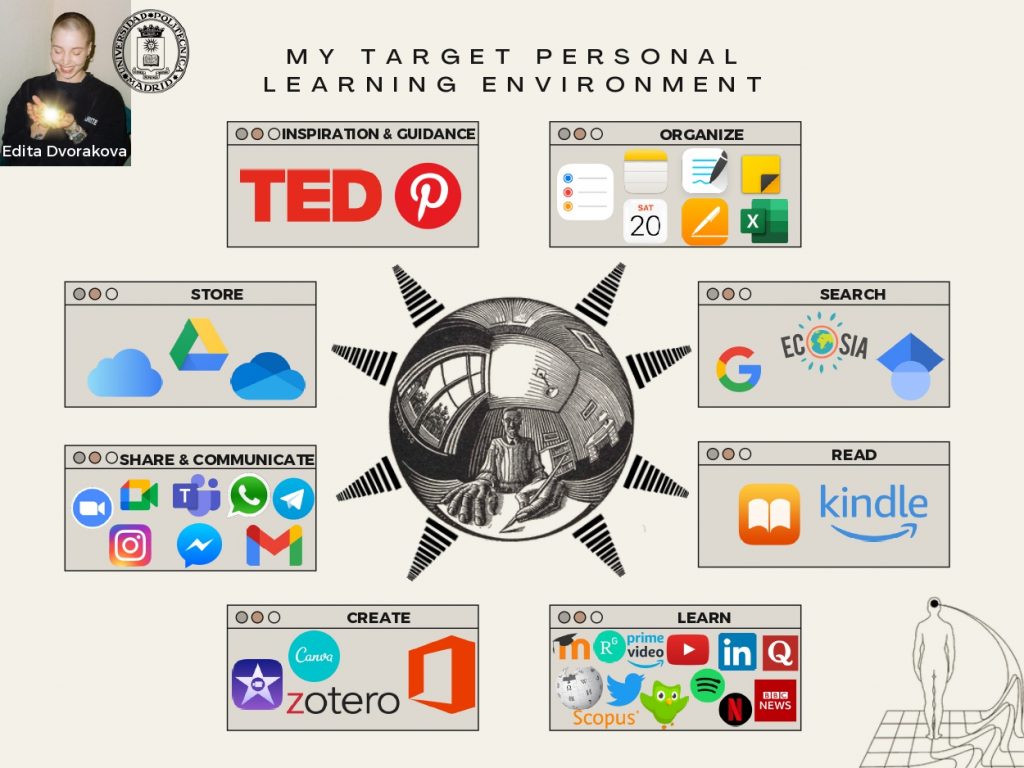
Today, a lot of social media platforms can serve as tools for inspiration, organization, learning, creation, sharing and communication purposes at the same time. I use several resources such as Pinterest, Instagram, Linkedin and Quora in multiple ways. Thus, to classify them for this PLE, I placed them in a category reflecting on the most frequent personal use.
My target PLE has not drastically changed from the initial one, since I really enjoy the resources that I already use. Nevertheless, I have reorganized the categories and added Twitter as a new source of information that I am currently working on setting up.
After seeing the presentations of my peers, I wrote down a short list with platforms/tools (Mendeley, Spark, Flaticon) that I would like to try out and maybe implement in my future PLE if they can further simplify my life.
Thank you, dear reader, for your time and all the best,
Edita Dvorakova


My initial personal learning shows the tools I use often for learning and how I classify them. The other image below shows my improved learning environments, I got familiar with several new tools from my colleague’s presentations and I am proud they could be part of my learning environments. Lastly, I now have 6 personal classifications which started from 01 to 06 as follows.
Thank you for checking my personal learning tools what are yours? Share and comment.
Damilare.
Hello everyone,
This is my Personal Learning Environment. The first is my current one with all the applications and websites that I use almost every day. I want to emphasise two of those that made my life easier. The first one is Zotero that keep me organised during the writting of reports and on my bachelor thesis and secondly, is the connected papers which gives the opportunity to find, organise and analyse papers in the best possible way (highly recommended).

On my future PLE, I want to indulge more on platforms like. SimaPro and LCA in order to obtain more practical knowledge but also python as it seems like a basic programming language that a lot of companies ask for.

Dimitris Pantelakis
Hello everyone,
in this post I’ll show you the initial version of my Personal Learning Environment and the improvements I made. I decided to upload the PDF so you’re able to see the small comments/suggestions I put in the improved version, I suggest you to download it.
Thanks for your attention!
Luigi

