MOOC II: Circular Economy – An Introduction

TU Delft: Circular Economy: An Introduction

Note

I found nothing new in this course. Everything mentioned was already taught in the online course taught by Dr. Guido Sonnemann in the first semester.

1. Reinforced that Circular Economy as System Design, Not Just “Recycling”

Course insight: The first module reframed the problem: planetary challenges (resource scarcity, waste, environmental impact) are systemic. The circular economy is not a “plug-in” add-on, but a full paradigm shift in how products are designed, used, and re-used.

My takeaway: As a materials-science & recycling student, this only reinforced what I already knew and have learnt multiple times throughout this masters degree, that my work doesn’t start (or end) at material selection. Instead, I should think in closed loops: from raw material sourcing → product design → use → end-of-life recovery/recycling/revalorization.
2. Value Creation via Circular Business and Supply-Chain Models

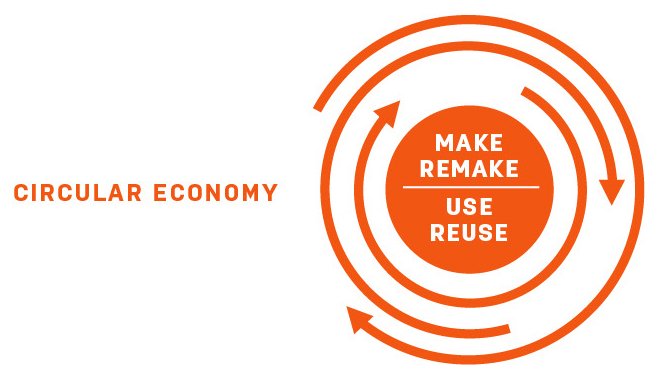
Course insight: One episode explores how closed-loop supply chains and reverse logistics enable new business models: shifting from selling products to providing services, leasing, take-back programs, remanufacturing, or product-as-service models.

My takeaway: This goes beyond technical recycling, there is economic viability in circular models. For example, in recycling construction-based recycling projects (my background), circular business models could guarantee material recapture and sustainable material flows rather than pure disposal or downcycling.
3. “Design for R” Philosophy

Course insight: The course emphasizes designing products to last longer, be repaired, remanufactured or recycled, rather than built for obsolescence.

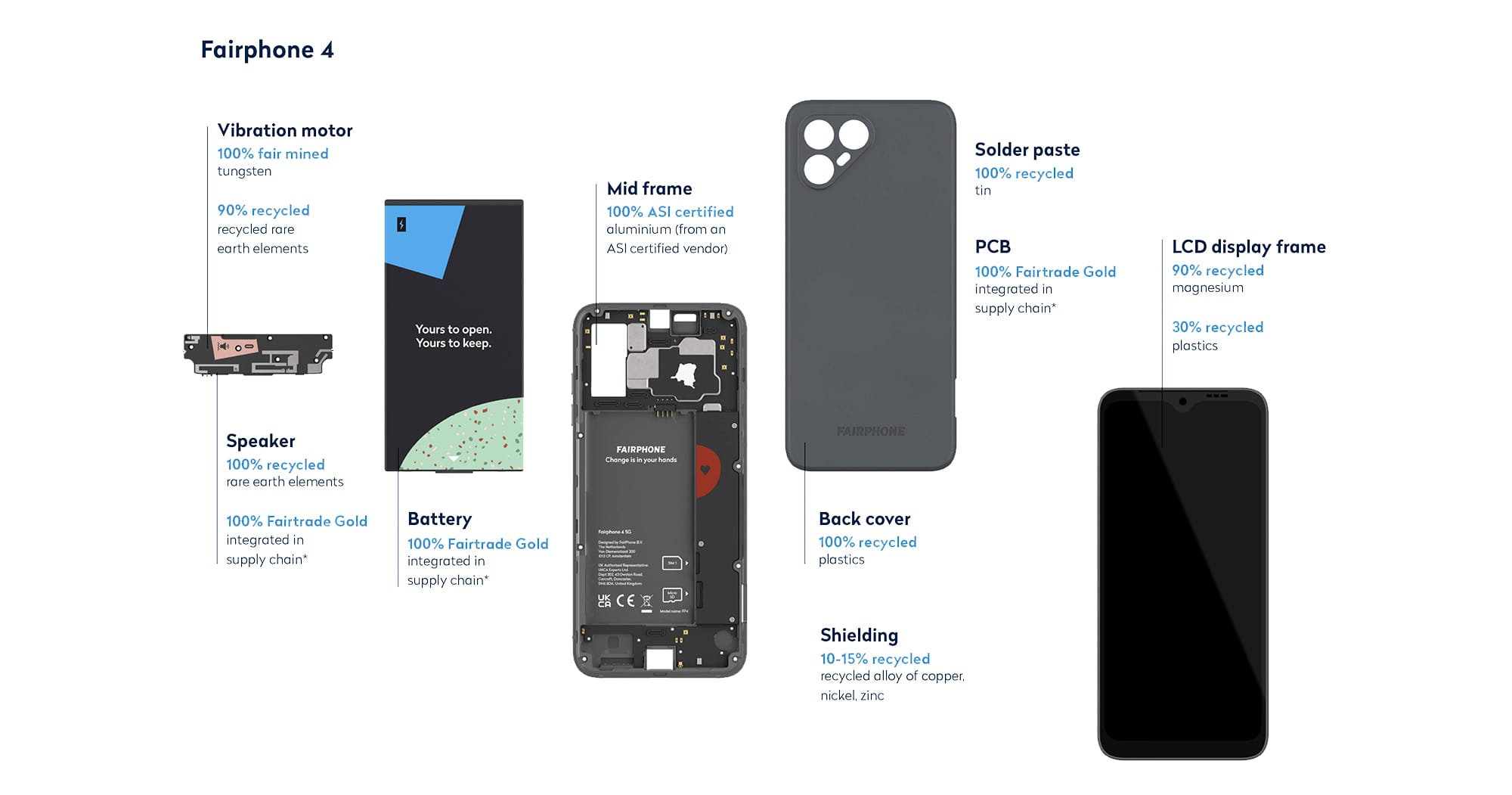
My takeaway: Given my interest in materials science and recycling, this principle resonates strongly: when developing new materials/processes (e.g. in mine waste recycling), I must consider entire lifecycle: durability, ease of disassembly, reuse potential, recyclability, not just performance in first use. One nice thing to go through again was fairphone being mentioned. I discovered fairphone through a colleague who is also enrolled in the same program, Valentina Chessa, so it was interesting to see Fairphone used as a case study in this course.
Thank you for taking the time out to read my reflections for the optional course! 🙂


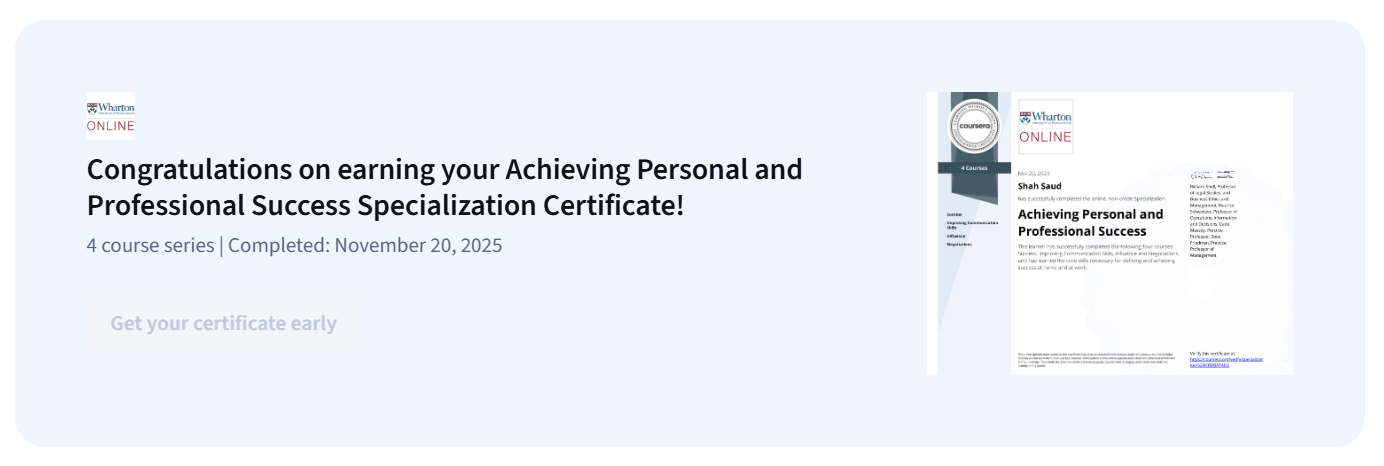
I hope you liked my reflections and learnings from the course. All proof of completion can be found in here:


Lastly, since this will probably be my last post on this blog. I also want to share my love for photography, specifically astrophotography, with my current colleagues and all future readers. I will miss posting here 😢

About SHAH SAUD

Hi! I am Shah. Professionally, I like to exist in the intersection of materials and circularity. Currently pursuing a Master’s in Advance Materials Innovative Recycling at Universidad Politécnica de Madrid (UPM). Outside my professional sphere, you will find me chasing sunsets, travelling to lesser-known destinations and making a mean carrot cake.
MOOC I: Achieving Personal and Professional Success

Over the past weeks, I completed the Achieving Personal and Professional Success specialization from the University of Pennsylvania. The specialization was divided into 4 courses: Success, Improving Communication, Influence & Negotiation.

Instead of writing a long reflective essay, I distilled the core reflections on things that I particularly found interesting and how that impacts my PLE (Personal Learning Environment).

1) Success (Richard Shell)

The Six Lives reflection forced me to compare competing life scripts and choose priorities rather than default to academic expectations.
PLE update: Add a weekly 20-min “Six-Lives” check-in (Notion) to test if tasks still match my selected script.
Specific tool: Achievement–Happiness Matrix — used it to tag ongoing projects (e.g., thesis experiment vs. teaching assistant duties) as Achievement-heavy or Happiness-supporting.

Link to the six lives exercise (if you want to do it without accessing the entire course): https://grichardshell.com/book-extras/six-lives-exercise/


2) Improving Communication Skills (Maurice Schweitzer)

When to Compete vs. Cooperate — taught the three principles: scarcity, sociability, dynamic instability. I can apply this this in a group work decisions: choosing cooperation when resources were tight reduced conflict.
PLE update: Add a “cooperation checklist” to meeting notes.


3) Influence (Cade Massey)

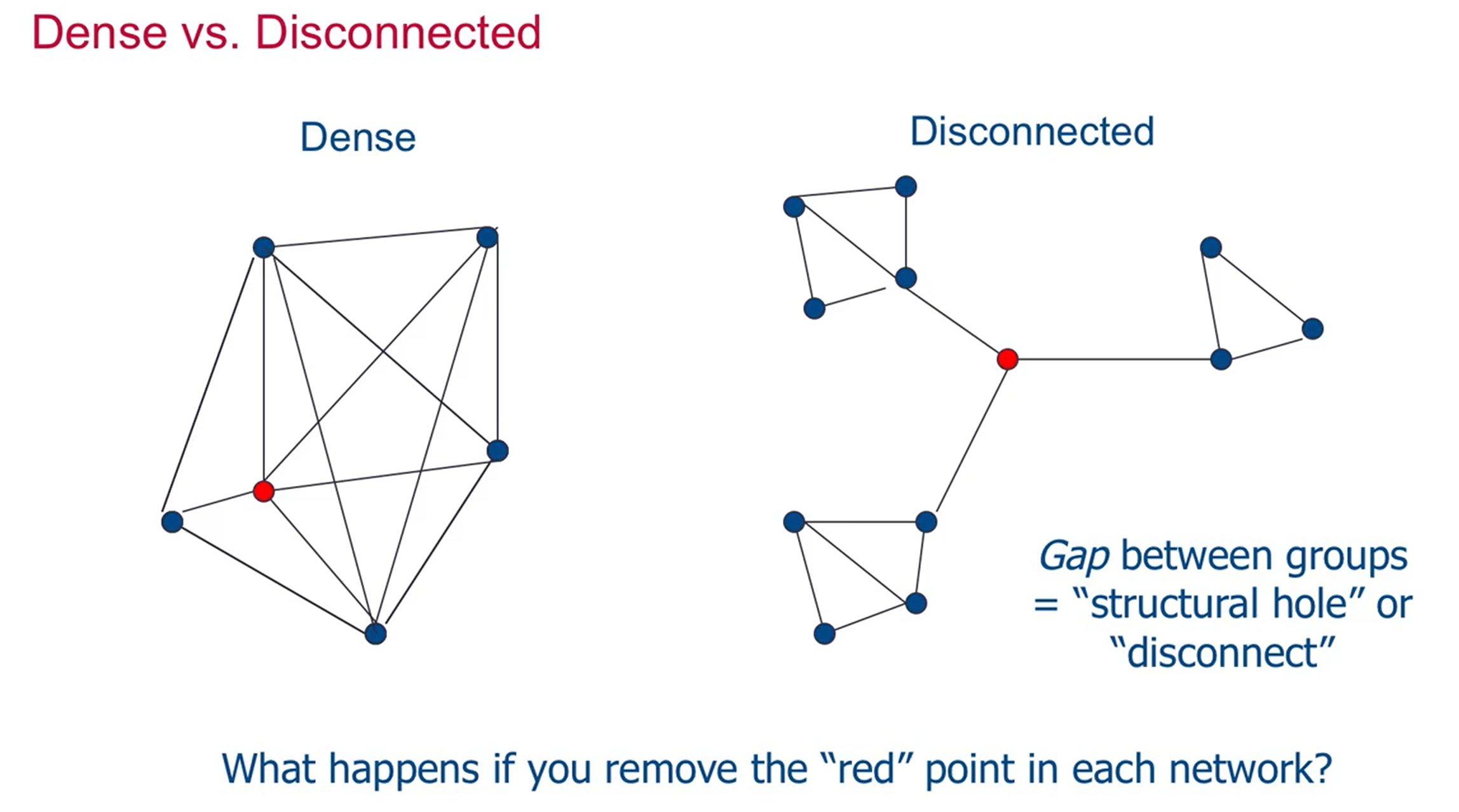
Network types: dense vs. disconnected. This helped me think about how I could map my contacts. Infact, it made me realize about a gap between my academic contacts and industry sustainability practitioners. I will now leverage my efforts towards starting to bridging via targeted LinkedIn messages.
PLE update: Add a “network map” sheet to my PLE and a monthly outreach task.

Another thing that was interesting was the Signals of Trust & Repairing Trust, practical cues (vulnerability, warmth) and apology structure. While learning this I was reflecting how I can use this during conflicts with teammates; to help rebuild rapport quickly.

Specifically, the SUCCES-style message crafting: using “Simple + Story + Credible” formula to reframe a technical slide for a nontechnical stakeholder can result in clearer buy-in for the targetted audience whether it is a prospective employer.


4) Negotiation (Maurice Schweitzer)

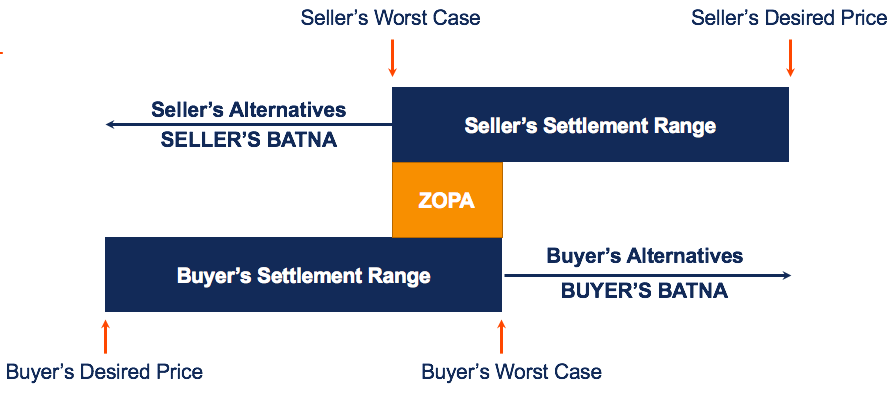
In this module ZOPA (Zone of Potential Agreement) & BATNA (Best Alternative to a Negotiated Agreement)  exercises, can help practice setting a BATNA before an employment-type negotiation simulation; outcome: stronger first offer and better terms. Although it is typically used in financial settlements during negotiations for purchases between a buyer and seller but can easily apply to all other non-financial examples. This is especially relevant to us as students as we will soon step into the professional realm and will have to negotiate our salaries and working contracts.
PLE update: To create a “BATNA + First Offer” page in Notion before real negotiations.


Quick PLE summary (what changed — 3 bullets)

  1. Purpose tagging: Projects now carry an achievement vs. happiness tag from the Success matrix so I prioritize meaning-aligned work.
  2. Communication templates & checklists: Templates for apologies, cooperation checklists, BATNA planning stored in Notion.
  3. Network mapping + outreach routine: Monthly outreach and a “bridge contacts” list to connect dense academic clusters with diverse industry contacts.PLE update: To create a “BATNA + First Offer” page in Notion before real negotiations.

I hope you liked my reflections and learnings from the course. All proof of completion can be found in here:


Lastly, since this will probably be my last post on this blog. I also want to share my love for photography, specifically astrophotography, with my current colleagues and all future readers. I will miss posting here 😢

AS10-34-5018” by Apollo Image Gallery/ pdm 1.0
AS09-21-3278” by Apollo Image Gallery/ pdm 1.0

About SHAH SAUD

Hi! I am Shah. Professionally, I like to exist in the intersection of materials and circularity. Currently pursuing a Master’s in Advance Materials Innovative Recycling at Universidad Politécnica de Madrid (UPM). Outside my professional sphere, you will find me chasing sunsets, travelling to lesser-known destinations and making a mean carrot cake.
(MOOC) Circular Economy: An Introduction

Following this circular economy MOOC was a new and truly valuable experience. I was familiar with ideas like recycling, remanufacturing, product design and new business models, but never had full picture of how they interact. This course gave me exactly that: a broader lens. Instead of thinking in terms of “fixing waste at the end,” it encouraged me to look upstream, at how systems, incentives and design choices shape impacts long before something becomes waste. It reframed circular economy not as a set of tools, but as a way of organizing value within planetary boundaries.

One of the parts that struck me most was the darker side of access. We often celebrate “access-based” models, streaming, car sharing, “product as a service” as modern, smart and sustainable. But the course forced me to ask access for whom, and on whose terms. Access is not neutral. If a company controls access, it also controls: who can enter (and who is excluded),when conditions change (price, rules, data use) and who carries risks and responsibilities.
Circular business models are not automatically “good”. We must look not only at materials and emissions, but also at power, fairness and control. The question “who controls access?” is now stuck in my head every time I see a new “green” business model.
Another big “click” moment was the idea that the smaller the loop, the greater the value.” Instead of jumping immediately to recycle, the course constantly pushed a hierarchy:
-If it works, keep using it.
-If it breaks, repair it.
-If repair is not enough, remanufacture it.

Recycle only as a last option!

This connects directly with the six design strategies for longer-lasting products. What I like here is how design becomes strategy. It’s not just about aesthetics; it’s about deciding whether a product will die quickly or stay in use for years. The course made me see every hinge, screw and connector as a political choice about waste and value. The segment on remanufacturing was particularly compelling, especially in the way it connected environmental benefits with real business opportunities. Remanufacturing means taking a used product and then rebuilding it so that: the performance, the lifetime, and the quality are equivalent to a brand-new product.

I found it fascinating that many companies entered remanufacturing for the money” to save materials and production costs and only later realized the environmental benefits. It shows that circular strategies can be economically attractive first, and ecologically beneficial as a consequence, which is often more convincing for industry. The course also pointed out the real obstacles: second-hand still has a bad image, modern electronics are difficult to test, and some regulations still treat remanufactured products almost like waste. These issues are small on paper but decisive in practice.
From my perspective, remanufacturing is now one of the most promising inner loops because it turns existing products into a reservoir of valuable materials instead of a disposal challenge.

Waste = food… but only if we are honest about complexity

The “Waste = Food” part brought the framework to life. By tracing actual streams such as fridges, electronics and textiles, it demonstrated how different materials metals, plastics, fibers can be captured and fed back into the economy rather than lost as waste. But what I appreciated most was honesty: circularity is hard.
– A “100% cotton” T-shirt is not automatically safe for composting if dyes and finishes are toxic.
– Many clothes are made from fiber blends, which makes them technically difficult to recycle.
– Biological cycles and technical cycles need completely different strategies.
Tools like Fibersort, automatically sorting textiles by fiber composition made me see how data and automation are essential if we want high-quality recycling, not just “feel-good” recycling bins.

Looking back, this MOOC changed the way I think more than I expected. It clarified how access shapes power, how design locks in tomorrow’s impact and how inner loops like remanufacturing protect value. But more importantly, it gave me a practical mindset: to see materials, products and systems as moving over long lifetimes and to understand that change happens by redesign, not by reacting at the end.
In the end, the course didn’t just add new concepts, it helped me develop a more coherent and systemic way of seeing the world.

About DEA ZAKOLLI

Hi! I’m an Industrial & Environmental Chemist (B.Sc. + M.Sc., Albania) with five years experience in the mining industry. In 2024 I began a Master in Advanced Materials & Circular Economy in Madrid to go deeper into life-cycle assessment, materials recovery, and circular process design. I combine careful lab work with a practical mindset and I’m excited to keep growing. My goal is simple: use solid data to improve efficiency and build more circular, real-world solutions. Open to collaborations and roles where analytical excellence meets circular innovation.

Luis’s learning from MOOC in Circular Economy

As an environmental engineer currently studying a master degree in circular economy, the MOOC “Circular Economy: An Introduction” from TU Delft on edX mostly covered ideas I already knew, but it gave me a solid structure that helped reinforce what I’ve learned.
It was useful to see the main concepts of the circular economy, like the difference between biological and technical cycles and the role of systems thinking, explained in such a clear and organized way. Going through everything step by step made the reasoning behind many strategies feel more solid.
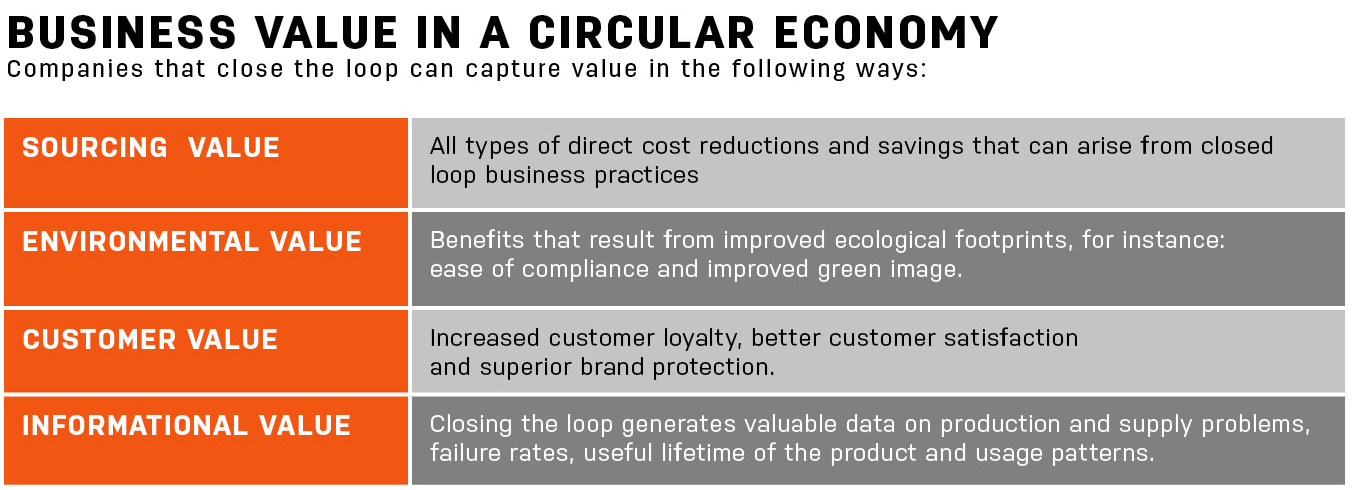
Two parts of the course stood out to me in a very practical way: First, the section on value creation in circular business models was explained simply and clearly. Instead of just saying companies should use these models, it showed how they actually work financially. It also described the different types of value a circular business needs to offer including source, environmental, customer, and information value which made the concepts feel more concrete. Seeing examples like Product-as-a-Service and performance-based contracts helped me understand how these models can create stronger customer relationships and more stable revenue.
Second, I liked the explanation of the inertia principle. Connecting it to the waste management hierarchy made it easier to understand, basically, focus on not doing waste heavy actions before relying on later solutions. Designing products and systems so they naturally stay in useful cycles goes beyond simple recyclability. It’s about building circularity into the product from the start so it becomes the easiest option. As an engineer, this mindset feels practical and applicable.
Overall, the MOOC brought together many topics I had learned before in a clear and coherent way. The content and case studies connected ideas from life cycle assessment to circular business models.

About LUIS ANGEL QUINTERO SERRANO

Environmental engineer passionate about creating innovative solutions that promote circular economy to drive positive change in society. My professional trajectory has focused on research, proposal development, and computational modeling in various areas of environmental engineering, especially in water resources and solid waste. I am convinced that addressing environmental challenges requires interdisciplinary collaboration and the formation of a strong network of professionals with deep knowledge in science and technology. My goal is to actively contribute to this collective effort, applying my skills and experience to generate positive impact on the environment and society as a whole.

Activity MOOC II: “The Circular Economy”

The “Circular Economy” course as part of the Transformative Leadership in the Circular Economy Specialization on Coursera by The University of Colorado Boulder, gave me a deeper and more practical understanding of how sustainable systems work and how they can be applied across industries. One of the first things I learned was how fundamentally different a circular model is from the traditional linear “take–make–waste” economy. The course helped me see how circularity aims to design out waste from the beginning, keep materials in use for as long as possible, and regenerate natural systems. This shifted my view of sustainability from simply reducing harm to actively redesigning products, processes, and business models in smarter, more regenerative ways.

As the course progressed, I explored real-world circular business models and how companies are already transitioning toward shared platforms, closed-loop systems, and circular material flows. Seeing examples from packaging, textiles, electronics, and the built environment made the concept tangible. I began to understand that circularity is not a single action but a complete rethinking of how industries operate from how products are designed to how they are repaired, reused, or recycled.

Another important insight came from studying the barriers to circularity. While the benefits are clear, organizations face real challenges such as high initial investment, lack of infrastructure, and resistance to change. Hearing from industry experts showed me that successful circular transitions require leadership, collaboration, and a willingness to experiment. This part of the course strengthened my belief that meaningful change depends on both technical innovation and human commitment.

Finally, the course introduced me to the tools and metrics used to measure circular performance. I learned how life-cycle assessments, circular indicators, digital twins, and data-sharing platforms help organizations evaluate their impact and improve their strategies. Understanding these tools made me realize that circular economy is not just an idea, it is measurable, trackable, and actionable when supported by the right technologies.

Overall, this course helped me see the circular economy as both a mindset and a practical framework for creating sustainable solutions. It equipped me with knowledge I can apply as a future materials engineer, especially in designing systems that are efficient, regenerative, and aligned with global sustainability goals.


Avatar photo

About MAVIS OLAYEMI OLORUNYOMI

Hello everyone! My name is Mavis O. Olorunyomi, and I am passionate about sustainability, circular economy, materials innovation, and green technologies. I am currently pursuing a Master’s degree in Advanced Materials and Innovative Recycling (AMIR) through the Erasmus Mundus program, where I study at Universidade NOVA de Lisboa and Universidad Politécnica de Madrid. My academic journey began with a Bachelor’s in Industrial Chemistry from the University of Cape Coast in Ghana. Over time, I have developed a strong interest in creating sustainable materials and exploring how scientific research can drive environmental resilience and circular design. Beyond academics, I enjoy taking on new challenges, learning continuously, and contributing to projects that make a positive environmental impact. I am deeply motivated by the idea of building a greener and more sustainable future through innovation and practical action.

MOOC “Circular Economy: An Introduction

Even after seeing circular economy concepts many times during the master, finishing the edX MOOC “Circular Economy: An Introduction” was surprisingly refreshing and helped to dive deeper into ideas that now feel much more concrete. Revisiting the topic with a structured focus on real cases and design strategies made the whole picture of a circular system more practical and connected to engineering decisions.

The real business cases were the highlight: Caterpillar’s approach to remanufacturing, the textile examples, and the urban mining perspective all showed how circularity can actually work at scale instead of staying as theory. The course also deepened the understanding of the butterfly diagram as a map of how materials circulate in biological and technical cycles, clarifying where strategies like reuse, repair, remanufacturing, and recycling sit in the hierarchy. The favorite part, though, was design for assembly and its close link with design for disassembly within the circular economy. As a mechanical engineer, topics like fastener selection, modular architecture, and ease of access to components resonate strongly, because they directly determine how simple or difficult it will be to repair, upgrade, or remanufacture a product later on.

Beyond the content itself, this course also connects strongly to a broader Personal Learning Environment, where edX plays a central role as a flexible platform to explore new topics and deepen existing interests. Being able to choose MOOCs from different universities, follow them at a personal pace, and combine them with the master’s curriculum turns edX into a kind of experimental lab for continuous learning, reflection, and skill building.

Avatar photo

About MARIA GODOY VIVAR

Hello, my name is Maria Jose, but you can call me Majo. I studied mechanical engineer in Ecuador (back home). I worked in the plastics and metals recycling industry, where I discovered I wanted to continue my studies in materials science, which is why I'm here in this master's program. Outside of my professional life, I love animals, desserts, and hiking.

Moving Beyond “Take-Make-Waste”: My Experience with the Circular Economy MOOC

Over the past few weeks, I completed a course called “Circular Economy: An Introduction,” offered by Delft University of Technology (TU Delft). It was an eye-opening experience that challenged the way I look at every product I own, from my phone to my jeans.

Since the goal of this blog is to share our achievements in this Master degree and how I fit a university course into my schedule, I wanted to share exactly what a MOOC is and why I recommend this specific one.

First things first: What is a MOOC?

If you haven’t taken one before, MOOC stands for Massive Open Online Course. It’s a model of learning that has democratized education in a pretty incredible way.

  • Massive: Unlike a normal classroom with 30 students, these courses can have thousands of participants from all over the world learning together.
  • Open: You don’t need to apply or be a registered student at the university. Most MOOCs allow you to “audit” the material for free, meaning you can watch the lectures and read the materials without paying a cent (though you can pay a fee if you want a verified certificate for your LinkedIn).
  • Online: Everything happens virtually. You watch video lectures, take quizzes, and discuss topics in forums on platforms like edX (where I took this course), Coursera, or Udacity.

It is a fantastic way to upskill without the pressure or cost of a traditional degree.

Course Review: Circular Economy – An Introduction

Provider: Delft University of Technology (TU Delft) Platform: edX Duration: Approx. 7 Weeks

This course wasn’t just about recycling; it was a deep dive into why our current economic model is broken and how we can fix it.

The Core Concept: Linear vs. Circular The course starts by explaining our current “Linear Economy”, the “take-make-waste” model where we extract resources, turn them into products, use them for a short time, and then throw them away.

The Circular Economy, by contrast, is restorative by design. The goal is to keep materials and products in use for as long as possible. A key framework used in the course is the “Butterfly Diagram” (developed by the Ellen MacArthur Foundation), which visualizes two distinct cycles:

  1. The Biological Cycle: Food and bio-based materials that can safely return to nature (composting).
  2. The Technical Cycle: Metals, plastics, and synthetics that should circulate through reuse, repair, and remanufacturing.

Key Takeaways from the Modules

The course is broken down into “Episodes,” and here were my biggest highlights:

  • Business Value: This was surprising. The course argues that circularity isn’t just “nice to have”, it’s profitable. We looked at business models like “Product-as-a-Service,” where companies sell you the performance of a product (like light or mobility) rather than the product itself. This incentivizes them to make things that last longer, rather than things that break easily.
  • Remanufacturing vs. Recycling: I learned that recycling should actually be the last resort. It takes a lot of energy to melt down a product. It is much better to repair or remanufacture (refurbish to like-new condition) because it preserves the value and energy already put into the product.
  • Waste = Food: Inspired by nature, this module taught that in a true circular system, waste doesn’t exist. Everything becomes “food” or input for the next stage of the cycle.

Final Thoughts

This MOOC did a great job of blending engineering, design, and business strategy. It helps you see the “system” behind the products. You stop seeing a broken toaster as trash and start seeing it as a design flaw, why wasn’t it made to be easily repaired?

If you are interested in sustainability, design, or just want to understand the future of business, I highly recommend checking it out.

Have you ever taken a MOOC ? Let me know in the comments !

Avatar photo

About VICTOR HERMEZ

Hey ! I am Victor Hermez from Bordeaux, France. I hold a bachelor's degree in Chemistry. Currently, I am pursuing my Master in Advanced Materials and Innovative Recycling (AMIR). My academic and research interests focus more on metals for automotive and aeronautic industry, hydrometallurgy for recycling of batteries, new processes and innovations. Outside academics, I am found of hiking, traveling and challenging myself through sports. Through my travels, I love discovering nature and animals.

Reflections on “Achieving Personal and Professional Success” Course

I recently completed the Coursera course Achieving Personal and Professional Success. The course is based on four popular Wharton courses and covers topics from defining success to influence, building trust, and negotiation.

The first module helped me explore what success really means by examining my core values and comparing my beliefs with those of others, including through the “Six Lives” exercise. The second module focused on influence, showing how flexibility, situational awareness, and agency can help navigate organizational dynamics effectively. The third module looked at building trust and cooperation, teaching how vulnerability, warmth, and shared goals foster strong relationships. The fourth module addressed emotion in negotiation, offering practical ways to manage anxiety, diffuse anger, and use humor strategically.

Across the course, I particularly valued the focus on communication, self-reflection, and comparison. Learning to communicate in ways that truly connect with others emotionally and build trust was eye-opening. Exercises that encouraged comparing my perspective with others helped me understand different ways people define success and approach challenges. I also found the strategies for managing anxiety during negotiations extremely practical, showing how emotions influence interactions and outcomes. The discussion of deception was especially interesting, highlighting subtle cues and helping me think about how to navigate situations where trust is uncertain.

What I really appreciated is that this course didn’t just give me tools or frameworks, it made me pause and reflect on myself. I came away with a clearer sense of what success means to me, a better understanding of how I interact with others, and practical ways to approach my goals with more confidence, authenticity, and awareness.

Certificate: https://drive.google.com/file/d/1IqjLW_Mvbve0XQosd69JumXB_f-zNwVS/view?usp=sharing

Activity MOOC I: “Achieving Personal and Professional Success” Specialization

After a successful completion of my MOOC I on the Achieving Personal and Professional Success specialization from the University of Pennsylvania on Coursera, a four-course journey that deepened my understanding of success, influence, communication, and negotiation. Basically, developing the skills needed to navigate both personal and professional environments with confidence. Here are my biggest takeaways I would like to share;

One of the most valuable lessons came from redefining what success truly means. I learned that success is deeply personal and often shaped unconsciously by our upbringing, culture, and social expectations. Through different exercises and reflections, I began to separate achievement from fulfillment, realizing that real success must align with my values, strengths, and long-term aspirations. This helped me develop a clearer sense of internal motivation rather than relying on external approval.

The course on communication reshaped the way I approach conversations and relationships. I became more aware of when to compete, when to cooperate, and how trust is built through openness, warmth, and shared goals. I also learned the importance of choosing the right medium for each message and how to navigate challenging interactions, whether that involves detecting deception, apologizing effectively, or simply listening with more intention.

The module on influence taught me that influencing others is less about authority and more about understanding people, networks, and organizational dynamics. It emphasized the ethical responsibility that comes with influence and the need to balance soft and hard power with self-awareness and integrity. I now see influence as a relational skill rooted in generosity, authenticity, and strategic thinking.

Finally, the negotiation course gave me practical tools that apply far beyond formal negotiations. I learned how to prepare systematically, understand bargaining zones, ask questions that reveal meaningful information, and manage the emotional side of negotiation. The lessons on handling anxiety, diffusing anger, and building trust were especially powerful, reminding me that successful negotiation depends as much on emotional intelligence as on tactics.

Overall, this specialization offered a cohesive set of insights that go beyond theory. It helped me define my own vision of success, communicate with greater clarity, influence ethically, and negotiate with confidence. These lessons have already begun shaping how I show up in conversations, collaborations, and decisions; and I know they will continue to guide me on my personal and professional journey.

Avatar photo

About MAVIS OLAYEMI OLORUNYOMI

Hello everyone! My name is Mavis O. Olorunyomi, and I am passionate about sustainability, circular economy, materials innovation, and green technologies. I am currently pursuing a Master’s degree in Advanced Materials and Innovative Recycling (AMIR) through the Erasmus Mundus program, where I study at Universidade NOVA de Lisboa and Universidad Politécnica de Madrid. My academic journey began with a Bachelor’s in Industrial Chemistry from the University of Cape Coast in Ghana. Over time, I have developed a strong interest in creating sustainable materials and exploring how scientific research can drive environmental resilience and circular design. Beyond academics, I enjoy taking on new challenges, learning continuously, and contributing to projects that make a positive environmental impact. I am deeply motivated by the idea of building a greener and more sustainable future through innovation and practical action.

Review of “Achieving Personal and Professional Success” Course

Over the past weeks, I completed the University of Pennsylvania’s Achieving Personal and Professional Success specialization on Coursera—four courses taught by Wharton professors Richard Shell, Maurice Schweitzer and Cade Massey. The course forces you to zoom out, define what success actually means for you, and then zoom back in to the practical tools you need to reach it.

The specialization covers everything from personality and values to communication, influence, teamwork and goal-setting. It’s less about polished organisational theory and more about the personal mechanisms behind effectiveness. Who is successful in your point of view? Who influences you in what way? What are your future goals?.

One of the most interesting parts for me was the self-assessment work. You spend time identifying your strengths, blind spots, motivations and patterns. It helped me articulate my own definition of success more clearly than I ever had before.

Here’s an excerpt from one of my submissions, which captures the core of it:

“For me, success isn’t a podium or a medal, but a lever: the measurable, lasting positive impact my work has on the world.”

Throughout the course, I refined this thinking into something more actionable. I realised that for me, success is not just about delivering strong individual projects. It’s about building approaches that others can adopt, improve and grow. That shift from individual output to collective scalability is exactly what the circular economy requires, and the course gave me the frameworks to articulate and structure that.

I’ve also clarified how I want to pursue this idea of success:

  • Work ambitiously on high-leverage projects
  • Maintain continuous learning as my operating system
  • Set structured goals – define what I truly want 
  • Leading and learning from others – communicating clearly across disciplines, building communities of practice

So in conclusion:
I don’t see success as a personal “achievement shelf.” I view it as a network effect: an impact that grows because others pick it up and carry it forward.

This is far more aligned with the challenges of sustainability and circularity. None of us can transform systems alone! Progress happens when ideas spread and become shared standards.

If you’re interested in redefining your goals, understanding your behavioural patterns, or learning to communicate and collaborate more effectively, I can genuinely recommend this specialization. It’s thoughtful, practical, and unexpectedly introspective. And in my case, it nudged me to think bigger. Not in terms of ambition, but in terms of who my work can enable.

About LINDA PRINZ

Hello I am Linda. I am currently a MSc student in Advanced Materials and Innovative Recycling in UPM Madrid. During my bachelor in Vienna I studied Chemical and Process Engineering (TU Wien) and Business and Economics (WU Wien). I am passionate about developing novel solutions in the field of sustainability, circular economy or renewable energy. In my free time, I am always looking for the next dopamine or adrenaline rush. Let’s get in touch and discuss contemporary challenges.