Luis’s Digital Identity Plan

In the professional world, your digital presence should be a living ecosystem, not just a static profile. I’m building mine like a tree, nurturing its growth in engineering and sustainability.

The Roots: My Foundation

My growth is rooted in a continuous investment of time and learning, fueled by everything from academic research and AI tools to open-source software.

The Mushrooms: My Symbiotic Network

Just as mushrooms form a symbiotic network with tree roots, my growth is interconnected with a community of collaborators. This includes classmates, professors, industry professionals, and environmental NGOs, who all help exchange knowledge and create opportunities for mutual growth.

The Trunk: My Core Mission

This foundation supports my central mission: to build a strong, visible professional identity. I do this by creating a personal website, producing educational content, and ensuring my online profiles are consistently updated and interconnected.

The Sap: The Value I Offer

The core value flowing through my work is clear, accurate, and engaging content on sustainability and circular economy topics..

The Branches & Leaves: Extending My Reach

My expertise extends through branches like Circular Economy and Urban Mining, shared on channels like LinkedIn, YouTube, and my blog. The leaves represent the connections I cultivate with industries and professionals, fostering the collaborative opportunities that drive real-world impact.

Link: https://drive.google.com/file/d/16D603Cd2kVPOxsKYk_AElSgicjznqGos/view?usp=sharing

About LUIS ANGEL QUINTERO SERRANO

Environmental engineer passionate about creating innovative solutions that promote circular economy to drive positive change in society. My professional trajectory has focused on research, proposal development, and computational modeling in various areas of environmental engineering, especially in water resources and solid waste. I am convinced that addressing environmental challenges requires interdisciplinary collaboration and the formation of a strong network of professionals with deep knowledge in science and technology. My goal is to actively contribute to this collective effort, applying my skills and experience to generate positive impact on the environment and society as a whole.

Circular Economy course by TU Delft completed!! And recommended :)

I recently followed the online course “DelftX: Circular Economy: An Introduction” from TU Delft, and it turned out to be much more transformative than I expected.

I started this course already passionate about sustainability and pretty familiar with the basic ideas of the circular economy. But I quickly realized the system is much deeper and more sophisticated than I had imagined. It didn’t just reinforce what I knew—it revealed the real mechanics behind making circularity actually work. These are the ideas that truly expanded my perspective:

1. The Business Model Is the Real Engine
I already understood that circular design matters, but the course showed me that business model innovation is where the real transformation happens. The examples of Caterpillar and MUD Jeans are basically case studies in how to do this right. By shifting from selling products to selling performance, they link their financial success directly to environmental stewardship. Their achievements aren’t niche—they’re proof that the most sustainable option can also be the most competitive.

2. “Value Loops” Have a Meaningful Hierarchy
I knew recycling was important, but the framework of value loops and the “Inertia Principle” gave me a completely new lens. The hierarchy—Repair > Remanufacture > Recycle—isn’t just a nice slogan; it’s an economic strategy to preserve the labour, energy, and complexity already embedded in a product. Seeing how Cat Reman rebuilds a sophisticated engine component to a “like-new” condition, instead of simply melting it down, really showed what it means to keep value circulating at its highest possible level.

3. Design for Disassembly Is Where Circularity Actually Begins
The Fairphone example really brought this home for me. It’s one thing to know that products should be repairable—it’s another to see a company build an entire business around modularity and simple, screwdriver-only repair. I personally support this brand and can say first-hand that it’s genuinely worth it. Fairphone shows exactly what’s possible when repairability isn’t an afterthought but the starting point of the design process. It also highlights the huge gap between a world of disposable, glued-shut devices and one where we have real control over the lifespan of our products.

4. The “Urban Mine” Is the Resource Frontier We’ve Been Overlooking
Ester van der Voet’s work completely reframed how I see cities. Instead of thinking of them as resource consumers, I now see them as our future mines. The aluminium in buildings and the copper in our infrastructure aren’t inevitable waste—they’re some of the richest and most accessible ore bodies we’ll ever have. This shift—from scarcity to smart resource management—changes the whole narrative.

5. Biomimicry Shows What Elegant Efficiency Looks Like
Finally, the course made biomimicry feel much more concrete. The example of Interface designing carpet tiles inspired by the random patterns of a forest floor was a real “wow” moment. It’s such a simple idea, but it eliminates installation waste entirely. It shows how designing like nature isn’t just poetic—it creates systems that are efficient, effective, and fundamentally regenerative.

In the end, this course helped me connect everything together. The circular economy isn’t a set of isolated concepts—it’s a coherent, intelligent system where design, business models, and resource thinking all reinforce each other. It’s practical, it’s viable, and honestly, it’s one of the smartest pathways we have for the future. I’m leaving the course even more convinced of its potential—and its necessity.

I’m sharing the link here because I genuinely recommend it to anyone who wants to understand these topics more deeply:
https://www.edx.org/learn/circular-economy/delft-university-of-technology-circular-economy-an-introduction

Video presentation

Hi all! Just a quick video about me. Thanks for watching! 🎥✨

https://www.youtube.com/watch?v=ZlkSSL0WLgE

About DEA ZAKOLLI

Hi! I’m an Industrial & Environmental Chemist (B.Sc. + M.Sc., Albania) with five years experience in the mining industry. In 2024 I began a Master in Advanced Materials & Circular Economy in Madrid to go deeper into life-cycle assessment, materials recovery, and circular process design. I combine careful lab work with a practical mindset and I’m excited to keep growing. My goal is simple: use solid data to improve efficiency and build more circular, real-world solutions. Open to collaborations and roles where analytical excellence meets circular innovation.

Linda Prinz – Video Presentation

Hey, I am Linda! Check out my introduction video! Let‘s connect! https://youtube.com/shorts/xeSUqtfNF6Q?si=4znuMrJF7ba56j-d

About SHAH SAUD

Hi! I am Shah. Professionally, I like to exist in the intersection of materials and circularity. Currently pursuing a Master’s in Advance Materials Innovative Recycling at Universidad Politécnica de Madrid (UPM). Outside my professional sphere, you will find me chasing sunsets, travelling to lesser-known destinations and making a mean carrot cake.

Luis’s Personal Learning Environment

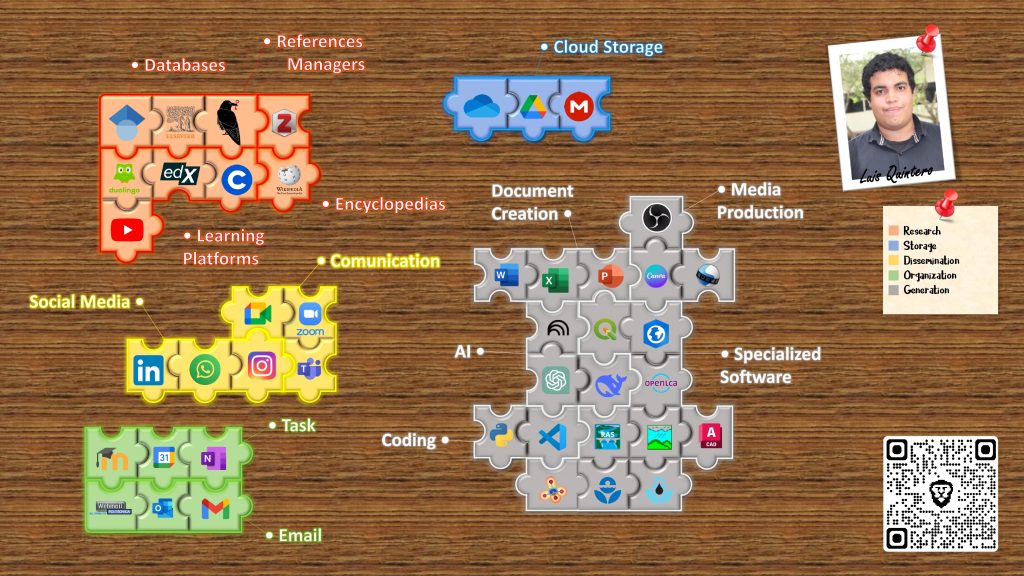
Creating my Personal Learning Environment (PLE) has been a meaningful process to reflect on how I learn and how I want to keep growing. My initial PLE represents the tools I currently use to research, organize, create, and share information. It includes resources that have supported my studies and projects so far, helping me stay informed, manage my work, and collaborate effectively.

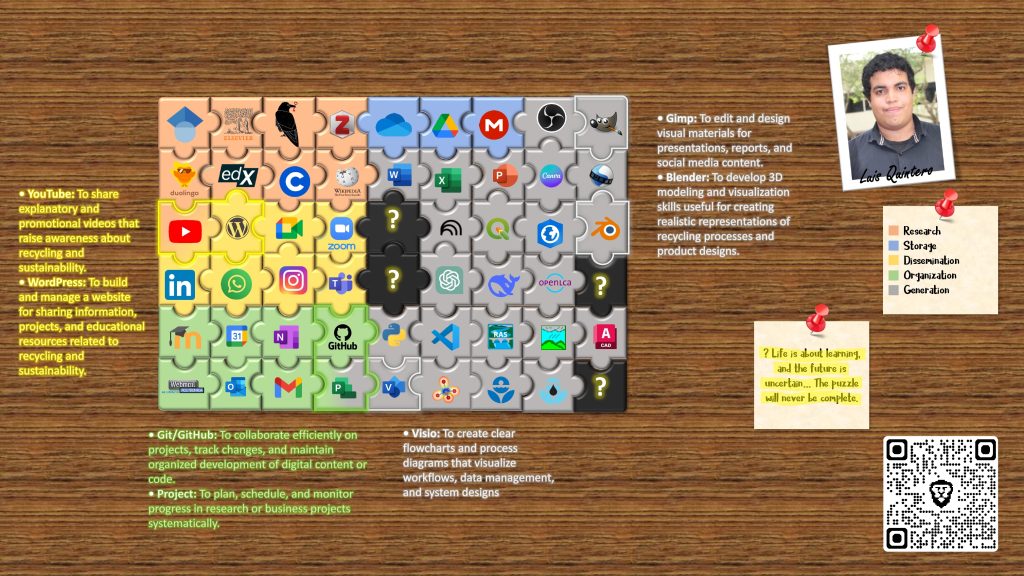
However, as I thought about my long-term academic and professional goals, I realized that my PLE could evolve to better align with the skills I want to develop and the projects I want to build. With this in mind, I redesigned my objective PLE to include tools that will strengthen my technical, creative, and organizational abilities.

For instance, I added Blender to learn 3D modeling and visualization for illustrating recycling processes, and GIMP to create and edit visuals for presentations and social media. WordPress and YouTube will help me share information and raise awareness about recycling through a website and video content. To improve project management and collaboration, I incorporated Git for version control, Microsoft Project for planning and tracking progress, and Visio for creating clear diagrams and workflows.

About LUIS ANGEL QUINTERO SERRANO

Environmental engineer passionate about creating innovative solutions that promote circular economy to drive positive change in society. My professional trajectory has focused on research, proposal development, and computational modeling in various areas of environmental engineering, especially in water resources and solid waste. I am convinced that addressing environmental challenges requires interdisciplinary collaboration and the formation of a strong network of professionals with deep knowledge in science and technology. My goal is to actively contribute to this collective effort, applying my skills and experience to generate positive impact on the environment and society as a whole.

Personal Reflection on Professional Future

 Key insights and journey experience in The Week-U

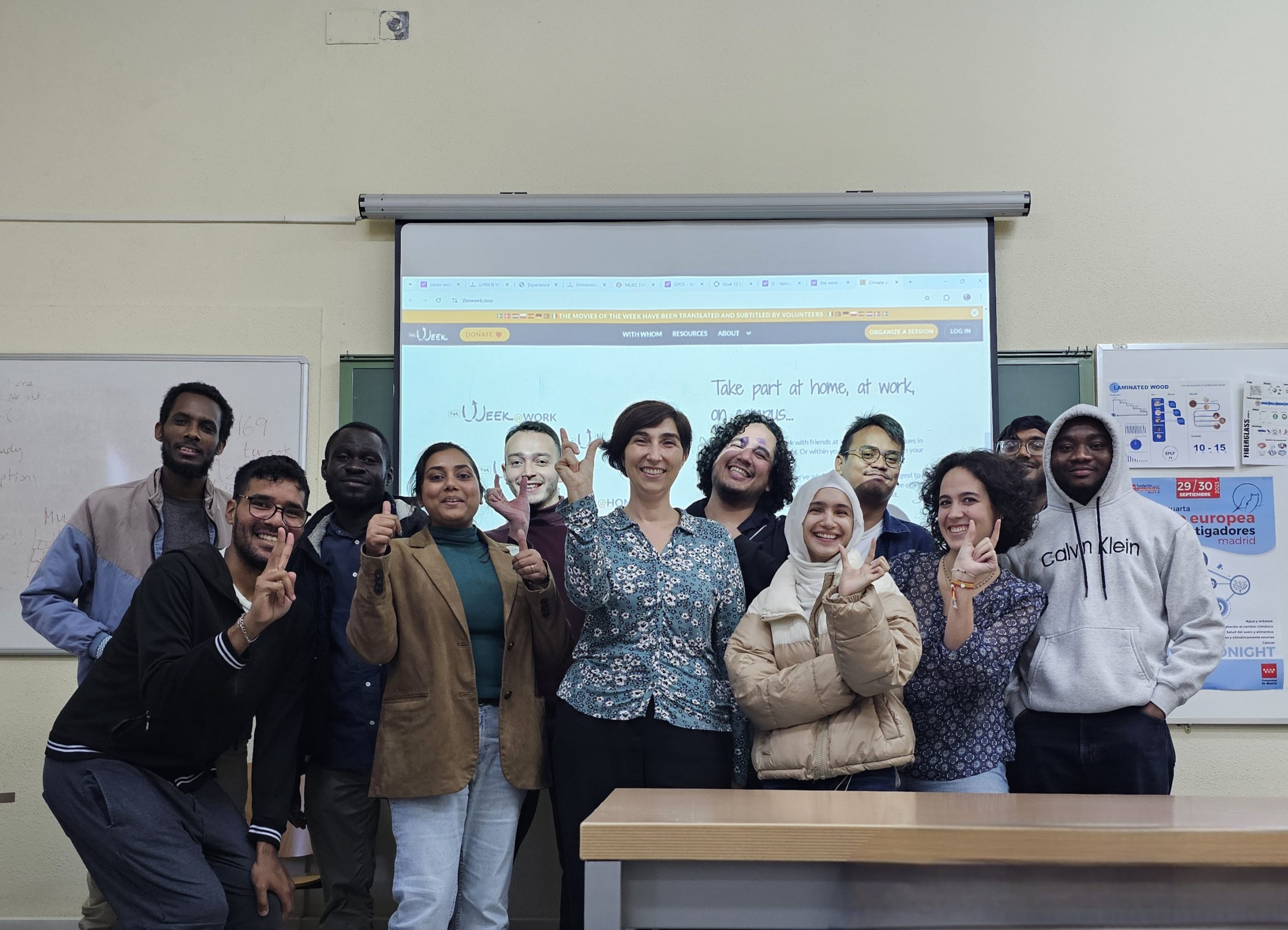
The U week was a journey of personal and collective learning that led us through three sessions in a process of reflection about the impact that our activities and those of large companies worldwide have on climate change, food production and distribution, and lifestyles in general.

Being part of this activity gave me a broader and more optimistic perspective on how to contribute positively to mitigate the effects of current production models and/or practices that threaten the sustainability of the planet. We can all contribute from our area of ​​interest and professional development. The projection of myself that I would like to see materialized in 10 years is that of a socially and environmentally responsible person serving as an agent of change to migrate towards alternative technology in the area of ​​materials. But I would also certainly like to lead a more holistic lifestyle. Sometimes less is more, and being immersed in a consumer society is something I want to avoid as much as possible.

Thanks to Professor Ruth Carrasco for taking us on this experience.

About DAVID DUARTE NIETO

Hello! I am David Duarte, I was born in Colombia, but I grew up in Venezuela. I work in the field of materials and their potential in the construction world. I'm currently studying a master's degree in advanced recycling of materials, a path that brings me closer to the goal of contributing to a more sustainable world. I like being in contact with nature. If I can overcome laziness, I like hiking and mountaineering. At home, I usually read manga and watch Japanese animation, a culture that awakens a lot of curiosity and admiration in me. I also enjoy exploring the gastronomy of each new place I visit.

Navigating the Future: Merging Technology, Sustainability, and Social Responsibility in the Age of the Fourth Industrial Revolution (Professional Reflection)

Reflecting on my professional future in the context of the Fourth Industrial Revolution, I find myself at the crossroads of technology and sustainability. The rapid advancements in AI, automation, and robotics are pushing industries to evolve at an unprecedented pace. However, as highlighted in the videos I watched, there’s an ongoing challenge to ensure that these innovations are harnessed for the greater good, both environmentally and socially. I see this revolution not only as an opportunity to advance in my career but also as a call to action to contribute to shaping a future that integrates technology responsibly.

The discussions on digital platforms higlights the urgency of addressing the societal impacts of automation, especially the potential for job displacement. These conversations resonate deeply with me because they make clear the need for proactive measures to ensure that technological progress does not lead to greater inequality. I understand that the work ahead will require adaptability, not just in acquiring technical skills, but in fostering empathy and ethics within the workplace. It’s essential to contribute to a future where these innovations can be used to empower people, not just replace them.

In my own career, I want to blend my passion for technology with a strong sense of social responsibility. As we move towards an era of smarter, more efficient systems, my goal is to ensure these technologies align with sustainable practices and positively impact communities. By keeping a focus on the long-term implications—both environmental and human—I aim to be part of a solution that creates meaningful, equitable opportunities for people in an increasingly automated world. My professional journey, therefore, will be rooted in bridging the gap between innovation and societal progress.

About NAUFAL AFIF PRAHASTHO

Innovative Sustainability Expert | MSc Candidate in Advanced Materials: Innovative Recycling Erasmus Mundus Program | Experienced Analyst in Renewable Energy & Environmental Sustainability Solutions

About Myself!

Hello everyone!

My name is Laki, and I am from Bangladesh. I am a passionate and driven master’s student specializing in Advanced Materials & Innovative Recycling (AMIR), an EU-supported program under the Erasmus initiative. I have completed my first year at Masters of Material science and Engineering from NOVA School of Science and Technology (NOVA FCT) – University of Lisbon. Currently I am doing my second year, Masters of Circular Economy_ Priorities construction Materials at Technical University of Madrid (UPM). I have gained extensive knowledge in recycling, circular economy, and sustainability principles.Throughout my academic journey, I have developed strong expertise in materials recycling, waste-to-energy projects, carbon capture and storage (CCS), construction and demolition (C&D) recycling, sustainable product design, and packaging. My studies, paired with professional experience in entrepreneurship and sustainability management, have prepared me to make meaningful contributions to the recycling and sustainability sectors. I am very happy to connect with you, All!

Objective:I am actively seeking a challenging and dynamic internship or thesis project that aligns with my background in materials recycling, waste management, and sustainability. I am open to working in various environments, from urban centers to remote locations, and am eager to apply my knowledge to impactful projects that drive sustainable innovation.

Avatar photo

About LAKI KHATUN

Hello everyone! My name is Laki, and I am from Bangladesh. I am a passionate and driven master’s student specializing in Advanced Materials & Innovative Recycling (AMIR), an EU-supported program under the Erasmus initiative. I have completed my first year at Masters of Material science and Engineering from NOVA School of Science and Technology (NOVA FCT) – University of Lisbon. Currently I am doing my second year, Masters of Circular Economy_ Priorities construction Materials at Technical University of Madrid (UPM). I have gained extensive knowledge in recycling, circular economy, and sustainability principles. Throughout my academic journey, I have developed strong expertise in materials recycling, waste-to-energy projects, carbon capture and storage (CCS), construction and demolition (C&D) recycling, sustainable product design, and packaging. My studies, paired with professional experience in entrepreneurship and sustainability management, have prepared me to make meaningful contributions to the recycling and sustainability sectors. I am very happy to connect with you, All! Objective: I am actively seeking a challenging and dynamic internship or thesis project that aligns with my background in materials recycling, waste management, and sustainability. I am open to working in various environments, from urban centers to remote locations, and am eager to apply my knowledge to impactful projects that drive sustainable innovation.

Introduction: Laiba Zahid

I’m Laiba Zahid, a Materials engineer from Pakistan with a strong focus on sustainability, circular economy, and social impact. I completed my Bachelor’s in Materials Science and Engineering from the Institute of Space Technology in Islamabad Pakistan, followed by a Master’s in Advanced Materials and Innovative Recycling from the University of Nova Lisbon. Currently, I’m pursuing a specialization in Circular Economy for Minerals and Construction Products at Universidad Politécnica de Madrid. My research is focused on biomaterials, and have a publication of “Development and Characterization of a Polyethylene Oxide and Guar Gum-based Hydrogel: A detailed In-Vitro analysis of degradation and drug release kinetics” in International Journal of Biological Macromolecules.

Beyond my work in engineering, I am deeply committed to social advocacy, particularly in advancing educational opportunities for children in rural areas of Pakistan. I believe that real, sustainable change emerges when technological innovation meets social responsibility, addressing community needs at a foundational level. My goal is to help bridge the gap between science and society, ensuring that advancements in materials and sustainable practices also support under-resourced communities.

Avatar photo

About LAIBA ZAHID

A materials engineer specializing in advanced recycling and circular economy, currently pursuing a Master's in Circular Economy for Minerals and Construction Products at Universidad Politécnica de Madrid.