MOOC II: Circular Economy – An Introduction

TU Delft: Circular Economy: An Introduction

Note

I found nothing new in this course. Everything mentioned was already taught in the online course taught by Dr. Guido Sonnemann in the first semester.

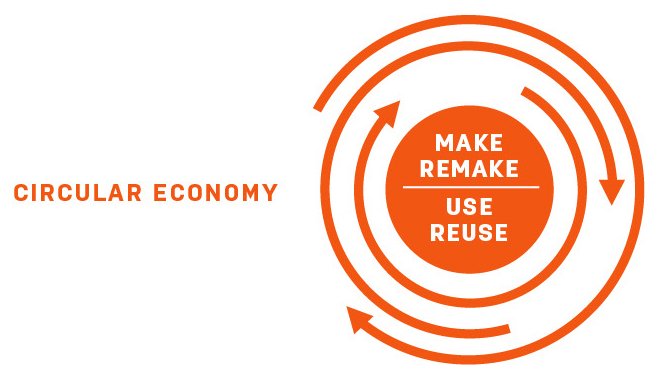
1. Reinforced that Circular Economy as System Design, Not Just “Recycling”

Course insight: The first module reframed the problem: planetary challenges (resource scarcity, waste, environmental impact) are systemic. The circular economy is not a “plug-in” add-on, but a full paradigm shift in how products are designed, used, and re-used.

My takeaway: As a materials-science & recycling student, this only reinforced what I already knew and have learnt multiple times throughout this masters degree, that my work doesn’t start (or end) at material selection. Instead, I should think in closed loops: from raw material sourcing → product design → use → end-of-life recovery/recycling/revalorization.
2. Value Creation via Circular Business and Supply-Chain Models

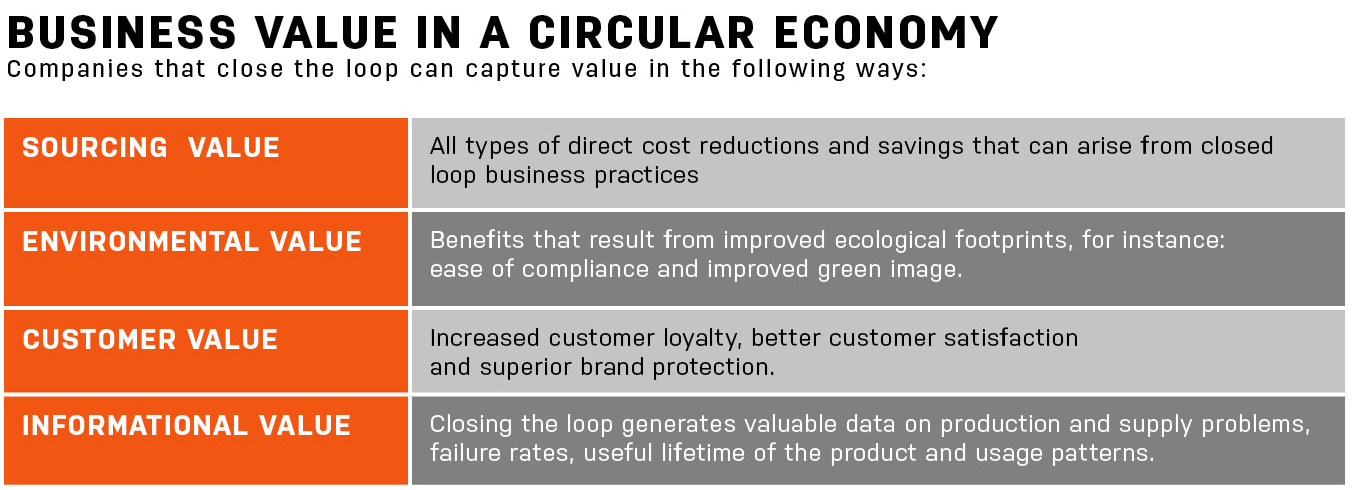
Course insight: One episode explores how closed-loop supply chains and reverse logistics enable new business models: shifting from selling products to providing services, leasing, take-back programs, remanufacturing, or product-as-service models.

My takeaway: This goes beyond technical recycling, there is economic viability in circular models. For example, in recycling construction-based recycling projects (my background), circular business models could guarantee material recapture and sustainable material flows rather than pure disposal or downcycling.
3. “Design for R” Philosophy

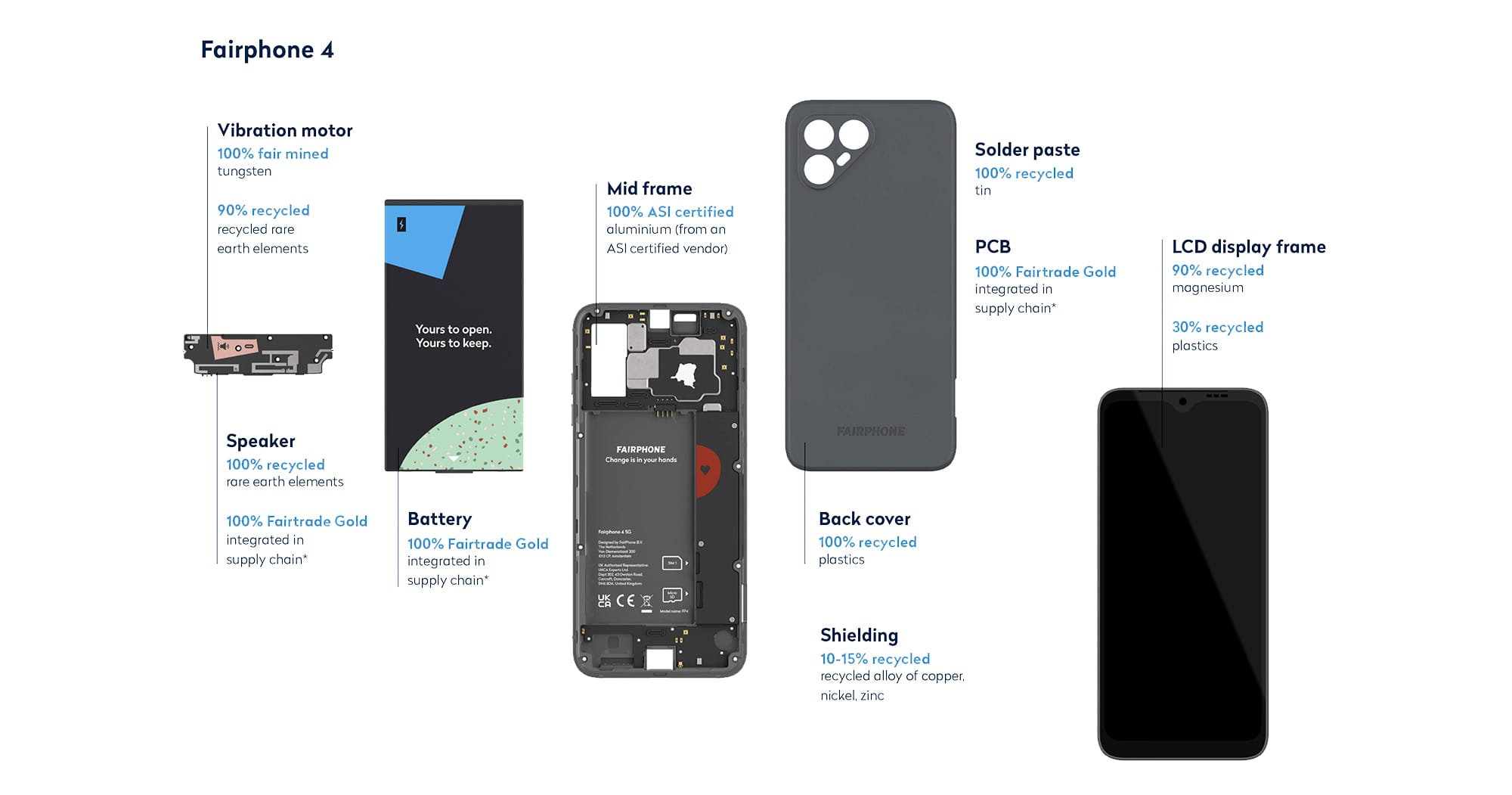
Course insight: The course emphasizes designing products to last longer, be repaired, remanufactured or recycled, rather than built for obsolescence.

My takeaway: Given my interest in materials science and recycling, this principle resonates strongly: when developing new materials/processes (e.g. in mine waste recycling), I must consider entire lifecycle: durability, ease of disassembly, reuse potential, recyclability, not just performance in first use. One nice thing to go through again was fairphone being mentioned. I discovered fairphone through a colleague who is also enrolled in the same program, Valentina Chessa, so it was interesting to see Fairphone used as a case study in this course.
Thank you for taking the time out to read my reflections for the optional course! 🙂


I hope you liked my reflections and learnings from the course. All proof of completion can be found in here:


Lastly, since this will probably be my last post on this blog. I also want to share my love for photography, specifically astrophotography, with my current colleagues and all future readers. I will miss posting here 😢

About SHAH SAUD

Hi! I am Shah. Professionally, I like to exist in the intersection of materials and circularity. Currently pursuing a Master’s in Advance Materials Innovative Recycling at Universidad Politécnica de Madrid (UPM). Outside my professional sphere, you will find me chasing sunsets, travelling to lesser-known destinations and making a mean carrot cake.
MOOC I: Achieving Personal and Professional Success

Over the past weeks, I completed the Achieving Personal and Professional Success specialization from the University of Pennsylvania. The specialization was divided into 4 courses: Success, Improving Communication, Influence & Negotiation.

Instead of writing a long reflective essay, I distilled the core reflections on things that I particularly found interesting and how that impacts my PLE (Personal Learning Environment).

1) Success (Richard Shell)

The Six Lives reflection forced me to compare competing life scripts and choose priorities rather than default to academic expectations.
PLE update: Add a weekly 20-min “Six-Lives” check-in (Notion) to test if tasks still match my selected script.
Specific tool: Achievement–Happiness Matrix — used it to tag ongoing projects (e.g., thesis experiment vs. teaching assistant duties) as Achievement-heavy or Happiness-supporting.

Link to the six lives exercise (if you want to do it without accessing the entire course): https://grichardshell.com/book-extras/six-lives-exercise/


2) Improving Communication Skills (Maurice Schweitzer)

When to Compete vs. Cooperate — taught the three principles: scarcity, sociability, dynamic instability. I can apply this this in a group work decisions: choosing cooperation when resources were tight reduced conflict.
PLE update: Add a “cooperation checklist” to meeting notes.


3) Influence (Cade Massey)

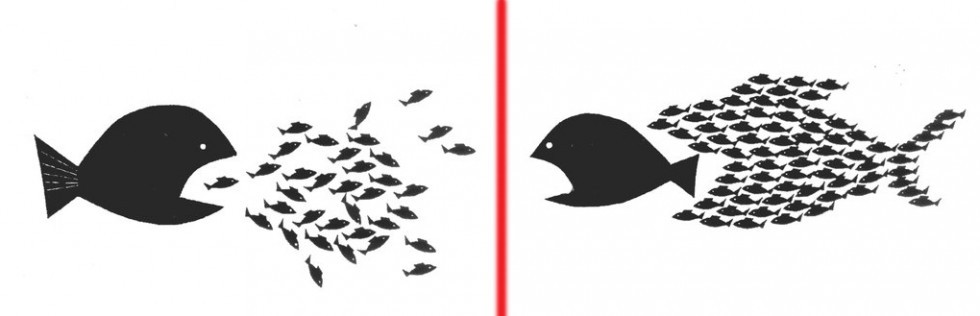
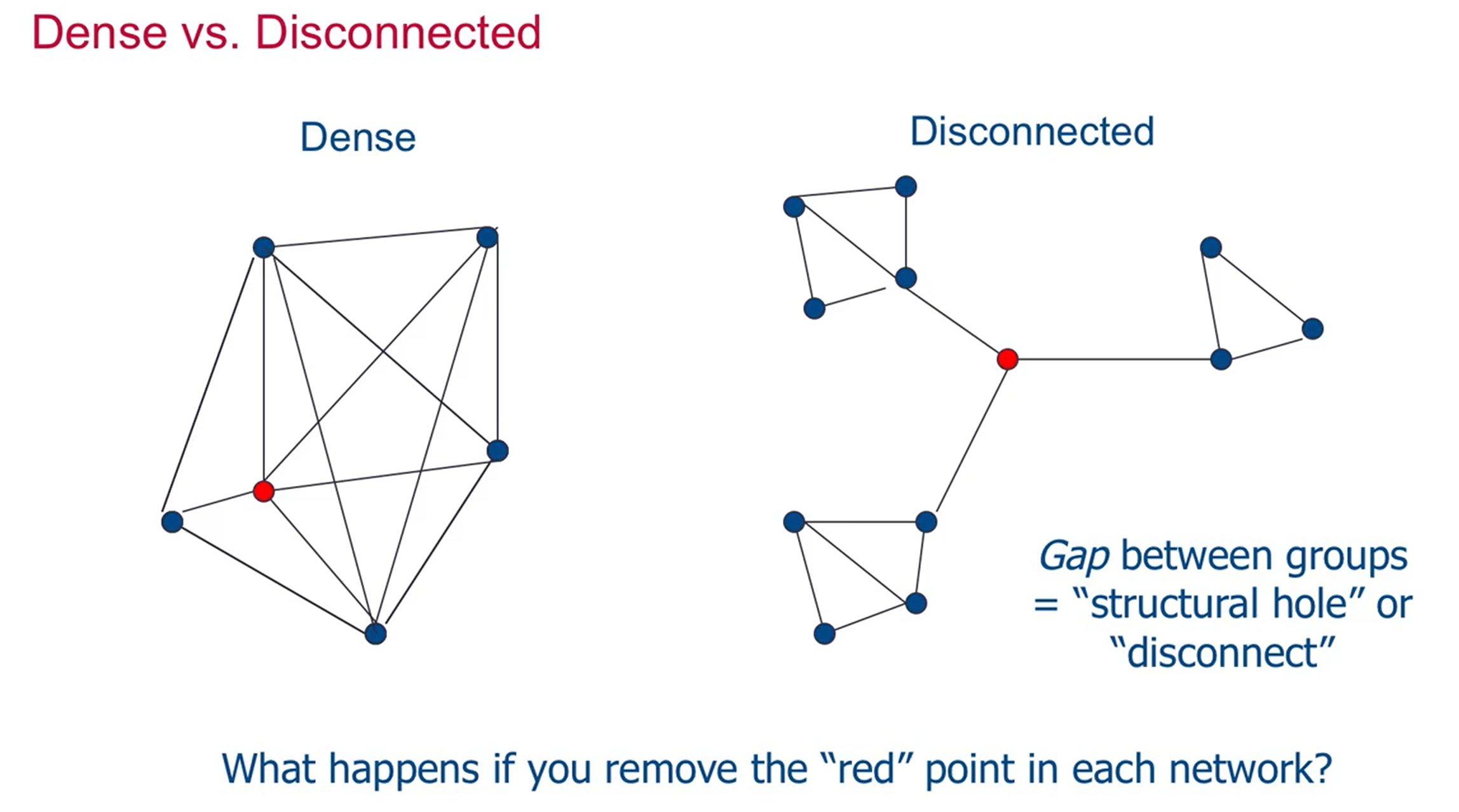
Network types: dense vs. disconnected. This helped me think about how I could map my contacts. Infact, it made me realize about a gap between my academic contacts and industry sustainability practitioners. I will now leverage my efforts towards starting to bridging via targeted LinkedIn messages.
PLE update: Add a “network map” sheet to my PLE and a monthly outreach task.

Another thing that was interesting was the Signals of Trust & Repairing Trust, practical cues (vulnerability, warmth) and apology structure. While learning this I was reflecting how I can use this during conflicts with teammates; to help rebuild rapport quickly.

Specifically, the SUCCES-style message crafting: using “Simple + Story + Credible” formula to reframe a technical slide for a nontechnical stakeholder can result in clearer buy-in for the targetted audience whether it is a prospective employer.


4) Negotiation (Maurice Schweitzer)

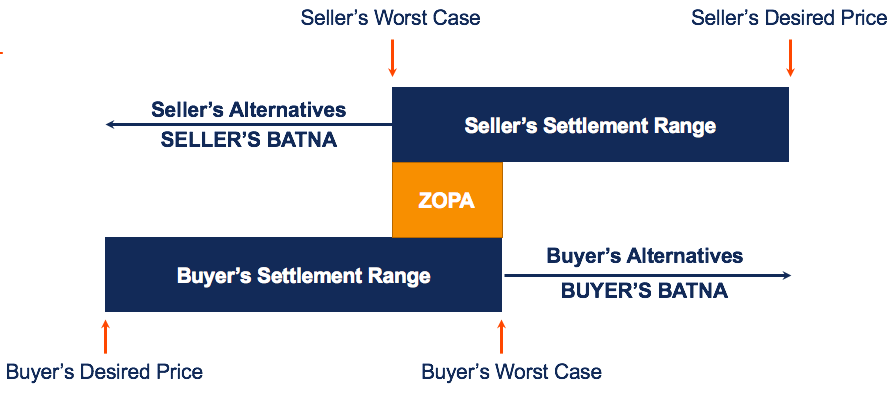
In this module ZOPA (Zone of Potential Agreement) & BATNA (Best Alternative to a Negotiated Agreement)  exercises, can help practice setting a BATNA before an employment-type negotiation simulation; outcome: stronger first offer and better terms. Although it is typically used in financial settlements during negotiations for purchases between a buyer and seller but can easily apply to all other non-financial examples. This is especially relevant to us as students as we will soon step into the professional realm and will have to negotiate our salaries and working contracts.
PLE update: To create a “BATNA + First Offer” page in Notion before real negotiations.


Quick PLE summary (what changed — 3 bullets)

  1. Purpose tagging: Projects now carry an achievement vs. happiness tag from the Success matrix so I prioritize meaning-aligned work.
  2. Communication templates & checklists: Templates for apologies, cooperation checklists, BATNA planning stored in Notion.
  3. Network mapping + outreach routine: Monthly outreach and a “bridge contacts” list to connect dense academic clusters with diverse industry contacts.PLE update: To create a “BATNA + First Offer” page in Notion before real negotiations.

I hope you liked my reflections and learnings from the course. All proof of completion can be found in here:


Lastly, since this will probably be my last post on this blog. I also want to share my love for photography, specifically astrophotography, with my current colleagues and all future readers. I will miss posting here 😢

AS10-34-5018” by Apollo Image Gallery/ pdm 1.0
AS09-21-3278” by Apollo Image Gallery/ pdm 1.0

About SHAH SAUD

Hi! I am Shah. Professionally, I like to exist in the intersection of materials and circularity. Currently pursuing a Master’s in Advance Materials Innovative Recycling at Universidad Politécnica de Madrid (UPM). Outside my professional sphere, you will find me chasing sunsets, travelling to lesser-known destinations and making a mean carrot cake.
Shah’s Digital Identity Plan

Hello everyone! I put of a lot effort into curating my digital identity plan. Every stylistic choice reflects something important. and is explained in the text debrief below the plan, if you want to read about it in detail. Even if you don’t, I believe the DI plan is self-explanatory enough. So enjoy! 😁

Content

My Digital Plan revolves around two of my current objectives: 1) Finding internship/master thesis opportunities in companies working on material eco-design applications in energy and manufacturing sectors. 2) Promoting the startup, GeoCura, I’m working on with my team. All sections are therefore filled out with these goals in mind.

Design

I used a simple cubical layout to arrange different sections of my DI plan. However, I directly connect sections which have a direct cause & effect relationship. For example, Objectives & Key Activities are tied together in this sense. I had to think of key activities which actively fulfil the objectives I have planned. Moreover, Key Resources & Costs also have a similar relationship as all the keyresources employed for this DI plan will have tangible and non-tangible costs associated to them.

You can also see that I used distinct colours for three sections: Value Proposition, Content and Target Audience. As these are the crux and backbone of my digital identity. The value proposition and content are aimed directly for the target audience of my digital identity. My value proposition and content are how I gain traction from my target audience.

Lastly, to make it easier to follow the DI plan, I have now also inserted a ‘start-here‘ arrow and connecting lines. To guide the viewer to go through it in the desired order it is supposed to be read: [Objectives, Key Activities] 🡢 [Collaborator] 🡢 [Channels] 🡢 [Value Proposition] 🡢 [Target Audience][Key Resources, Costs].

I hope you liked my take on designing my digital identity plan and were able to learn something new from it.

About SHAH SAUD

Hi! I am Shah. Professionally, I like to exist in the intersection of materials and circularity. Currently pursuing a Master’s in Advance Materials Innovative Recycling at Universidad Politécnica de Madrid (UPM). Outside my professional sphere, you will find me chasing sunsets, travelling to lesser-known destinations and making a mean carrot cake.
Linda Prinz – The Week Summary

Reflecting on The Week:

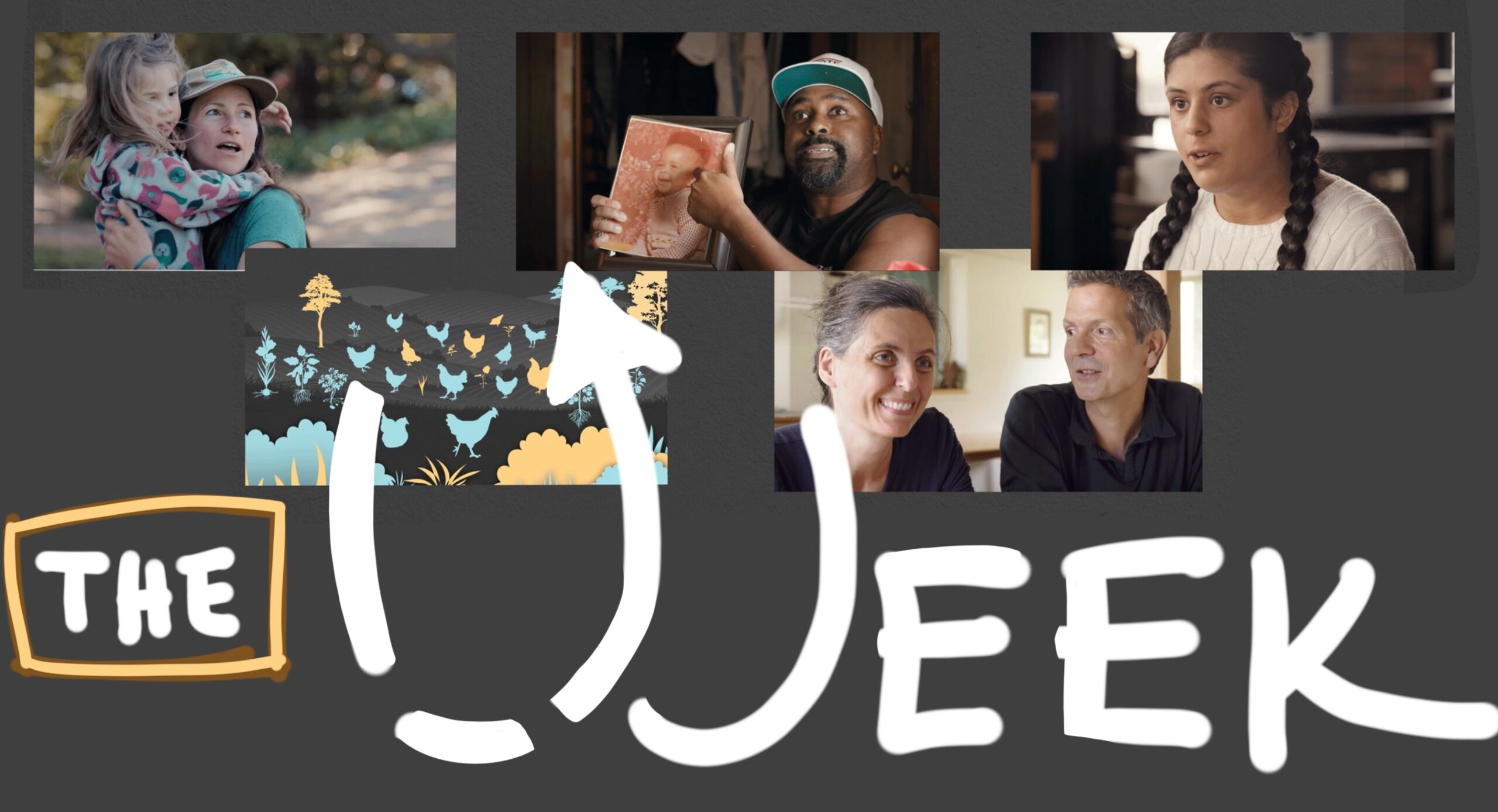
A Three-Day Journey Through Climate RealityI recently took part in The Week, a three-day documentary and reflection exercise about the climate crisis. I didn’t go into it expecting dramatic revelations. As most oft he people in my generation, I grew up with climate change, and it has been part of my life for decades. Because of that, much of the content wasn’t surprising. Still, sitting down and confronting everything in a concentrated, structured format brought up emotions and thoughts I don’t always give space to.Here’s what I took away from each day.

Day 1 – Reality Check

The first day focused on the blunt reality of where we’re heading. Again, nothing was new to me: the melting ice caps, the extreme weather, the political inaction. I’ve known about this since I was young.But even if the facts weren’t surprising, the emotional impact was still real. I felt sad and angry about the future, and frustrated that meaningful action is still so limited. These feelings weren’t caused by the video; they’ve been with me for years. The documentary simply brought them back to the surface.One part of the exercise was imagining my life in 2050. I pictured myself in a world that managed to stay at least somewhat stable. Not perfect, but one where we acted early enough to avoid the worst outcomes. A world where people chose cooperation over panic.Thinking of Vienna and Austria in 2050 felt strangely down-to-earth. We probably won’t be among the most drastically affected regions at first. But winters will look different, skiing may barely exist, and we’ll likely have more immigration from countries hit harder. The changes will be real, even if they don’t arrive explosively.

Day 2 – How Did We Get Here? Is There a Way Out?

Day 2 focused on responsibility: both personal and systemic. It made me reflect more honestly on my own choices.A big takeaway was the importance of knowing the impact behind what we consume: food, clothes, and everyday items. Asking simple but uncomfortable questions:Does eating meat really make me that much happier compared to a plant-based meal? Do I actually need this new T-shirt? What’s the cost behind it?I try to live with these questions in mind. I buy carefully, eat mostly plant-based, and use my bike or public transport whenever possible. But I’m far from perfect — traveling by plane is still my biggest weakness, and I know it.One thing I appreciated from the documentary is the reminder that we don’t need perfection. Two percent of people living flawlessly sustainable lives won’t fix anything. What matters is everyone contributing, even if imperfectly. And judging others for not choosing the same battles doesn’t help.

Day 3 – What Can We Do? Is There Hope?

The last day asked us to imagine a hopeful scenario. Not a fantasy, but a realistic version of 2050 where our actions actually mattered.I pictured myself at 34 years, having built a solid, meaningful career in sustainability or the circular economy. I imagined myself working on solutions, influencing others, and doing something that aligns with my values. Not saving the world, just contributing something real.This vision isn’t overly optimistic or utopian. It’s simply the version of the future I’d like to be able to look back on and feel okay about.Being frustrated and pessimistic about the future will get us nowhere. Of course, we shouldn’t be naïve about the current situation. However, a bit of optimism is necessary to keep trying and having a positive impact.

Final Thoughts

I wouldn’t say The Week changed my worldview. Climate change has been on my radar for most of my life, and nothing in the documentary was shocking or revolutionary. But it did force me to pause, reflect, and confront feelings I often push aside.It reminded me that the future we imagine isn’t guaranteed, but it also isn’t written yet. And while the documentary itself wasn’t perfect or particularly uplifting, the exercise of reflecting on my own role and my own future, was worthwhile.I think a similar exercise on very new topics, such as the impact of AI on our society, could have had a greater impact on me.

About SHAH SAUD

Hi! I am Shah. Professionally, I like to exist in the intersection of materials and circularity. Currently pursuing a Master’s in Advance Materials Innovative Recycling at Universidad Politécnica de Madrid (UPM). Outside my professional sphere, you will find me chasing sunsets, travelling to lesser-known destinations and making a mean carrot cake.

The Week Experience – Reflection

Hello everyone🙏🏽! so let me tell U
about this U-Shaped Week
I had…

The first session reopened a topic I’ve lived with for years: climate change. The video carried an emotional message, urging responsibility and awareness. However, us Gen-Zs have grown up to be part of the most climate aware and active generation, so this was not surprising at all and neither did it make me feel emotional. What struck me most was the diversity of reactions in the group. Some felt shaken; others, like me, viewed it through the lens of someone who has grown up with this crisis as a constant reality.

Our conversation highlighted how differently we internalize the same message depending on where we come from, what we’ve lived through, and how climate change has touched our lives.

The second day shifted toward a more philosophical tone. We explored the systems beneath the crisis—consumerism, capitalism, and the way narratives shape our understanding of the world. The idea of the “Story of More” resonated with me, especially as someone from the Global South, where “more” is often synonymous with a “successful life.” I grew up in a culture, where good grades, translated into better jobs which translated into a high-paying career. So the focus was always cramming for a ‘story of more.’

Our discussions reminded me how personal sustainability choices can be, and how they intersect with identity, culture, and most importantly privilege.

The final session brought the whole class together. Instead of focusing on climate change directly, we reflected on pride, identity, and the futures we imagine for ourselves. Hearing so many voices, each shaped by unique experiences, felt grounding. It was a reminder of how connection and empathy are powerful tools for imagining a shared future.

Overall, The Week did not transform my understanding of climate change—I’ve lived too closely with its realities for too long. But it did give me something else: clarity of experiencing it through the lense of eight other individuals.

It also reminded me of the importance of small, personal acts: returning to calligraphy, nurturing connections across distance, watching sunsets in quiet reflection. These moments enrich my life far more than external achievements ever could. Things that would become increasingly difficult to pursue in a post-apocalyptic world of the climate catastrophy.

The content may not have been new, but the conversations, perspectives, and self-reflection gave it meaning. And that meaning stays with me as I continue shaping my own story, a story not of “more,” but of intention, compassion, and growth.

About SHAH SAUD

Hi! I am Shah. Professionally, I like to exist in the intersection of materials and circularity. Currently pursuing a Master’s in Advance Materials Innovative Recycling at Universidad Politécnica de Madrid (UPM). Outside my professional sphere, you will find me chasing sunsets, travelling to lesser-known destinations and making a mean carrot cake.

Linda Prinz – Personal Learning Environment

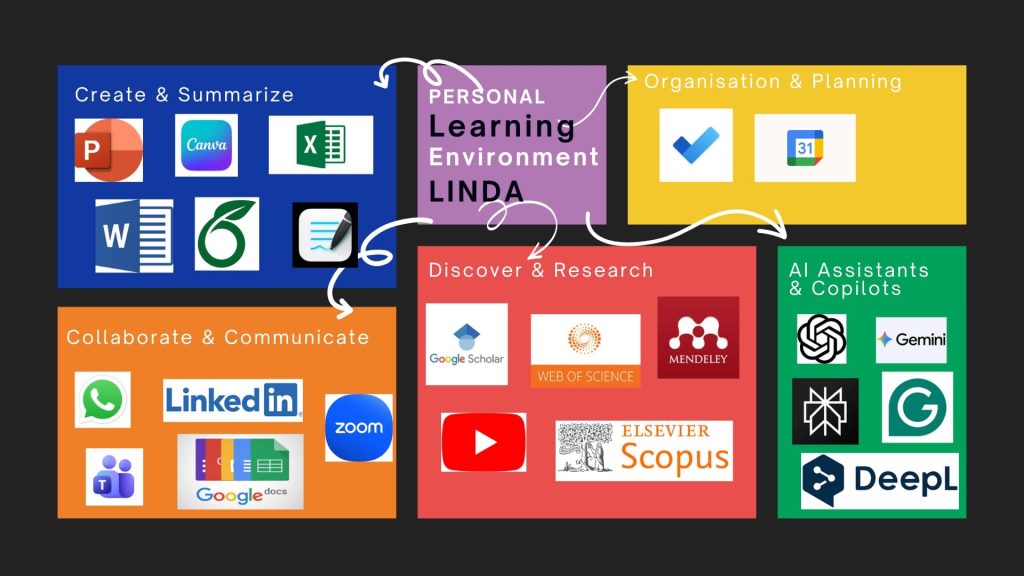
Heyy, check out my Personal Learning Environment! – Linda.

About SHAH SAUD

Hi! I am Shah. Professionally, I like to exist in the intersection of materials and circularity. Currently pursuing a Master’s in Advance Materials Innovative Recycling at Universidad Politécnica de Madrid (UPM). Outside my professional sphere, you will find me chasing sunsets, travelling to lesser-known destinations and making a mean carrot cake.

My Personal Learning Environment – Shah Saud

PLE-Old.png

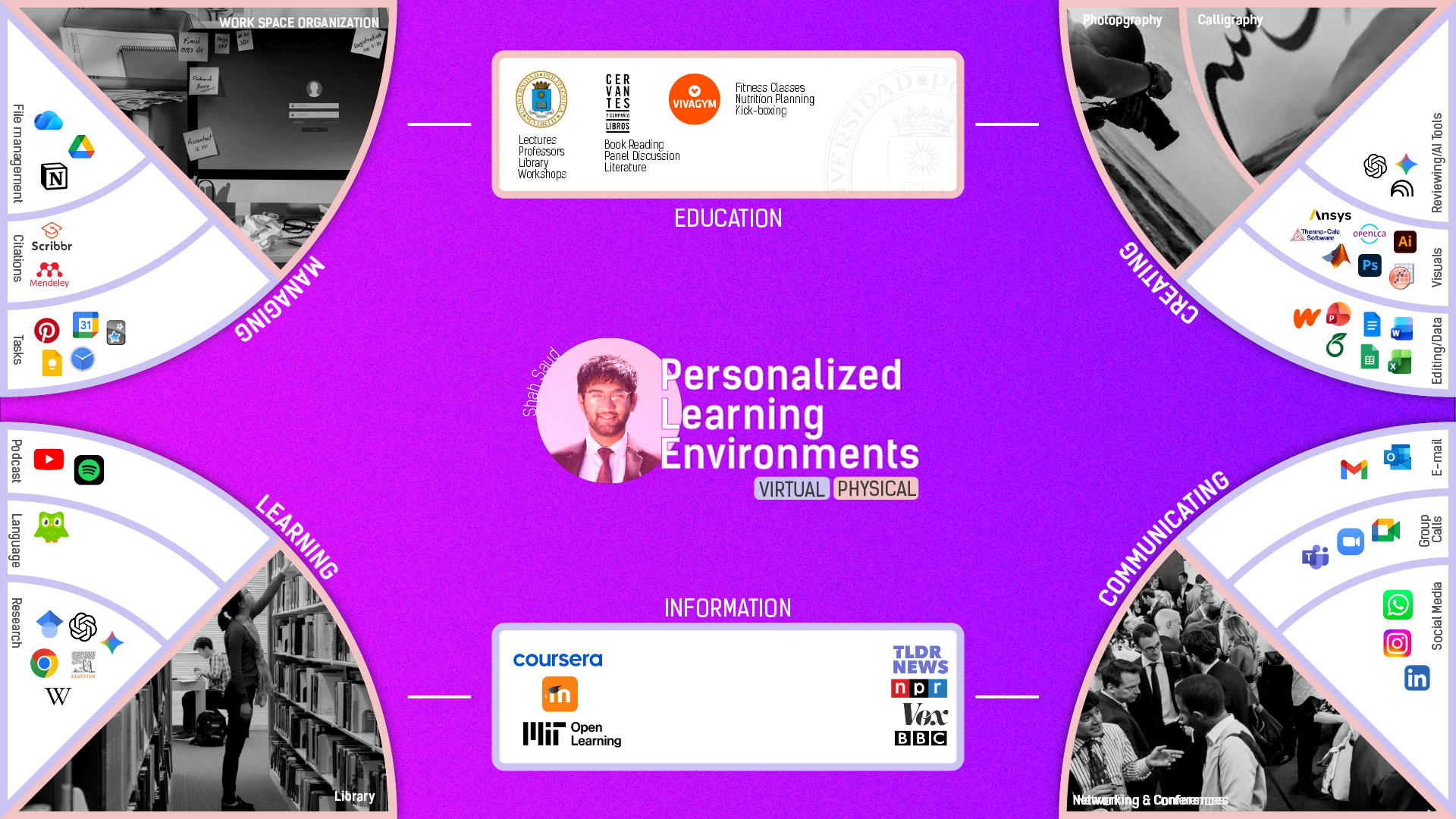
My existing Personalized Learning Environment (PLE) is organized around four major domains of my daily academic, personal, and professional life: Learning, Managing, Communicating, and Creating. Each domain highlights the physical spaces, activities, and digital tools that support how I acquire knowledge, stay organized, connect with others, and produce content.

Learning

This area represents the different ways I engage with new knowledge—through libraries, podcasts, online platforms, research tools, and language-learning apps. It shows the diverse inputs I rely on to expand my understanding and learn new skills.

Managing

Here, I capture the systems and tools I use to organize my work and personal life, such as file-management platforms, citation managers, calendars, and task-tracking applications. This quadrant reflects how I maintain structure and efficiency in both physical and virtual environments.

Communicating

This domain maps out how I stay connected with others across both formal and informal channels. It includes email platforms, social media, group-call tools, and in-person networking environments. Together, these support my collaboration, communication, and relationship-building.

Creating

The creating section showcases the tools I use to design, edit, and express my ideas visually or through multimedia. It encompasses software for writing, designing, analyzing data, photography, and exploring new creative AI tools.

Overall, the existing PLE presents a holistic snapshot of my everyday practices and the digital ecosystems that support my learning, productivity, and creativity.

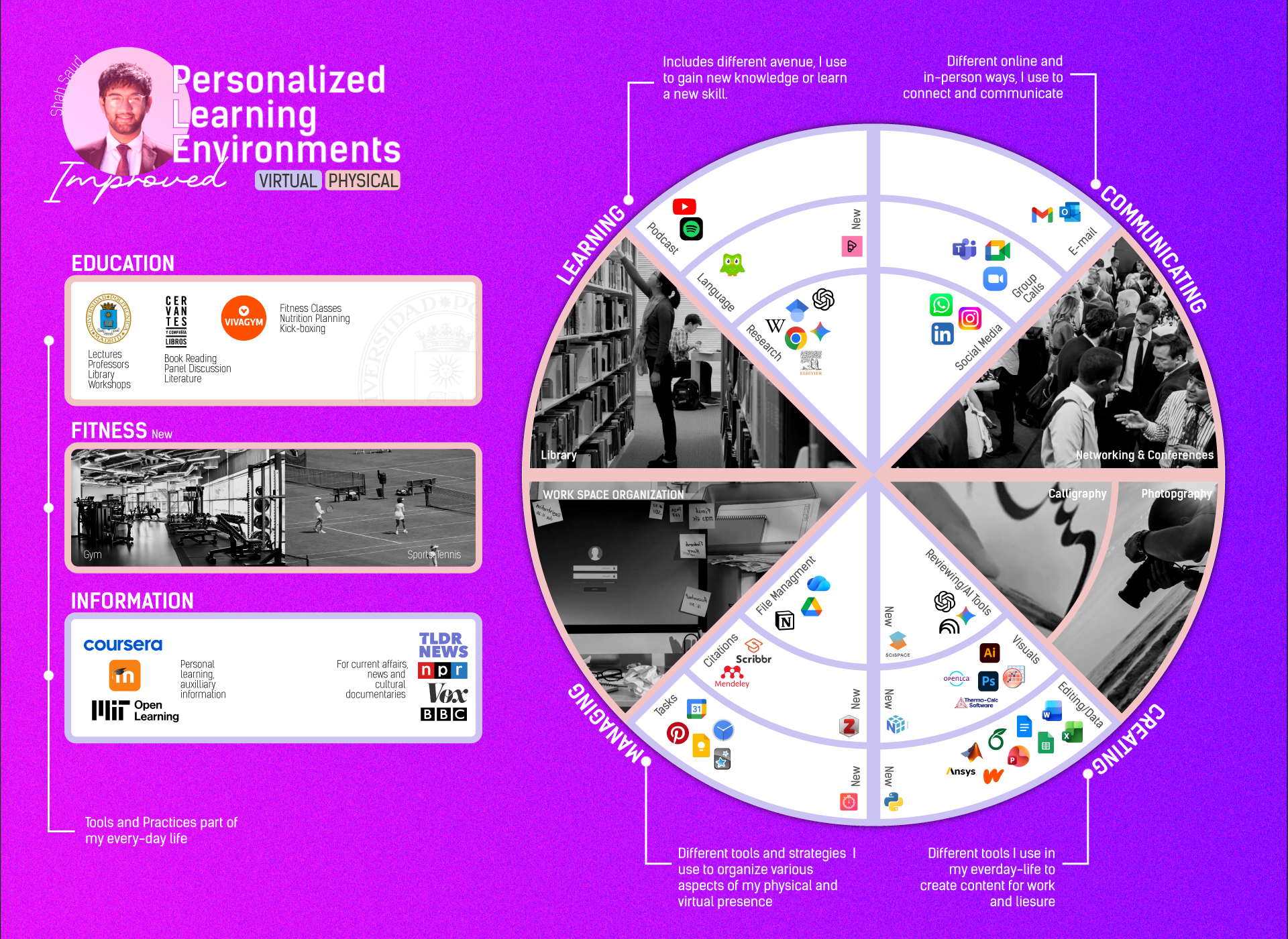
My improved PLE builds upon the original by expanding tool categories, adding new platforms, and restructuring the visual layout for greater clarity. The update makes my learning environment more comprehensive, modern, and aligned with my current goals.

Enhanced Visual Structure

This was an intentional change to show the existing PLE connecting in a circular with the additions of improved PLE. This symbolizes how learning from all differet tools in inter-connected and that I don’t solely rely on these environments seperately to accomplish a task but they all help in different ways in achievening a common end goal.

More Detailed Categorization

The improved PLE introduces clearer subdivisions within each quadrant—for example, breaking down learning tools into podcasts, language learning, research, and new-skills development. This increases specificity and highlights the variety of methods I use.

New Tools Across Domains

Several new tools appear across the updated model, particularly in the areas of:

  • AI-assisted learning and creation: Such as more advanced AI research and generation tools like scispace. A tool I have heard good things about but never incorporated it into my daily tasks. I would like to use it and see if it workds well for academic research as compared to conventional LLMs which I already use.
  • Creative platforms: Covering visuals, editing, simulations, and engineering-related software. I have a strong background in numerical coding and design but I am currently learning tools like numpy.
  • Language Learning: I have used Dualingo as long as I remember. It offers a very passive way of learning a new language. In the end you’re able to speak a few very basic sentences and words. However, I am still not able to speak any German, even after my 1000 day streak 😅. Am I bad learner? I don’t know. Is Dualingo ineffective, I would say yes. Therefore, I incorporated the use of another platform, preply, that places itself as a competitor to Dualingo while offering real-time progress in learning a new language.

These additions reflect the evolution of my workflow toward more sophisticated, technology-enhanced solutions.

Integration of Physical & Virtual Environments

The improved PLE explicitly acknowledges both physical and virtual elements of my learning ecosystem, including:

  • Physical learning spaces such as libraries, workshops, and fitness environments.
  • Virtual spaces such as online courses, digital information sources, and cloud-based tools.

This dual emphasis shows a more holistic approach to personal development.

Expanded Education, Information, and Fitness Sections

New panels highlight:

  • Education: academic environments, workshops, literature activities, and fitness programs.
  • Information: reliable news, educational platforms, and current-affairs sources.
  • Fitness: gym routines and sports, representing the role of well-being in my PLE.

About SHAH SAUD

Hi! I am Shah. Professionally, I like to exist in the intersection of materials and circularity. Currently pursuing a Master’s in Advance Materials Innovative Recycling at Universidad Politécnica de Madrid (UPM). Outside my professional sphere, you will find me chasing sunsets, travelling to lesser-known destinations and making a mean carrot cake.

Video Presentation – Shah Saud

Hello friends and colleagues! To see me speak about myself for one whole minute (actually 55s) click on the link below 😉:

https://photos.app.goo.gl/wnizsKUqZRAUc7ix5

About SHAH SAUD

Hi! I am Shah. Professionally, I like to exist in the intersection of materials and circularity. Currently pursuing a Master’s in Advance Materials Innovative Recycling at Universidad Politécnica de Madrid (UPM). Outside my professional sphere, you will find me chasing sunsets, travelling to lesser-known destinations and making a mean carrot cake.

Linda Prinz – Video Presentation

Hey, I am Linda! Check out my introduction video! Let‘s connect! https://youtube.com/shorts/xeSUqtfNF6Q?si=4znuMrJF7ba56j-d

About SHAH SAUD

Hi! I am Shah. Professionally, I like to exist in the intersection of materials and circularity. Currently pursuing a Master’s in Advance Materials Innovative Recycling at Universidad Politécnica de Madrid (UPM). Outside my professional sphere, you will find me chasing sunsets, travelling to lesser-known destinations and making a mean carrot cake.

Linda Prinz – Video Reflection

After watching Tom Bilyeu’s interview with Yuval Noah Harari, the message that stayed with me was his focus on adaptability and emotional balance. He argues that in a world shaped by fast technology cycles and persuasive algorithms, the real advantage is learning quickly while staying steady. That excites me a lot about my future because I’m genuinely eager to learn new things and keep reinventing myself. This perspective pushed me to see my career as something I will actively evolve, not just choose once.This mindset fits the path I want: working in the field of circular economy and renewable energy. Circularity is about designing products and systems that can change – repair, reuse, remanufacture – while renewables power those loops with clean energy. If I can translate between design, operations, and energy, I can help keep materials circulating and emissions falling even as markets and tools evolve.Practically, I’m committed to build skills that support this: lifecycle assessment to make choices with real data, design-for-disassembly to shorten repair time, and basic renewable procurement so operations align with low-carbon electricity. Guided by Harari’s advice, my plan is simple: keep learning, keep calm, and build durable loops that deliver impact over time.

About SHAH SAUD

Hi! I am Shah. Professionally, I like to exist in the intersection of materials and circularity. Currently pursuing a Master’s in Advance Materials Innovative Recycling at Universidad Politécnica de Madrid (UPM). Outside my professional sphere, you will find me chasing sunsets, travelling to lesser-known destinations and making a mean carrot cake.