Note: The blog’s storage is almost full. Which is why I had to reduce the size of my PLE images to upload them, thereby reducing the quality of the images. If you want to view the high-resolution images, you can find them here: PLE-Shah Saud
Existing PLE:
Link to higher-resolution image:
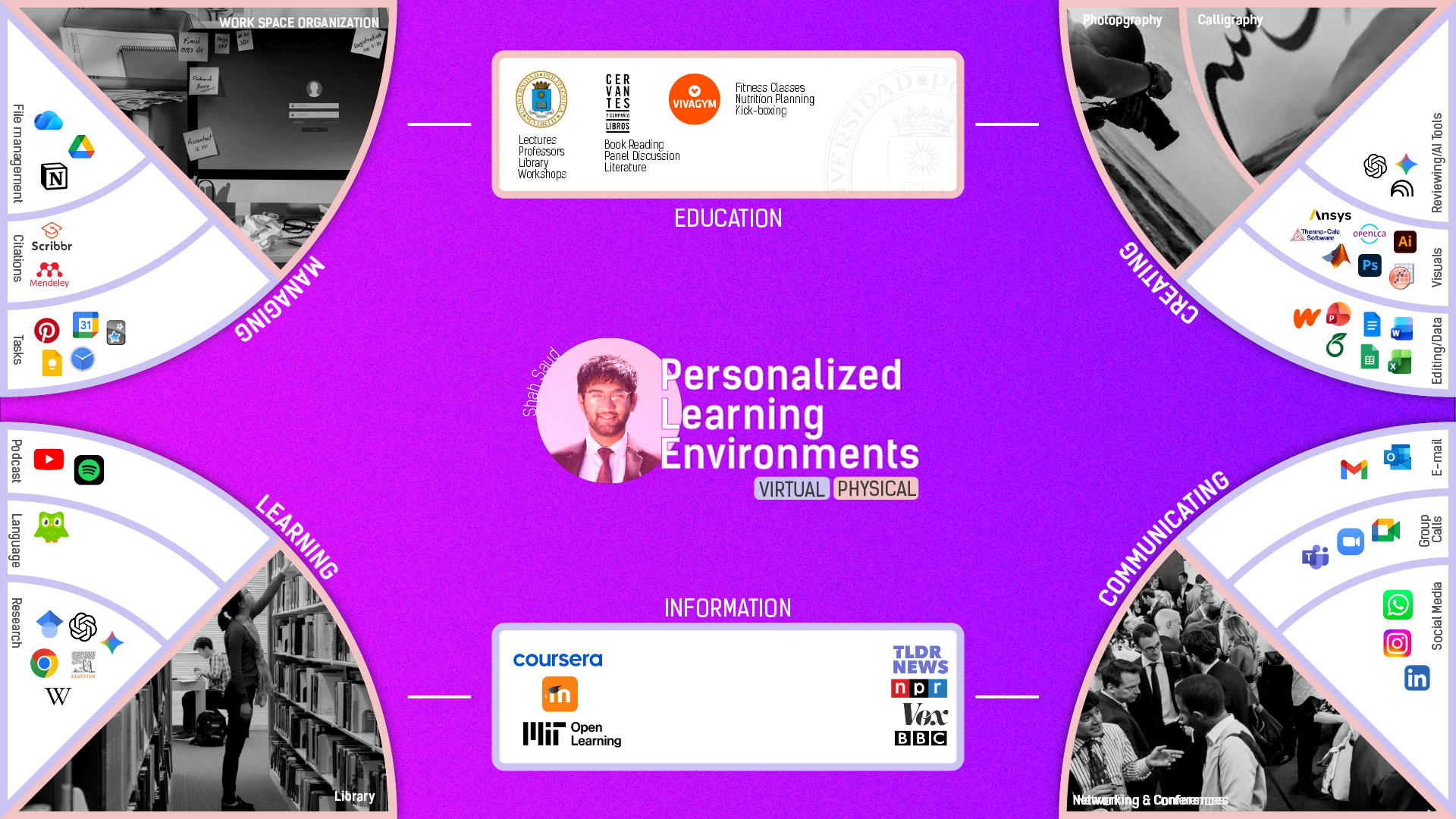
My existing Personalized Learning Environment (PLE) is organized around four major domains of my daily academic, personal, and professional life: Learning, Managing, Communicating, and Creating. Each domain highlights the physical spaces, activities, and digital tools that support how I acquire knowledge, stay organized, connect with others, and produce content.
Learning
This area represents the different ways I engage with new knowledge—through libraries, podcasts, online platforms, research tools, and language-learning apps. It shows the diverse inputs I rely on to expand my understanding and learn new skills.
Managing
Here, I capture the systems and tools I use to organize my work and personal life, such as file-management platforms, citation managers, calendars, and task-tracking applications. This quadrant reflects how I maintain structure and efficiency in both physical and virtual environments.
Communicating
This domain maps out how I stay connected with others across both formal and informal channels. It includes email platforms, social media, group-call tools, and in-person networking environments. Together, these support my collaboration, communication, and relationship-building.
Creating
The creating section showcases the tools I use to design, edit, and express my ideas visually or through multimedia. It encompasses software for writing, designing, analyzing data, photography, and exploring new creative AI tools.
Overall, the existing PLE presents a holistic snapshot of my everyday practices and the digital ecosystems that support my learning, productivity, and creativity.
Improved PLE:
Link to high-resolution picture:
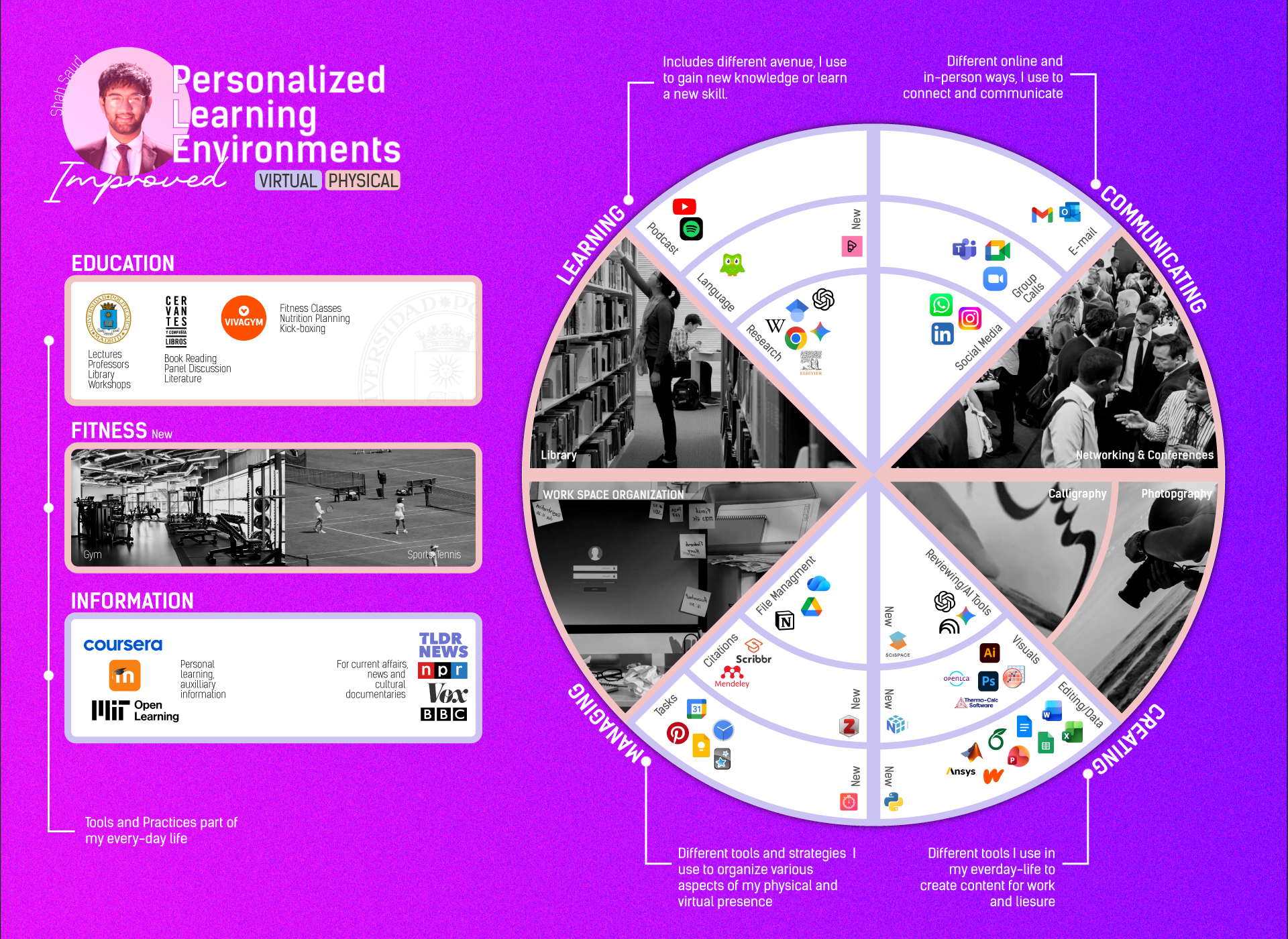
My improved PLE builds upon the original by expanding tool categories, adding new platforms, and restructuring the visual layout for greater clarity. The update makes my learning environment more comprehensive, modern, and aligned with my current goals.
Enhanced Visual Structure
This was an intentional change to show the existing PLE connecting in a circular with the additions of improved PLE. This symbolizes how learning from all differet tools in inter-connected and that I don’t solely rely on these environments seperately to accomplish a task but they all help in different ways in achievening a common end goal.
More Detailed Categorization
The improved PLE introduces clearer subdivisions within each quadrant—for example, breaking down learning tools into podcasts, language learning, research, and new-skills development. This increases specificity and highlights the variety of methods I use.
New Tools Across Domains
Several new tools appear across the updated model, particularly in the areas of:
- AI-assisted learning and creation: Such as more advanced AI research and generation tools like scispace. A tool I have heard good things about but never incorporated it into my daily tasks. I would like to use it and see if it workds well for academic research as compared to conventional LLMs which I already use.
- Creative platforms: Covering visuals, editing, simulations, and engineering-related software. I have a strong background in numerical coding and design but I am currently learning tools like numpy.
- Language Learning: I have used Dualingo as long as I remember. It offers a very passive way of learning a new language. In the end you’re able to speak a few very basic sentences and words. However, I am still not able to speak any German, even after my 1000 day streak 😅. Am I bad learner? I don’t know. Is Dualingo ineffective, I would say yes. Therefore, I incorporated the use of another platform, preply, that places itself as a competitor to Dualingo while offering real-time progress in learning a new language.
These additions reflect the evolution of my workflow toward more sophisticated, technology-enhanced solutions.
Integration of Physical & Virtual Environments
The improved PLE explicitly acknowledges both physical and virtual elements of my learning ecosystem, including:
- Physical learning spaces such as libraries, workshops, and fitness environments.
- Virtual spaces such as online courses, digital information sources, and cloud-based tools.
This dual emphasis shows a more holistic approach to personal development.
Expanded Education, Information, and Fitness Sections
New panels highlight:
- Education: academic environments, workshops, literature activities, and fitness programs.
- Information: reliable news, educational platforms, and current-affairs sources.
- Fitness: gym routines and sports, representing the role of well-being in my PLE.

About SHAH SAUD
Hi! I am Shah. Professionally, I like to exist in the intersection of materials and circularity. Currently pursuing a Master’s in Advance Materials Innovative Recycling at Universidad Politécnica de Madrid (UPM). Outside my professional sphere, you will find me chasing sunsets, travelling to lesser-known destinations and making a mean carrot cake.