Luis’s learning from MOOC in Circular Economy

As an environmental engineer currently studying a master degree in circular economy, the MOOC “Circular Economy: An Introduction” from TU Delft on edX mostly covered ideas I already knew, but it gave me a solid structure that helped reinforce what I’ve learned.
It was useful to see the main concepts of the circular economy, like the difference between biological and technical cycles and the role of systems thinking, explained in such a clear and organized way. Going through everything step by step made the reasoning behind many strategies feel more solid.
Two parts of the course stood out to me in a very practical way: First, the section on value creation in circular business models was explained simply and clearly. Instead of just saying companies should use these models, it showed how they actually work financially. It also described the different types of value a circular business needs to offer including source, environmental, customer, and information value which made the concepts feel more concrete. Seeing examples like Product-as-a-Service and performance-based contracts helped me understand how these models can create stronger customer relationships and more stable revenue.
Second, I liked the explanation of the inertia principle. Connecting it to the waste management hierarchy made it easier to understand, basically, focus on not doing waste heavy actions before relying on later solutions. Designing products and systems so they naturally stay in useful cycles goes beyond simple recyclability. It’s about building circularity into the product from the start so it becomes the easiest option. As an engineer, this mindset feels practical and applicable.
Overall, the MOOC brought together many topics I had learned before in a clear and coherent way. The content and case studies connected ideas from life cycle assessment to circular business models.

About LUIS ANGEL QUINTERO SERRANO

Environmental engineer passionate about creating innovative solutions that promote circular economy to drive positive change in society. My professional trajectory has focused on research, proposal development, and computational modeling in various areas of environmental engineering, especially in water resources and solid waste. I am convinced that addressing environmental challenges requires interdisciplinary collaboration and the formation of a strong network of professionals with deep knowledge in science and technology. My goal is to actively contribute to this collective effort, applying my skills and experience to generate positive impact on the environment and society as a whole.
Luis’s Digital Identity Plan

In the professional world, your digital presence should be a living ecosystem, not just a static profile. I’m building mine like a tree, nurturing its growth in engineering and sustainability.

The Roots: My Foundation

My growth is rooted in a continuous investment of time and learning, fueled by everything from academic research and AI tools to open-source software.

The Mushrooms: My Symbiotic Network

Just as mushrooms form a symbiotic network with tree roots, my growth is interconnected with a community of collaborators. This includes classmates, professors, industry professionals, and environmental NGOs, who all help exchange knowledge and create opportunities for mutual growth.

The Trunk: My Core Mission

This foundation supports my central mission: to build a strong, visible professional identity. I do this by creating a personal website, producing educational content, and ensuring my online profiles are consistently updated and interconnected.

The Sap: The Value I Offer

The core value flowing through my work is clear, accurate, and engaging content on sustainability and circular economy topics..

The Branches & Leaves: Extending My Reach

My expertise extends through branches like Circular Economy and Urban Mining, shared on channels like LinkedIn, YouTube, and my blog. The leaves represent the connections I cultivate with industries and professionals, fostering the collaborative opportunities that drive real-world impact.

Link: https://drive.google.com/file/d/16D603Cd2kVPOxsKYk_AElSgicjznqGos/view?usp=sharing

About LUIS ANGEL QUINTERO SERRANO

Environmental engineer passionate about creating innovative solutions that promote circular economy to drive positive change in society. My professional trajectory has focused on research, proposal development, and computational modeling in various areas of environmental engineering, especially in water resources and solid waste. I am convinced that addressing environmental challenges requires interdisciplinary collaboration and the formation of a strong network of professionals with deep knowledge in science and technology. My goal is to actively contribute to this collective effort, applying my skills and experience to generate positive impact on the environment and society as a whole.

My Reflection on The Week – Luis Quintero

Taking part in The Week was a meaningful experience for me. I already knew a lot about climate change, but watching everything together with time to think, discuss, and imagine the future, made me reflect more deeply on my own feelings and my role in this crisis.

Day 1

The first day showed the main problems we face: melting ice, extreme weather, and the lack of strong political action. While the situation is serious, my main takeaway aligns with what I noted in our group work: I believe that being sad or angry won’t solve the situation. That’s why I prefer to keep a positive attitude toward the future and work to change it. When we imagined our lives in 2050, I pictured myself happy, with no worries about the climate situation because we managed to solve it collectively.

Day 2

Day 2 made me think about personal choices and the bigger system. My philosophy, which I shared with the group, revolves around balance and a holistic approach. I try to live a “better” life, seeking functionality over quantity, but I recognize that some “more” aspects, like eating meat or air travel, are hard to change without big sacrifices. The key for me is ensuring the story of “better” is higher than the story of “more.” I also agree with the idea from the videos and my teammate Linda that we don’t need to be perfect; we just need everyone to try their best.

Day 3

The last day focused on imagining a positive and realistic future. This resonated strongly with me. I see myself developing environmentally optimized solutions for manufacturing industries, contributing to a circular economy. This future-oriented thinking gives me motivation instead of fear. Hope is not unrealistic; it is a necessary driver for action.

Talking With the Group

The group discussion was one of the best parts. Majo from Ecuador and I (from Colombia) shared concerns about our coastal cities facing flooding and sea-level rise, while Mavis said Ghana is already experiencing irregular rainfall and heat. In contrast, Linda noted that Austria is “not deadly affected.” This made the climate crisis feel immediate and personal, showing it’s not a future problem but a current one that impacts people unevenly. Our personal philosophies also aligned; we all emphasized mindful consumption, with Linda and I focusing on awareness of what we consume, and Majo and Mavis on mindful eating and anti-consumerism. We all want to support a fair and sustainable future.

Inner Development Goals

Reflecting on the Inner Development Goals, I can see my strengths and areas for growth. I am generally good at Being and Thinking; I have a strong sense of curiosity and a learning mindset, and I can use systems thinking to understand our complex world. However, I feel my presence could be stronger, and I need to work more consciously on the Relating domain, particularly on deepening my empathy and improving my communication skills. I want to grow in my ability to truly connect with others’ experiences and articulate ideas collaboratively. These personal skills are not just important for my future work, but are essential for the collective transition our world needs.

Final Thoughts

The Week did not completely change my worldview, but it helped me slow down and reflect. It reinforced my belief that the future is not fixed, it depends on what we do today. By 2050, I hope to look back and feel that I contributed something meaningful through my work, my support for sustainable solutions, and a life aligned with my values. I cannot change everything. But I can choose how I act, how I work, and what kind of future I support.

About LUIS ANGEL QUINTERO SERRANO

Environmental engineer passionate about creating innovative solutions that promote circular economy to drive positive change in society. My professional trajectory has focused on research, proposal development, and computational modeling in various areas of environmental engineering, especially in water resources and solid waste. I am convinced that addressing environmental challenges requires interdisciplinary collaboration and the formation of a strong network of professionals with deep knowledge in science and technology. My goal is to actively contribute to this collective effort, applying my skills and experience to generate positive impact on the environment and society as a whole.

Video CV – Luis Quintero

Hello everyone, here is my presentation video: https://youtu.be/7l4_4073yGM

About LUIS ANGEL QUINTERO SERRANO

Environmental engineer passionate about creating innovative solutions that promote circular economy to drive positive change in society. My professional trajectory has focused on research, proposal development, and computational modeling in various areas of environmental engineering, especially in water resources and solid waste. I am convinced that addressing environmental challenges requires interdisciplinary collaboration and the formation of a strong network of professionals with deep knowledge in science and technology. My goal is to actively contribute to this collective effort, applying my skills and experience to generate positive impact on the environment and society as a whole.

Luis’s Personal Learning Environment

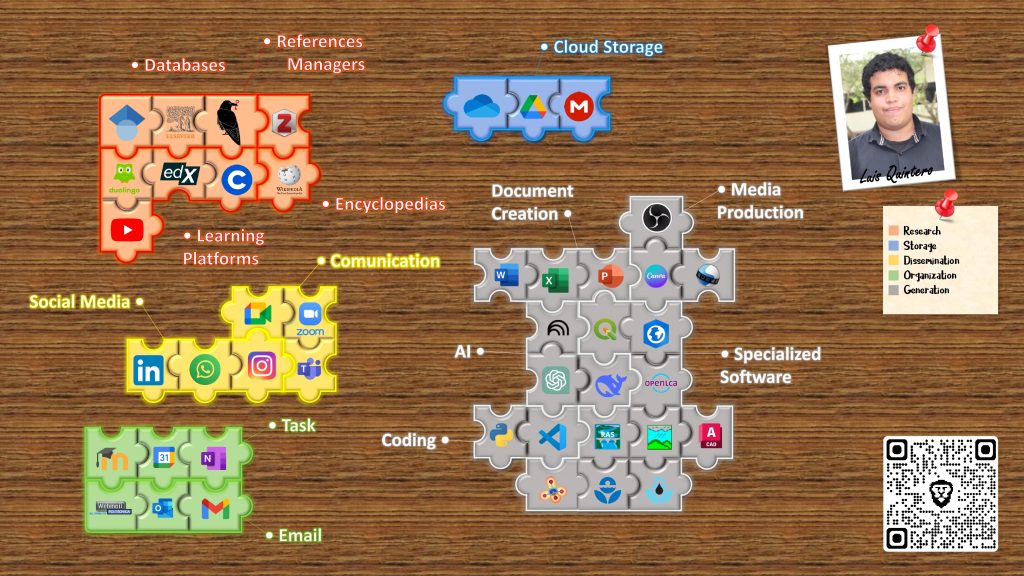
Creating my Personal Learning Environment (PLE) has been a meaningful process to reflect on how I learn and how I want to keep growing. My initial PLE represents the tools I currently use to research, organize, create, and share information. It includes resources that have supported my studies and projects so far, helping me stay informed, manage my work, and collaborate effectively.

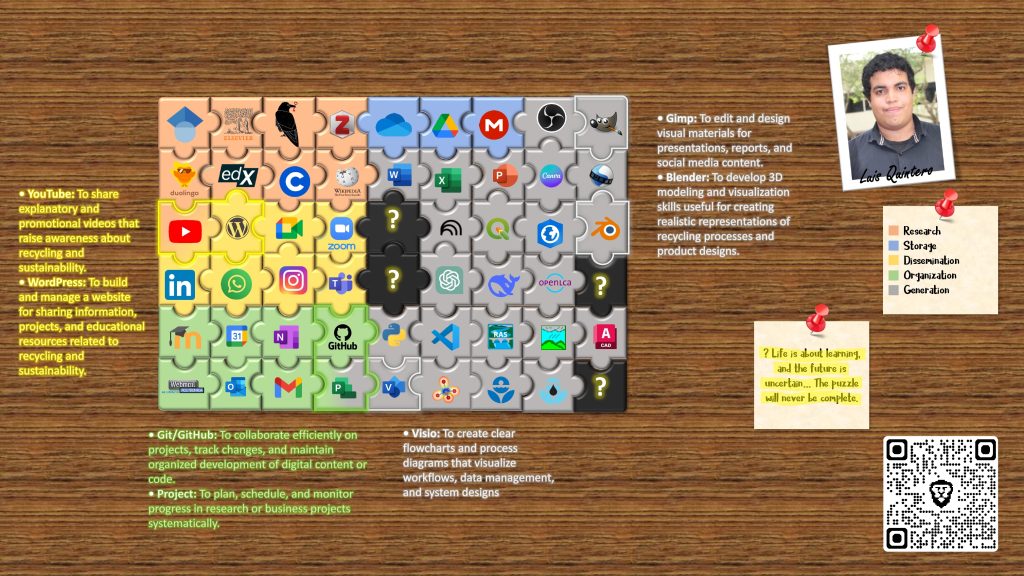
However, as I thought about my long-term academic and professional goals, I realized that my PLE could evolve to better align with the skills I want to develop and the projects I want to build. With this in mind, I redesigned my objective PLE to include tools that will strengthen my technical, creative, and organizational abilities.

For instance, I added Blender to learn 3D modeling and visualization for illustrating recycling processes, and GIMP to create and edit visuals for presentations and social media. WordPress and YouTube will help me share information and raise awareness about recycling through a website and video content. To improve project management and collaboration, I incorporated Git for version control, Microsoft Project for planning and tracking progress, and Visio for creating clear diagrams and workflows.

About LUIS ANGEL QUINTERO SERRANO

Environmental engineer passionate about creating innovative solutions that promote circular economy to drive positive change in society. My professional trajectory has focused on research, proposal development, and computational modeling in various areas of environmental engineering, especially in water resources and solid waste. I am convinced that addressing environmental challenges requires interdisciplinary collaboration and the formation of a strong network of professionals with deep knowledge in science and technology. My goal is to actively contribute to this collective effort, applying my skills and experience to generate positive impact on the environment and society as a whole.

Personal reflection on the professional future

Having watched “#MiEmpleoMiFuturo” videos, I see an urgent narrative about the future of professional life. This isn’t a distant future; it’s unfolding now, and it demands a specific mindset. The central tension is clear: technology is accelerating at an exponential rate, while our traditional models for education and career paths are struggling to keep up. This isn’t a minor adjustment; it’s a fundamental restructuring of what it means to have valuable skills and build a meaningful career.

For me, this reality is both a warning and a validation. It warns against the comfort of deep specialization in a single, static tool or methodology. The ability to simply execute a complex model or analysis is being rapidly commoditized. The value is shifting upstream, toward the ability to frame the right problems, to ask the foundational questions that these powerful tools are then unleashed to solve. My recent experience into materials science research during my first year internship feels like a direct response to this shift. Working with Density Functional Theory isn’t just about learning another software; it’s an immersion in first-principles thinking. It’s about understanding matter at its most fundamental level, which is the ultimate source of innovation and the last bastion against automation. This, coupled with my focus on the circular economy, represents my attempt to apply this same rigorous, ground-up thinking to the broken systems of our linear economy.

Furthermore, #MiEmpleoMiFuturo highlights the death of the linear career ladder and the birth of the dynamic skill portfolio. Looking at my own trajectory (from water resources in Colombia to solid-state batteries in France) I see this playing out. What might have once been viewed as a lack of focus, I now reframe as a strategic accumulation of diverse contexts. Each project, whether in hydrology, clean cooking, or air quality, has been a masterclass in a different facet of our global sustainability challenge. This breadth is not a distraction from expertise; it is the necessary context that makes deep expertise meaningful. It allows me to be a translator, someone who can connect the quantum behavior of a battery material to the macroeconomic policies needed for a circular future.

However, technical and strategic skills alone are not enough. The most critical insight from this new reality is that as machines master execution, our humanity becomes our greatest professional asset. My technical training has been robust, but I recognize a pressing need to consciously develop the “power skills” that enable true collaboration and leadership. This means moving beyond simply presenting data to truly understanding the feelings, motivations, and concerns of stakeholders, be they community members affected by a project, engineers from a different discipline, or policymakers with competing priorities. The ability to build trust, navigate resistance, and foster a shared vision is what transforms a technically sound solution into an adopted and successful one.

My path forward, therefore, is a threefold endeavor: to continue deepening my technical and strategic integration, to actively build bridges between disparate fields, and to deliberately cultivate the empathy and communication skills necessary to lead and inspire collective action. The future of work is not something that will happen to me; it is something I must actively build. By weaving together technical depth, systemic thinking, and a profound understanding of the human element, I can strive not just to adapt to the new world, but to help shape it into one that is more sustainable and equitable for all.

About LUIS ANGEL QUINTERO SERRANO

Environmental engineer passionate about creating innovative solutions that promote circular economy to drive positive change in society. My professional trajectory has focused on research, proposal development, and computational modeling in various areas of environmental engineering, especially in water resources and solid waste. I am convinced that addressing environmental challenges requires interdisciplinary collaboration and the formation of a strong network of professionals with deep knowledge in science and technology. My goal is to actively contribute to this collective effort, applying my skills and experience to generate positive impact on the environment and society as a whole.

Presentation – Luis Quintero

Hi, I’m Luis, an environmental engineer passionate about creating innovative solutions that promote circular economy to drive positive change in society. My professional trajectory has focused on research, proposal development, and computational modeling in various areas of environmental engineering, especially in water resources and solid waste. I am convinced that addressing environmental challenges requires interdisciplinary collaboration and the formation of a strong network of professionals with deep knowledge in science and technology. My goal is to actively contribute to this collective effort, applying my skills and experience to generate positive impact on the environment and society as a whole.

About LUIS ANGEL QUINTERO SERRANO

Environmental engineer passionate about creating innovative solutions that promote circular economy to drive positive change in society. My professional trajectory has focused on research, proposal development, and computational modeling in various areas of environmental engineering, especially in water resources and solid waste. I am convinced that addressing environmental challenges requires interdisciplinary collaboration and the formation of a strong network of professionals with deep knowledge in science and technology. My goal is to actively contribute to this collective effort, applying my skills and experience to generate positive impact on the environment and society as a whole.