Luis’s Digital Identity Plan

In the professional world, your digital presence should be a living ecosystem, not just a static profile. I’m building mine like a tree, nurturing its growth in engineering and sustainability.

The Roots: My Foundation

My growth is rooted in a continuous investment of time and learning, fueled by everything from academic research and AI tools to open-source software.

The Mushrooms: My Symbiotic Network

Just as mushrooms form a symbiotic network with tree roots, my growth is interconnected with a community of collaborators. This includes classmates, professors, industry professionals, and environmental NGOs, who all help exchange knowledge and create opportunities for mutual growth.

The Trunk: My Core Mission

This foundation supports my central mission: to build a strong, visible professional identity. I do this by creating a personal website, producing educational content, and ensuring my online profiles are consistently updated and interconnected.

The Sap: The Value I Offer

The core value flowing through my work is clear, accurate, and engaging content on sustainability and circular economy topics..

The Branches & Leaves: Extending My Reach

My expertise extends through branches like Circular Economy and Urban Mining, shared on channels like LinkedIn, YouTube, and my blog. The leaves represent the connections I cultivate with industries and professionals, fostering the collaborative opportunities that drive real-world impact.

Link: https://drive.google.com/file/d/16D603Cd2kVPOxsKYk_AElSgicjznqGos/view?usp=sharing

About LUIS ANGEL QUINTERO SERRANO

Environmental engineer passionate about creating innovative solutions that promote circular economy to drive positive change in society. My professional trajectory has focused on research, proposal development, and computational modeling in various areas of environmental engineering, especially in water resources and solid waste. I am convinced that addressing environmental challenges requires interdisciplinary collaboration and the formation of a strong network of professionals with deep knowledge in science and technology. My goal is to actively contribute to this collective effort, applying my skills and experience to generate positive impact on the environment and society as a whole.

🌍 The Week: From Fear to Responsibility

🌿 The Week is a three-part journey that takes us down into the reality of the climate and social crisis, leaves us for a moment in that uncomfortable space, and then invites us to imagine how we want to live and act in the future. It is built like a U: we start with facts and emotions, we go through confusion and questions, and we come back up with a different sense of responsibility.

━━━ ✿ ✧ ⋆ 。˚ ⋆ ✧ ✿ ━━━

🌈 Our group perception of The Week

We are four people with very different stories, so it would be natural for us to see things differently.

🌊 One of us grew up with annual floods that now hit even the wealthiest areas, ☀️ another with Mediterranean summers that already feel like ovens, 📰 a third in a country that talks a lot about climate but rarely feels it directly, 🕊️ and me, who grew up in a post-communist country where living with very little was still normal in my early years.

I was probably the most emotional one in the group 💧, while others felt the tone was too dramatic and preferred more data, nuance and concrete numbers.

The turning point in our discussion came when we started comparing our real experiences. For some of us, climate change is still something mostly seen in graphs and news headlines; for others, it already means flooded homes, unbearable summers or damaged ecosystems. Realizing this contrast made us understand that what some call a “future risk” is already everyday reality for many people.

🌱 But we all agreed on one point: the crisis is real, and it is already here.

What united all these ideas was the wish to be useful, not just successful. It reminded us that the SDGs are not only about technology, but also about the kind of people and societies we want to become.

Behind all our reactions to The Week, the real question was who actually drives change: individuals or systems? Individual action alone mostly reduces guilt, while systemic change without people pushing for it will never arrive. They are not alternatives; they are two sides of the same strategy.
Profit is not ‘automatically’ the enemy, but profit that relies on destroying ecosystems or deepening inequality cannot last. The same economic model that is pushing us beyond planetary boundaries is also the one that is emptying the middle class, widening within-country inequality, and making young people postpone or completely abandon the idea of having children.

🌡️ Consumerism is not only cooking the planet; it is cooking our mental health and our hope for the future at the same time.

Any real solution must respect planetary limits and protect social foundations. The week invites us to rethink what “development” really means and what kind of future we want to create as earth citizens.

━━━ ✿ ✧ ⋆ 。˚ ⋆ ✧ ✿ ━━━

🌱 2. My own critical reflection

For me, watching The Week felt like looking at the world and at myself in a mirror at the same time. On one side, I saw the big picture: rising temperatures, social tensions, damaged ecosystems, and a model of endless growth that is simply impossible on a finite planet. On the other side, I saw my own story: a young industrial and environmental chemist, just entering the field of circular economy, trying to find her place between fear and action.

I appreciated that the series did not stay only on the level of “save the polar bears” or “take shorter showers”. It tried to show how our economic system, our food systems, and our cultural idea of a “good life” are all connected. From my point of view, individual choices are important, but not enough. If we only tell people to recycle, eat less meat or buy less, while large structures remain unchanged, we create frustration and guilt more than real transformation.

This is where the SDG framework helps me to think more clearly. The goals remind us that sustainability is systemic: climate (SDG 13) is tied to energy (SDG 7), cities (SDG 11), health (SDG 3), inequality (SDG 10) and responsible production and consumption (SDG 12).
As someone who is moving towards a career in circular solutions, I feel called to work not only on “less waste” but also on better design, fairer value chains and long-term health for people and ecosystems.

The videos made me realize something else: the dominant economic story of the last decades: endless growth on a finite planet! It is not only disconnected from ecological reality, but also mentally draining. We were promised that more stuff would make us happy. Instead, we got burnout. It is coming a generation delaying having children because “how can I bring a child into this world?”. If we want a different future, we have to rewrite this story together.

🌿 The “Story of More” is literally eating the future.

I do not know exactly which job title I will have, but I know that I do not want to be “just another brick in the wall”. I want to contribute to a transition where science, policy and daily life move in the same direction.

━━━ ✿ ✧ ⋆ 。˚ ⋆ ✧ ✿ ━━━

🌸 3. Inner Development Goals: who I need to become

The Inner Development Goals bring a deeper, more personal dimension to this reflection. They suggest that deep change in the world also requires inner change in people: in how we are, think, relate, collaborate and act.

When I think about Being, I recognize myself in an openness and learning mindset: I am genuinely curious, and I am ready to update my views when I meet new information or perspectives. In the area of Thinking, I feel close to perspective skills: I naturally try to see issues from different sides: Global North and South, present and future, individual and system, which protects me from simplistic solutions.

In terms of Relating, I notice that my heart is soft: empathy, compassion and a sense of connectedness come quite naturally to me, even if forgiveness is sometimes difficult. Still, I know that holding anger forever does not help. For Collaborating, I rely a lot on my communication and mobilization skills. I like to listen, to create understanding between people, and to encourage others when they hesitate. Finally, in the dimension of Acting, I want to cultivate courage, hope, optimism and a proactive attitude. The future can look dark, but if I lose hope, I also lose my ability to contribute.

Taken together, these inner qualities are not separate from my professional path; they are part of it.

The Week did not give me a list of perfect solutions, but it helped me see the kind of person I want to be in this transition: an earth citizen who thinks in the long term, who cares about both people and planet, and who is willing to act, even when the balance is hard and the outcome is uncertain.

In 2050 I will be 55. I do not know if the world will be cooler, fairer, or more beautiful than today. What I do know is that the direction we take will be decided by the small and large choices of people who are alive right now, people like us.

🌱 So, this is my promise, written publicly so I cannot quietly forget it:

I choose the better story. Not because it is easy or guaranteed to win. But because it is the only story worth telling to the future generation who will ask us, one day,

💙 “What did you do, back when there was still time?”

~ Dea ♡ November 2025

            ━━━ ✿ May we all choose the better story together ✿ ━━━

About DEA ZAKOLLI

Hi! I’m an Industrial & Environmental Chemist (B.Sc. + M.Sc., Albania) with five years experience in the mining industry. In 2024 I began a Master in Advanced Materials & Circular Economy in Madrid to go deeper into life-cycle assessment, materials recovery, and circular process design. I combine careful lab work with a practical mindset and I’m excited to keep growing. My goal is simple: use solid data to improve efficiency and build more circular, real-world solutions. Open to collaborations and roles where analytical excellence meets circular innovation.

Luis’s Personal Learning Environment

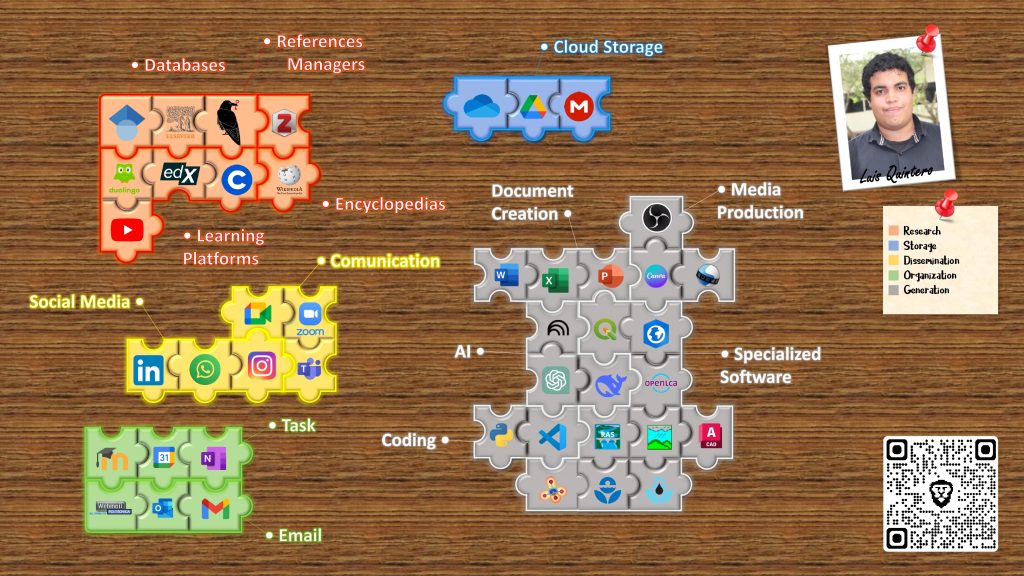
Creating my Personal Learning Environment (PLE) has been a meaningful process to reflect on how I learn and how I want to keep growing. My initial PLE represents the tools I currently use to research, organize, create, and share information. It includes resources that have supported my studies and projects so far, helping me stay informed, manage my work, and collaborate effectively.

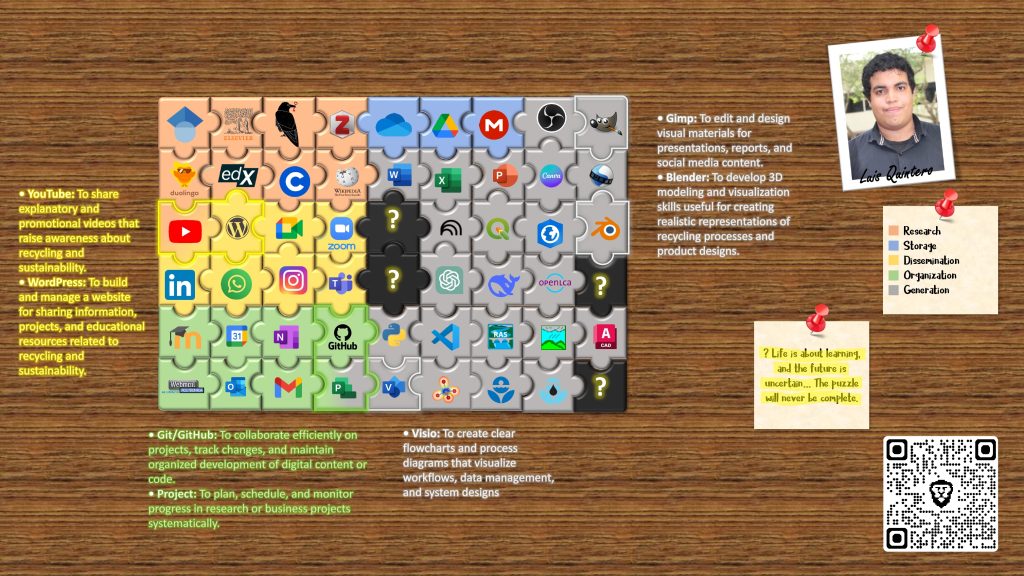
However, as I thought about my long-term academic and professional goals, I realized that my PLE could evolve to better align with the skills I want to develop and the projects I want to build. With this in mind, I redesigned my objective PLE to include tools that will strengthen my technical, creative, and organizational abilities.

For instance, I added Blender to learn 3D modeling and visualization for illustrating recycling processes, and GIMP to create and edit visuals for presentations and social media. WordPress and YouTube will help me share information and raise awareness about recycling through a website and video content. To improve project management and collaboration, I incorporated Git for version control, Microsoft Project for planning and tracking progress, and Visio for creating clear diagrams and workflows.

About LUIS ANGEL QUINTERO SERRANO

Environmental engineer passionate about creating innovative solutions that promote circular economy to drive positive change in society. My professional trajectory has focused on research, proposal development, and computational modeling in various areas of environmental engineering, especially in water resources and solid waste. I am convinced that addressing environmental challenges requires interdisciplinary collaboration and the formation of a strong network of professionals with deep knowledge in science and technology. My goal is to actively contribute to this collective effort, applying my skills and experience to generate positive impact on the environment and society as a whole.

Personal reflection on the professional future

Having watched “#MiEmpleoMiFuturo” videos, I see an urgent narrative about the future of professional life. This isn’t a distant future; it’s unfolding now, and it demands a specific mindset. The central tension is clear: technology is accelerating at an exponential rate, while our traditional models for education and career paths are struggling to keep up. This isn’t a minor adjustment; it’s a fundamental restructuring of what it means to have valuable skills and build a meaningful career.

For me, this reality is both a warning and a validation. It warns against the comfort of deep specialization in a single, static tool or methodology. The ability to simply execute a complex model or analysis is being rapidly commoditized. The value is shifting upstream, toward the ability to frame the right problems, to ask the foundational questions that these powerful tools are then unleashed to solve. My recent experience into materials science research during my first year internship feels like a direct response to this shift. Working with Density Functional Theory isn’t just about learning another software; it’s an immersion in first-principles thinking. It’s about understanding matter at its most fundamental level, which is the ultimate source of innovation and the last bastion against automation. This, coupled with my focus on the circular economy, represents my attempt to apply this same rigorous, ground-up thinking to the broken systems of our linear economy.

Furthermore, #MiEmpleoMiFuturo highlights the death of the linear career ladder and the birth of the dynamic skill portfolio. Looking at my own trajectory (from water resources in Colombia to solid-state batteries in France) I see this playing out. What might have once been viewed as a lack of focus, I now reframe as a strategic accumulation of diverse contexts. Each project, whether in hydrology, clean cooking, or air quality, has been a masterclass in a different facet of our global sustainability challenge. This breadth is not a distraction from expertise; it is the necessary context that makes deep expertise meaningful. It allows me to be a translator, someone who can connect the quantum behavior of a battery material to the macroeconomic policies needed for a circular future.

However, technical and strategic skills alone are not enough. The most critical insight from this new reality is that as machines master execution, our humanity becomes our greatest professional asset. My technical training has been robust, but I recognize a pressing need to consciously develop the “power skills” that enable true collaboration and leadership. This means moving beyond simply presenting data to truly understanding the feelings, motivations, and concerns of stakeholders, be they community members affected by a project, engineers from a different discipline, or policymakers with competing priorities. The ability to build trust, navigate resistance, and foster a shared vision is what transforms a technically sound solution into an adopted and successful one.

My path forward, therefore, is a threefold endeavor: to continue deepening my technical and strategic integration, to actively build bridges between disparate fields, and to deliberately cultivate the empathy and communication skills necessary to lead and inspire collective action. The future of work is not something that will happen to me; it is something I must actively build. By weaving together technical depth, systemic thinking, and a profound understanding of the human element, I can strive not just to adapt to the new world, but to help shape it into one that is more sustainable and equitable for all.

About LUIS ANGEL QUINTERO SERRANO

Environmental engineer passionate about creating innovative solutions that promote circular economy to drive positive change in society. My professional trajectory has focused on research, proposal development, and computational modeling in various areas of environmental engineering, especially in water resources and solid waste. I am convinced that addressing environmental challenges requires interdisciplinary collaboration and the formation of a strong network of professionals with deep knowledge in science and technology. My goal is to actively contribute to this collective effort, applying my skills and experience to generate positive impact on the environment and society as a whole.

Personal Reflection on Professional Future

Activity 5: Personal Reflection – Shah Saud

About SHAH SAUD

Hi! I am Shah. Professionally, I like to exist in the intersection of materials and circularity. Currently pursuing a Master’s in Advance Materials Innovative Recycling at Universidad Politécnica de Madrid (UPM). Outside my professional sphere, you will find me chasing sunsets, travelling to lesser-known destinations and making a mean carrot cake.

Presentation – Luis Quintero

Hi, I’m Luis, an environmental engineer passionate about creating innovative solutions that promote circular economy to drive positive change in society. My professional trajectory has focused on research, proposal development, and computational modeling in various areas of environmental engineering, especially in water resources and solid waste. I am convinced that addressing environmental challenges requires interdisciplinary collaboration and the formation of a strong network of professionals with deep knowledge in science and technology. My goal is to actively contribute to this collective effort, applying my skills and experience to generate positive impact on the environment and society as a whole.

About LUIS ANGEL QUINTERO SERRANO

Environmental engineer passionate about creating innovative solutions that promote circular economy to drive positive change in society. My professional trajectory has focused on research, proposal development, and computational modeling in various areas of environmental engineering, especially in water resources and solid waste. I am convinced that addressing environmental challenges requires interdisciplinary collaboration and the formation of a strong network of professionals with deep knowledge in science and technology. My goal is to actively contribute to this collective effort, applying my skills and experience to generate positive impact on the environment and society as a whole.

My Digital Identity

Below, I present my digital identity plan, where I aim to strengthen my professional and academic presence. My goal is to continue growing in areas such as ceramic materials, data science, and circular economy, while building a strong network to support my development. Here, I share the strategies, resources, and activities I am implementing to achieve my goals and establish my identity in the digital environment. https://drive.google.com/file/d/1VDnEUdUkPNYh_I55hnjJNxlnX4WAUF4i/view?usp=sharing

About DAVID DUARTE NIETO

Hello! I am David Duarte, I was born in Colombia, but I grew up in Venezuela. I work in the field of materials and their potential in the construction world. I'm currently studying a master's degree in advanced recycling of materials, a path that brings me closer to the goal of contributing to a more sustainable world. I like being in contact with nature. If I can overcome laziness, I like hiking and mountaineering. At home, I usually read manga and watch Japanese animation, a culture that awakens a lot of curiosity and admiration in me. I also enjoy exploring the gastronomy of each new place I visit.

My professional future

Reflecting on my professional future through the lens of Yuval Noah Harari’s insights, it’s clear that the rapid development of AI is reshaping the landscape of work and society. In a recent conversation between Harari and a program leader, he emphasized the paramount importance of adaptability and flexibility in career planning. As an engineering student, this advice resonates deeply. The notion that specific job roles could quickly become obsolete as AI systems advance requires an adaptable mindset—one ready to pivot and embrace new opportunities and skill sets as they emerge.

Harari argues that in a world dominated by technological progress, the ability to learn, unlearn, and relearn is not just valuable but essential. This perspective underscores the importance of cultivating a mentality that is open to constant change, where being attached to a singular career path might be limiting. Instead, I need to prioritize versatility, developing a toolkit of skills that allows me to shift roles or approaches seamlessly as AI begins to fill more technical and repetitive positions in engineering and beyond.

The ability to grasp new frameworks and adjust to different sets of rules quickly will be a competitive advantage. For an engineer like me, this might mean going beyond traditional training and incorporating interdisciplinary knowledge, such as data science, ethical AI considerations, and circular economy principles, into my expertise. This adaptability, coupled with ongoing learning, aligns with Harari’s prediction that the future belongs to those who can navigate the interplay between technology and human creativity.

To prepare for a career in this dynamic landscape, I need to stay proactive in identifying emerging trends and be ready to re-skill when necessary. Embracing this mindset will ensure that my work remains relevant and impactful in an era where technological development is both a challenge and an opportunity.

Avatar photo

About OSCAR LINDBERG AUGESTAD

Innovative Sustainability Expert | MSc Candidate in Advanced Materials: Innovative Recycling Erasmus Mundus Program | Experienced Analyst in Renewable Energy & Environmental Sustainability Solutions

A Personal Reflection on my Professional Future

Reflecting on Yuval Noah Harari’s insights in “The Two Most Important Skills for the Rest of Your Life” brought both excitement and introspection about where technology is taking us—and where it leaves me as a Material Engineer with a passion for sustainability and circular economy principles.

Harari introduces a future where human “hackability” isn’t science fiction. It’s about algorithms and AI understanding our choices before we do, predicting what we want or need next, and shifting our interactions with the world. This idea sparked a personal question: How will this AI-driven insight affect industries where sustainability and resource efficiency are key? Could AI predict not just material needs but also the most sustainable approaches to sourcing, lifecycle, and waste reduction? As exciting as these advancements sound, they come with ethical implications, particularly in sustainability fields where transparency is critical.

For me, this means adaptability isn’t just nice to have—it’s essential. Harari points out that, beyond technical expertise, we’ll need emotional resilience to pivot with each wave of change. As someone in a field rooted in problem-solving and environmental responsibility, I see this as a call to embrace lifelong learning. Today, I might be refining recycling processes; tomorrow, I could be collaborating with AI to discover the next best circular materials.

In a world where technical skills alone might not keep pace, I believe developing emotional intelligence will be my biggest advantage. It will help me stay grounded, stay curious, and ultimately, stay human in a world driven by technology. Harari’s message has deepened my commitment to sustainability and reinforced that adaptability and self-awareness aren’t just “soft skills” but vital tools in building a resilient, meaningful career.

Avatar photo

About LAIBA ZAHID

A materials engineer specializing in advanced recycling and circular economy, currently pursuing a Master's in Circular Economy for Minerals and Construction Products at Universidad Politécnica de Madrid.