Moving Beyond “Take-Make-Waste”: My Experience with the Circular Economy MOOC

Over the past few weeks, I completed a course called “Circular Economy: An Introduction,” offered by Delft University of Technology (TU Delft). It was an eye-opening experience that challenged the way I look at every product I own, from my phone to my jeans.

Since the goal of this blog is to share our achievements in this Master degree and how I fit a university course into my schedule, I wanted to share exactly what a MOOC is and why I recommend this specific one.

First things first: What is a MOOC?

If you haven’t taken one before, MOOC stands for Massive Open Online Course. It’s a model of learning that has democratized education in a pretty incredible way.

  • Massive: Unlike a normal classroom with 30 students, these courses can have thousands of participants from all over the world learning together.
  • Open: You don’t need to apply or be a registered student at the university. Most MOOCs allow you to “audit” the material for free, meaning you can watch the lectures and read the materials without paying a cent (though you can pay a fee if you want a verified certificate for your LinkedIn).
  • Online: Everything happens virtually. You watch video lectures, take quizzes, and discuss topics in forums on platforms like edX (where I took this course), Coursera, or Udacity.

It is a fantastic way to upskill without the pressure or cost of a traditional degree.

Course Review: Circular Economy – An Introduction

Provider: Delft University of Technology (TU Delft) Platform: edX Duration: Approx. 7 Weeks

This course wasn’t just about recycling; it was a deep dive into why our current economic model is broken and how we can fix it.

The Core Concept: Linear vs. Circular The course starts by explaining our current “Linear Economy”, the “take-make-waste” model where we extract resources, turn them into products, use them for a short time, and then throw them away.

The Circular Economy, by contrast, is restorative by design. The goal is to keep materials and products in use for as long as possible. A key framework used in the course is the “Butterfly Diagram” (developed by the Ellen MacArthur Foundation), which visualizes two distinct cycles:

  1. The Biological Cycle: Food and bio-based materials that can safely return to nature (composting).
  2. The Technical Cycle: Metals, plastics, and synthetics that should circulate through reuse, repair, and remanufacturing.

Key Takeaways from the Modules

The course is broken down into “Episodes,” and here were my biggest highlights:

  • Business Value: This was surprising. The course argues that circularity isn’t just “nice to have”, it’s profitable. We looked at business models like “Product-as-a-Service,” where companies sell you the performance of a product (like light or mobility) rather than the product itself. This incentivizes them to make things that last longer, rather than things that break easily.
  • Remanufacturing vs. Recycling: I learned that recycling should actually be the last resort. It takes a lot of energy to melt down a product. It is much better to repair or remanufacture (refurbish to like-new condition) because it preserves the value and energy already put into the product.
  • Waste = Food: Inspired by nature, this module taught that in a true circular system, waste doesn’t exist. Everything becomes “food” or input for the next stage of the cycle.

Final Thoughts

This MOOC did a great job of blending engineering, design, and business strategy. It helps you see the “system” behind the products. You stop seeing a broken toaster as trash and start seeing it as a design flaw, why wasn’t it made to be easily repaired?

If you are interested in sustainability, design, or just want to understand the future of business, I highly recommend checking it out.

Have you ever taken a MOOC ? Let me know in the comments !

Avatar photo

About VICTOR HERMEZ

Hey ! I am Victor Hermez from Bordeaux, France. I hold a bachelor's degree in Chemistry. Currently, I am pursuing my Master in Advanced Materials and Innovative Recycling (AMIR). My academic and research interests focus more on metals for automotive and aeronautic industry, hydrometallurgy for recycling of batteries, new processes and innovations. Outside academics, I am found of hiking, traveling and challenging myself through sports. Through my travels, I love discovering nature and animals.
Improved Digital Identity

Welcome to the next phase of my professional journey.

I have recently engaged in a deep restructuring of my personal brand, resulting in a new Digital Identity Plan. This document does more than just update my profile ; it redefines the standards I am setting for my future career in materials science. It reflects a comprehensive upgrade in how I approach sustainability challenges and technical innovation.

You can discover the full breakdown of my new goals and upcoming projects here. I am eager to hear your thoughts—please feel free to share your feedback !

Corrected DI.pptx

Avatar photo

About VICTOR HERMEZ

Hey ! I am Victor Hermez from Bordeaux, France. I hold a bachelor's degree in Chemistry. Currently, I am pursuing my Master in Advanced Materials and Innovative Recycling (AMIR). My academic and research interests focus more on metals for automotive and aeronautic industry, hydrometallurgy for recycling of batteries, new processes and innovations. Outside academics, I am found of hiking, traveling and challenging myself through sports. Through my travels, I love discovering nature and animals.
The week experience – by Victor Hermez

A three-episode journey like The Week can shift climate change from an abstract concern to a lived, collective reckoning that invites clearer thinking, grounded emotions, and concrete next steps in daily life and community roles. Experiencing the “U‑shaped” arc : facing difficult facts, making sense of them together, and rising into agency. From my point of view, this experience helps transform overwhelm into motivation and shared commitment to action at home, work, and in social circles.​

Let me make a quick recap on what we have seen and what did it bring personnally.

1st : Facing reality

The first episode’s descent into the hard truths of environmental breakdown surfaces fear, grief, and even denial. These feelings, many people instinctively avoid them, when climate headlines feel too overwhelming. The most difficult step perhaps is to name these emotions and try to normalize them. This create emotional capacity for honest appraisal and choices going forward.​

2nd : Making meaning together

The second episode’s aim is to reframe climate data within personal values and social context, enabling participants, such as me, to connect facts with what they love and want to protect. Structured dialogue help translate raw concern into clarity about risks, responsibilities, and spheres of influence, which is why the conversation is considered “the heart of the experience”.​ Indeed the conversation were really meaningful to me, it felt like a “safe place” to express ourself and everyone really played the game.

3rd : From concern to agency

The final episode is designed to restore “hope”. There is a shifting from individual eco‑anxiety to collective impacts through examples, next‑step ideas, and the social recognition that comes from acting together. I was feeling relieved and even energized after moving through the hardest material, because agency and community reduce isolation and helplessness. It was the same as the people interviewed inside the movies.​

What did it bring personally ?

I understood that this experience is different for everyone. Here I will share my personnal thoughts. This topic of climate change is not new for me, but it did gave me lived concern by guiding a journey from difficult facts to shared meaning and then to doable next steps with others. The fact that we all shared it together with the class created trust and accountability, making the conversations the emotional core that turned concern into motivation.​ This point is really what made for “The Week Experience” really enjoyable and a grateful moment.

About my purpose

As of right now I can choose one or two high‑impact changes in my daily life and studies and also inviting a small circle to do them with me. This journey showed me that honest dialogue, supportive community, and regular reflection can transform concerns into durable agency that protects what and who I love. I also seek more informations through other kind of activities like this one ; I would like to know more to help me establish feasible goal for the future and reach my true purpose. This question of “what is my purpose ?” is a question that, in my opinion, should be asked throughout all your life. I do seek with my current studies to work in a field that aims to do good for the planet. I would like to be able to do something even at my scale and put into light what I learned through my years of studies to past, present and future generations.

Avatar photo

About VICTOR HERMEZ

Hey ! I am Victor Hermez from Bordeaux, France. I hold a bachelor's degree in Chemistry. Currently, I am pursuing my Master in Advanced Materials and Innovative Recycling (AMIR). My academic and research interests focus more on metals for automotive and aeronautic industry, hydrometallurgy for recycling of batteries, new processes and innovations. Outside academics, I am found of hiking, traveling and challenging myself through sports. Through my travels, I love discovering nature and animals.

Video presentation – Victor Hermez

This work was really interesting. It was in my opinion difficult to resume my “life” in one minute and saying what I wanted to say. It was a first try and I hope to improve in the future. Also I didn’t know but having the camera right in front of us and filming can be weird at the beggining.

Sorry for the quality, when publishing on YouTube the video was not high quality. If you have any idea on how to solve this issue let me know !

Here is the link to my quick presentation : https://youtube.com/shorts/cs8yhEL9hr0

Avatar photo

About VICTOR HERMEZ

Hey ! I am Victor Hermez from Bordeaux, France. I hold a bachelor's degree in Chemistry. Currently, I am pursuing my Master in Advanced Materials and Innovative Recycling (AMIR). My academic and research interests focus more on metals for automotive and aeronautic industry, hydrometallurgy for recycling of batteries, new processes and innovations. Outside academics, I am found of hiking, traveling and challenging myself through sports. Through my travels, I love discovering nature and animals.

PLE – Victor Hermez

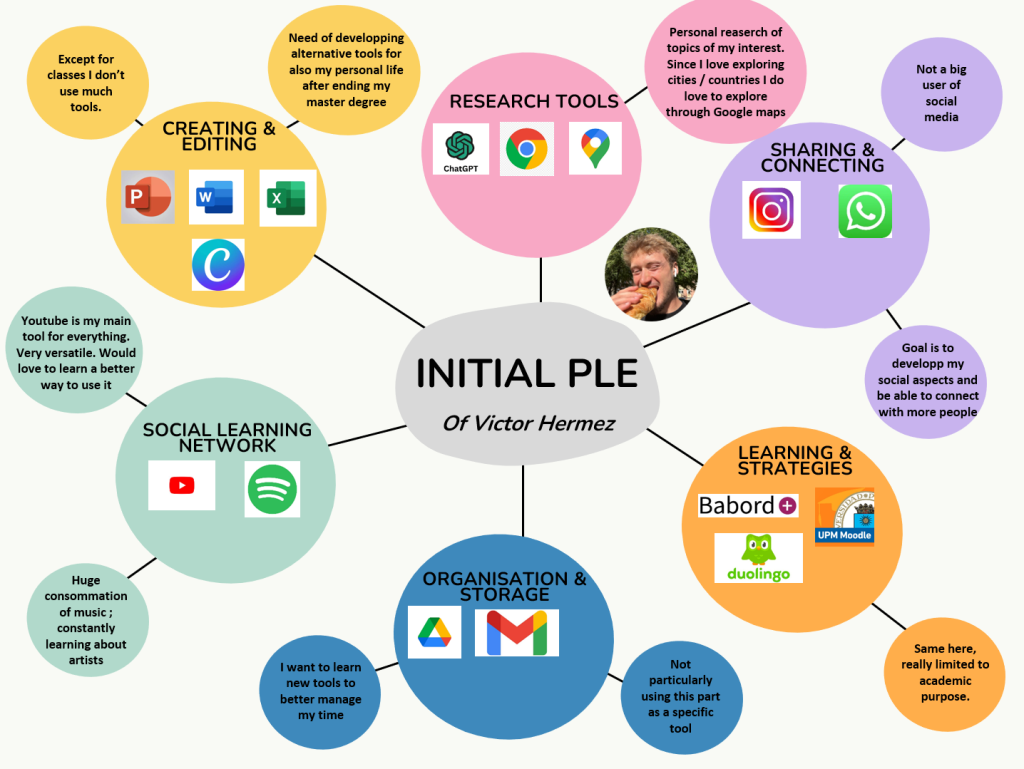
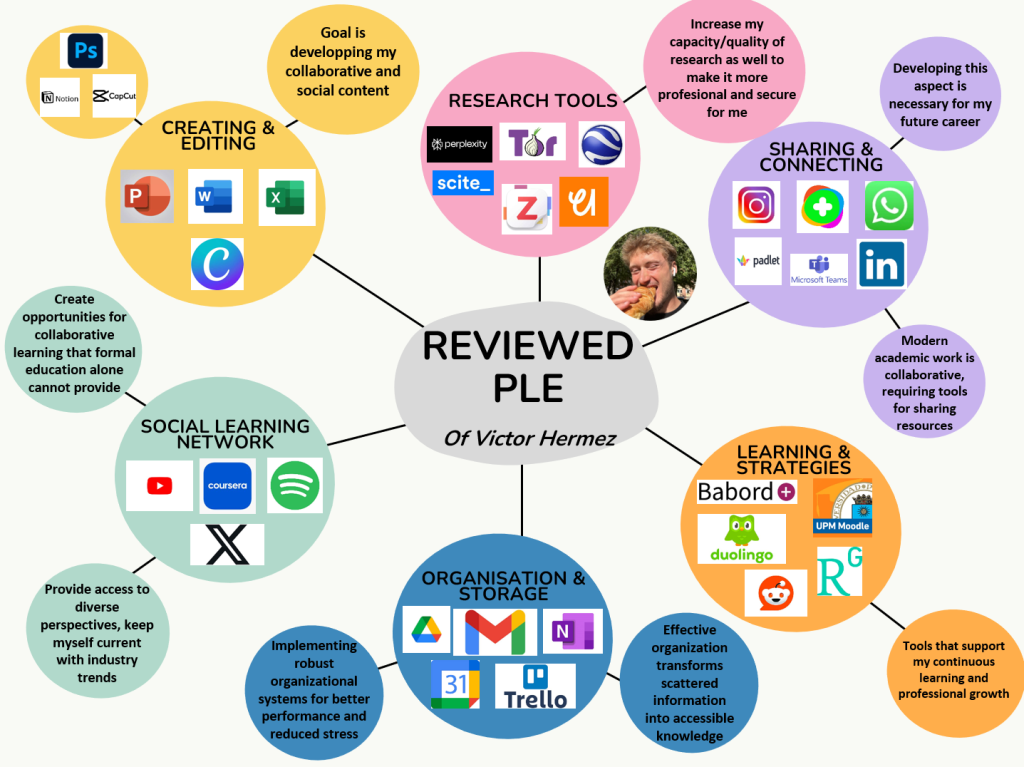
As a Master’s student in Advanced Materials Recycling and Innovation, building a robust Personal Learning Environment (PLE) is essential for academic success and professional development. I aimed six critical domains of my learning ecosystem and after a first draft (Initial PLE) I checked interesting tools from my classmates, past students, or even internet to actually learn about new tools that would be useful for my future. That’s where I came with my Reviewed PLE. Hope you enjoyed and let me know !

Avatar photo

About VICTOR HERMEZ

Hey ! I am Victor Hermez from Bordeaux, France. I hold a bachelor's degree in Chemistry. Currently, I am pursuing my Master in Advanced Materials and Innovative Recycling (AMIR). My academic and research interests focus more on metals for automotive and aeronautic industry, hydrometallurgy for recycling of batteries, new processes and innovations. Outside academics, I am found of hiking, traveling and challenging myself through sports. Through my travels, I love discovering nature and animals.

Personal reflection on the professional future

The professional future in Advanced Materials Recycling and Innovation is full of dynamic possibilities, driven by rapid technological change, evolving regulations, and society’s increasing focus on sustainability. As a Master student in this field, it is important to reflect on these trends and your potential role in shaping them.​

The recycling industry is experiencing a revolution through advanced technologies like chemical recycling, AI-based sorting and automation. These innovations make it possible to recycle complex and contaminated materials into high-quality raw materials for use in crucial industries such as food packaging, medical devices and manufacturing. For those with expertise in materials science, opportunities are emerging to work on processes like depolymerization, enzymatic recycling and solvent-based dissolution, all of which can dramatically increase recycling efficiency and material recovery rates.​

There is a major industry push towards the circular economy, where waste is redefined as a resource and closed-loop systems maximize material reuse and recovery. Professionals entering the workforce will contribute by developing biodegradable materials, designing for recyclability from the outset, and creating systems for life-cycle assessment and remanufacturing. Integrating these practices will be vital in meeting increasingly stringent regulatory standards and helping companies achieve recycled content mandates.​

The job market in recycling and waste management is expanding significantly as companies and governments invest more in sustainability. This trend translates into diverse career paths ranging from R&D and process engineering to regulatory compliance and project management. The industry’s impact goes far beyond technology, it offers the opportunity to genuinely improve global resource use, contribute to environmental stewardship, and address some of society’s most pressing challenges like climate change and resource scarcity.​

I am pursuing a career in Advanced Materials Recycling which places at the center of global innovation and societal transformation. I want to use scientific expertise to solve real-world problems, collaborate across disciplines, and help steer the world toward a more sustainable future. My future contributions could include developing new materials, optimizing recycling processes, or redefining business models to make industry more circular and resource-efficient.​ Entering this profession means choosing to be part of progress. It promises challenges, continual learning, and the satisfaction of meaningful impact, a future where science meets sustainability for the benefit of all.​

Avatar photo

About VICTOR HERMEZ

Hey ! I am Victor Hermez from Bordeaux, France. I hold a bachelor's degree in Chemistry. Currently, I am pursuing my Master in Advanced Materials and Innovative Recycling (AMIR). My academic and research interests focus more on metals for automotive and aeronautic industry, hydrometallurgy for recycling of batteries, new processes and innovations. Outside academics, I am found of hiking, traveling and challenging myself through sports. Through my travels, I love discovering nature and animals.

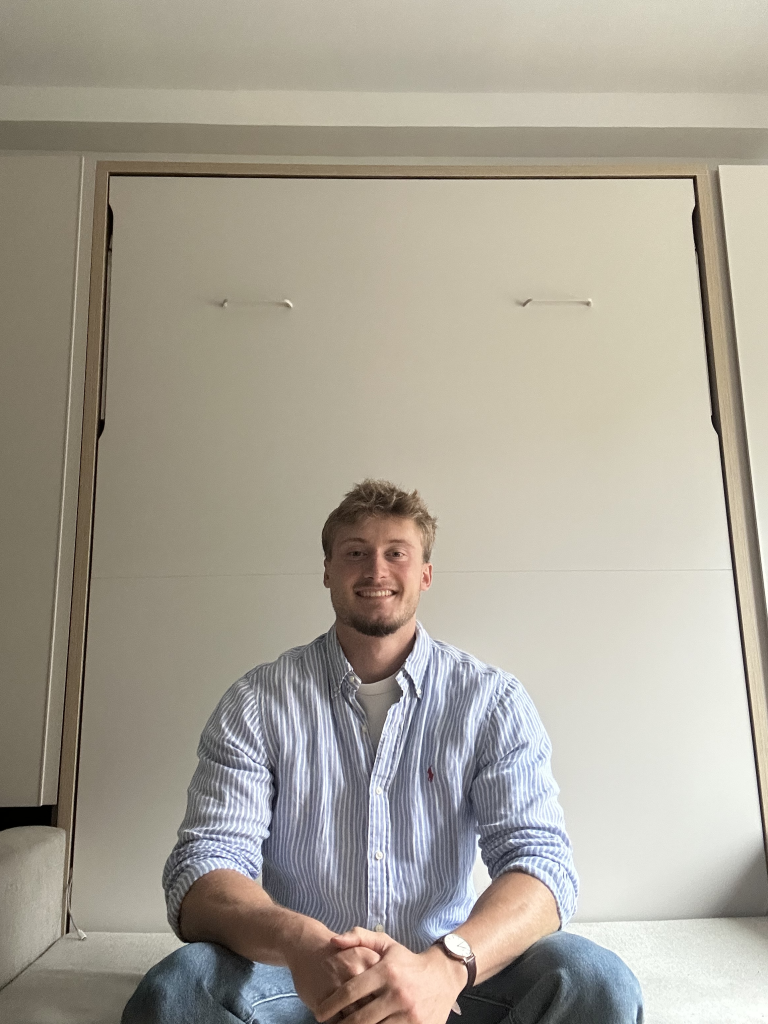
Student Presentation – Victor Hermez

Hey ! I am Victor Hermez from Bordeaux, France. I hold a bachelor’s degree in Chemistry. Currently, I am pursuing my Master in Advanced Materials and Innovative Recycling (AMIR). My academic and research interests focus more on metals for automotive and aeronautic industry, hydrometallurgy for recycling of batteries, new processes and innovations. Outside academics, I am found of hiking, traveling and challenging myself through sports. Through my travels, I love discovering nature and animals.

Avatar photo

About VICTOR HERMEZ

Hey ! I am Victor Hermez from Bordeaux, France. I hold a bachelor's degree in Chemistry. Currently, I am pursuing my Master in Advanced Materials and Innovative Recycling (AMIR). My academic and research interests focus more on metals for automotive and aeronautic industry, hydrometallurgy for recycling of batteries, new processes and innovations. Outside academics, I am found of hiking, traveling and challenging myself through sports. Through my travels, I love discovering nature and animals.