🌿 Inside My Personal Learning Environment (PLE)

Welcome to a little tour inside my learning world!

ā€œMost of my learning doesn’t happen in a single classroom or library anymore. It happens between my desk at home, my laptop, a list of digital tools, and the people I collaborate with every day. All of this together forms what we call a ā€œPersonal Learning Environment (PLE).ā€

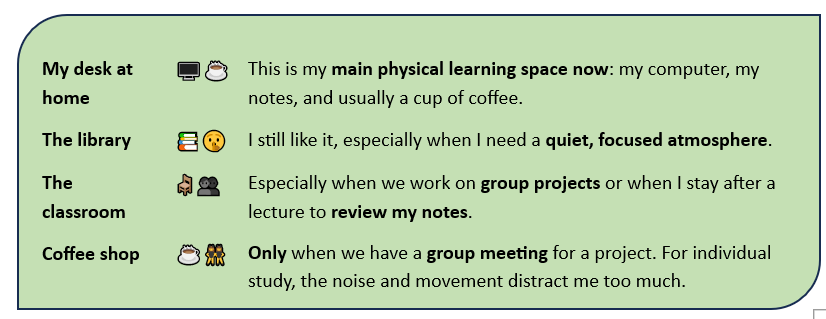
šŸ” Where my learning actually happens:

šŸ”” This is a good reminder that learning environments are very personal: what works for one student might not work for another.

šŸ› ļø What’s Inside My PLE?

(Beyond these physical spaces, my PLE also includes a set of digital tools that I rely on every day.)

 1. Learning & Research

When I start exploring a new topic:
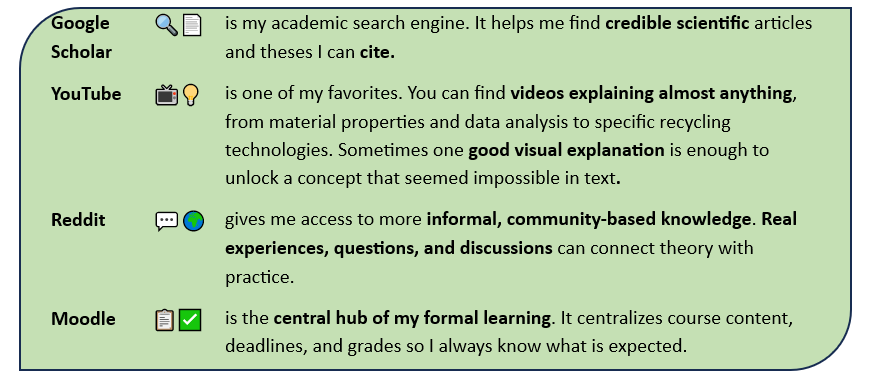
Together, these tools let me move between academic literature, visual explanations, and real-world discussions.

2. Note-Taking & Organization

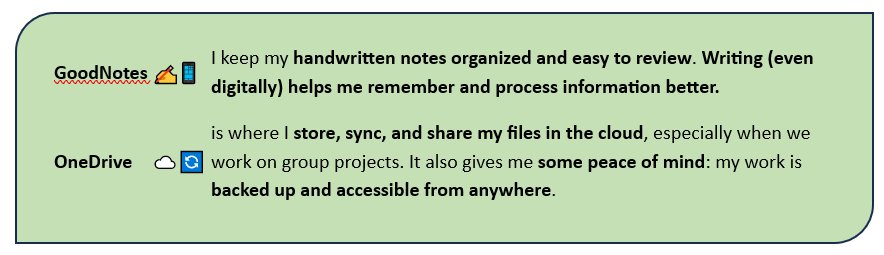
Collecting information is only useful if I can organize it:
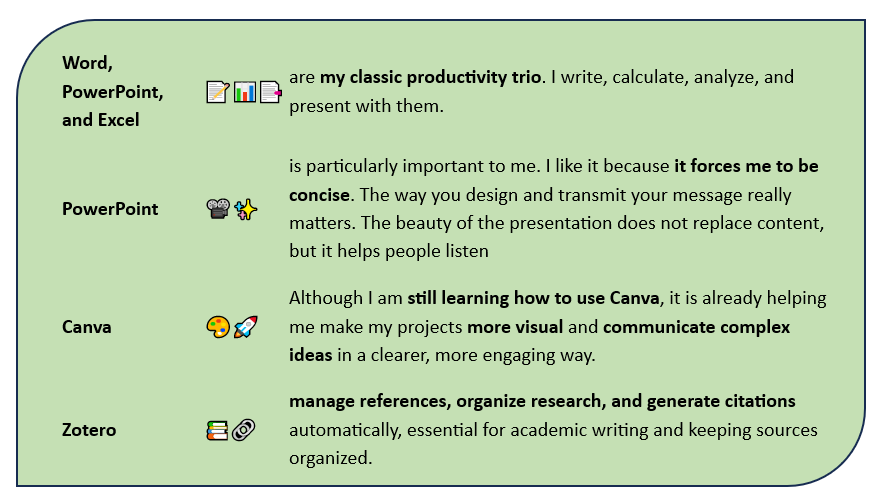
3. Creation & Productivity

In my Master, a lot of our learning happens through presentations and reports:
4. AI & Digital Support

We are now fully in the AI era, and my PLE is starting to reflect that.

I use AI tools to:
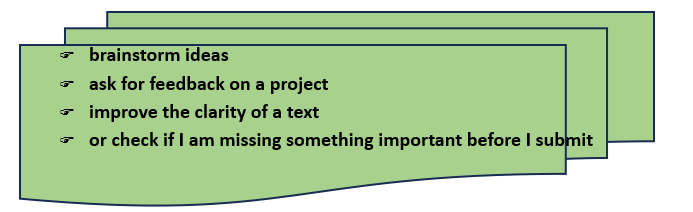
For example, when I finish a report or a presentation, I like to discuss it with an AI and ask for suggestions: ā€œIs my structure clear? Did I forget any obvious limitation? Can this slide be explained better?ā€

For me, AI is not about letting a tool think instead of me, it is more like having a critical friend who looks at my work and helps me polish it.

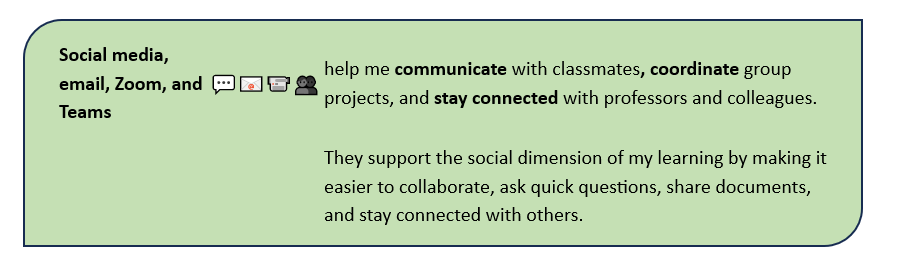
5. Social Media & More

Finally, my PLE also includes communication tools:
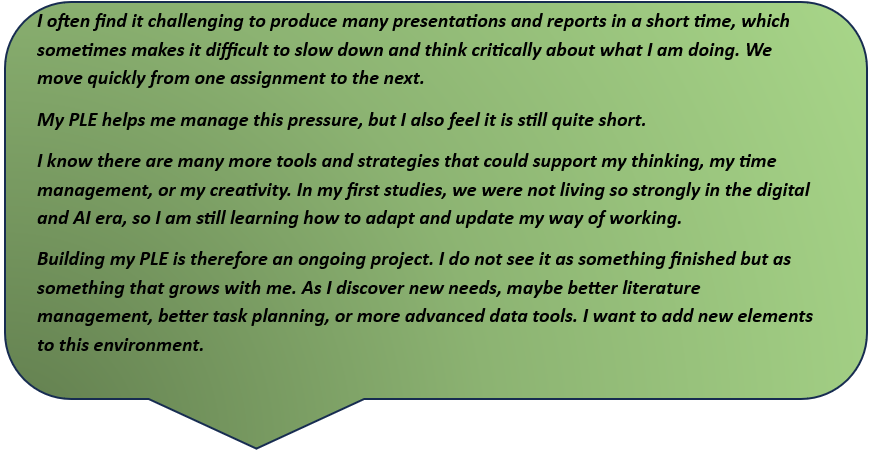
ā³ The Challenge of Thinking Deeply


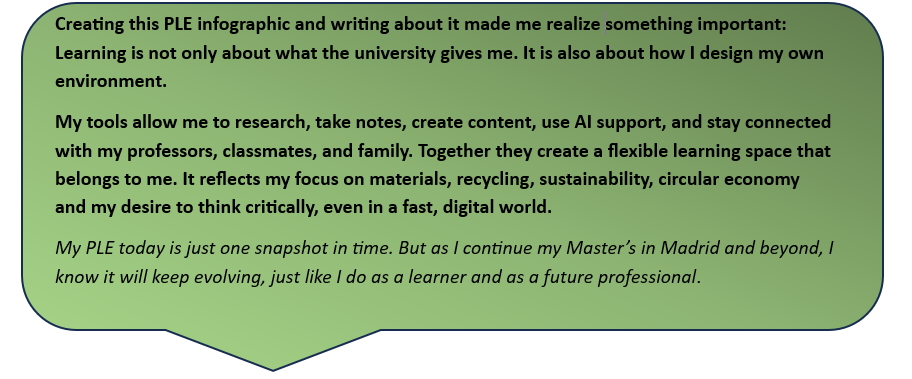
My PLE by my side on my learning journey.
šŸ’¬ Your Turn!

About DEA ZAKOLLI

Hi! I’m an Industrial & Environmental Chemist (B.Sc. + M.Sc., Albania) with five years experience in the mining industry. In 2024 I began a Master in Advanced Materials & Circular Economy in Madrid to go deeper into life-cycle assessment, materials recovery, and circular process design. I combine careful lab work with a practical mindset and I’m excited to keep growing. My goal is simple: use solid data to improve efficiency and build more circular, real-world solutions. Open to collaborations and roles where analytical excellence meets circular innovation.


Personal Reflection on Professional Future

My professional future

Reflecting on my professional future through the lens of Yuval Noah Harari’s insights, it’s clear that the rapid development of AI is reshaping the landscape of work and society. In a recent conversation between Harari and a program leader, he emphasized the paramount importance of adaptability and flexibility in career planning. As an engineering student, this advice resonates deeply. The notion that specific job roles could quickly become obsolete as AI systems advance requires an adaptable mindset—one ready to pivot and embrace new opportunities and skill sets as they emerge.

Harari argues that in a world dominated by technological progress, the ability to learn, unlearn, and relearn is not just valuable but essential. This perspective underscores the importance of cultivating a mentality that is open to constant change, where being attached to a singular career path might be limiting. Instead, I need to prioritize versatility, developing a toolkit of skills that allows me to shift roles or approaches seamlessly as AI begins to fill more technical and repetitive positions in engineering and beyond.

The ability to grasp new frameworks and adjust to different sets of rules quickly will be a competitive advantage. For an engineer like me, this might mean going beyond traditional training and incorporating interdisciplinary knowledge, such as data science, ethical AI considerations, and circular economy principles, into my expertise. This adaptability, coupled with ongoing learning, aligns with Harari’s prediction that the future belongs to those who can navigate the interplay between technology and human creativity.

To prepare for a career in this dynamic landscape, I need to stay proactive in identifying emerging trends and be ready to re-skill when necessary. Embracing this mindset will ensure that my work remains relevant and impactful in an era where technological development is both a challenge and an opportunity.

Avatar photo

About OSCAR LINDBERG AUGESTAD

Innovative Sustainability Expert | MSc Candidate in Advanced Materials: Innovative Recycling Erasmus Mundus Program | Experienced Analyst in Renewable Energy & Environmental Sustainability Solutions

A Personal Reflection on my Professional Future

Reflecting on Yuval Noah Harari’s insights in ā€œThe Two Most Important Skills for the Rest of Your Lifeā€ brought both excitement and introspection about where technology is taking us—and where it leaves me as a Material Engineer with a passion for sustainability and circular economy principles.

Harari introduces a future where human ā€œhackabilityā€ isn’t science fiction. It’s about algorithms and AI understanding our choices before we do, predicting what we want or need next, and shifting our interactions with the world. This idea sparked a personal question: How will this AI-driven insight affect industries where sustainability and resource efficiency are key? Could AI predict not just material needs but also the most sustainable approaches to sourcing, lifecycle, and waste reduction? As exciting as these advancements sound, they come with ethical implications, particularly in sustainability fields where transparency is critical.

For me, this means adaptability isn’t just nice to have—it’s essential. Harari points out that, beyond technical expertise, we’ll need emotional resilience to pivot with each wave of change. As someone in a field rooted in problem-solving and environmental responsibility, I see this as a call to embrace lifelong learning. Today, I might be refining recycling processes; tomorrow, I could be collaborating with AI to discover the next best circular materials.

In a world where technical skills alone might not keep pace, I believe developing emotional intelligence will be my biggest advantage. It will help me stay grounded, stay curious, and ultimately, stay human in a world driven by technology. Harari’s message has deepened my commitment to sustainability and reinforced that adaptability and self-awareness aren’t just ā€œsoft skillsā€ but vital tools in building a resilient, meaningful career.

Avatar photo

About LAIBA ZAHID

A materials engineer specializing in advanced recycling and circular economy, currently pursuing a Master's in Circular Economy for Minerals and Construction Products at Universidad PolitƩcnica de Madrid.

Navigating the Future: Merging Technology, Sustainability, and Social Responsibility in the Age of the Fourth Industrial Revolution (Professional Reflection)

Reflecting on my professional future in the context of the Fourth Industrial Revolution, I find myself at the crossroads of technology and sustainability. The rapid advancements in AI, automation, and robotics are pushing industries to evolve at an unprecedented pace. However, as highlighted in the videos I watched, there’s an ongoing challenge to ensure that these innovations are harnessed for the greater good, both environmentally and socially. I see this revolution not only as an opportunity to advance in my career but also as a call to action to contribute to shaping a future that integrates technology responsibly.

The discussions on digital platforms higlights the urgency of addressing the societal impacts of automation, especially the potential for job displacement. These conversations resonate deeply with me because they make clear the need for proactive measures to ensure that technological progress does not lead to greater inequality. I understand that the work ahead will require adaptability, not just in acquiring technical skills, but in fostering empathy and ethics within the workplace. It’s essential to contribute to a future where these innovations can be used to empower people, not just replace them.

In my own career, I want to blend my passion for technology with a strong sense of social responsibility. As we move towards an era of smarter, more efficient systems, my goal is to ensure these technologies align with sustainable practices and positively impact communities. By keeping a focus on the long-term implications—both environmental and human—I aim to be part of a solution that creates meaningful, equitable opportunities for people in an increasingly automated world. My professional journey, therefore, will be rooted in bridging the gap between innovation and societal progress.

About NAUFAL AFIF PRAHASTHO

Innovative Sustainability Expert | MSc Candidate in Advanced Materials: Innovative Recycling Erasmus Mundus Program | Experienced Analyst in Renewable Energy & Environmental Sustainability Solutions