
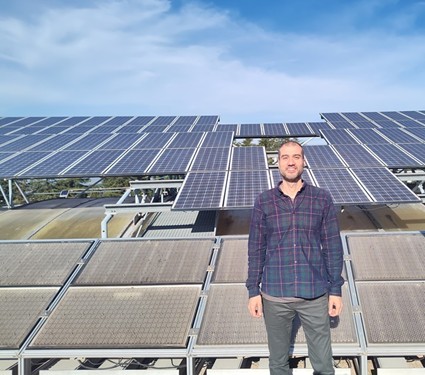
ERC Funds Íñigo Ramiro and his TANGO Project to Revolutionize the Field of Optoelectronics
Researcher Íñigo Ramiro from the Solar Energy Institute at UPM has been awarded a Consolidator Grant in the 2024 call of the European Research Council (ERC) for his groundbreaking project TANGO, which aims to develop a new class of materials and devices with advanced optoelectronic properties.
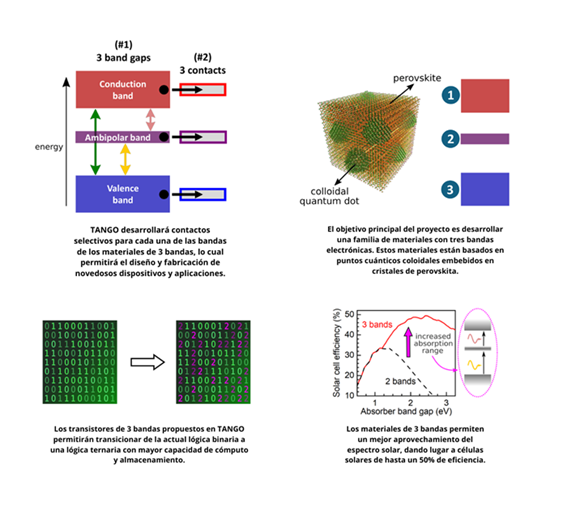
Over the past 50 years, optoelectronics has radically transformed numerous technological fields—from computing to solar energy—thanks to advances in semiconductor materials, which are traditionally characterized by two electronic bands. Taking a major leap forward, TANGO will develop materials with three electronic bands, enabling the creation of novel optoelectronic devices that were previously impossible to realize. This will be achieved by integrating colloidal quantum dots into a matrix of perovskite-family semiconductors, resulting in what is known as QDIP (Quantum Dot-in-Perovskite) structures.
By leveraging the extraordinary properties of QDIPs, TANGO will demonstrate the first-ever three-band optoelectronic devices: a transistor capable of switching between three states (0, 1, and 2), and a high-efficiency solar cell.
Challenges Addressed by the TANGO Project
According to Ramiro, “one of the main challenges of the project was to make these materials viable at room temperature, which requires avoiding thermal coupling between bands. TANGO proposes a way to eliminate this coupling through the use of QDIP, thereby creating the first three-band materials with practical applications. Furthermore,” the researcher continues, “the project will develop—for the first time—electrical contacts that provide simultaneous access to all three electronic bands. This represents a significant leap in the versatility of these materials compared to traditional semiconductors, enabling the design and fabrication of entirely new devices and applications.”
New Perspectives in the Field of Semiconductors
This advancement is significant, as the concept of three-band materials was first proposed in 1997 by researchers Antonio Luque and Antonio Martí from the Universidad Politécnica de Madrid, but viable materials had not been achieved until now. In the words of Ramiro, “the project aims to develop a new family of materials with the desired properties derived from the presence of three bands, potentially revolutionizing and revitalizing the field. Additionally, it will develop the first electrical contact to the third band—the ambipolar band—which will allow external control over it, something that had not been possible until now.”
Different Levels of Impact and Applications
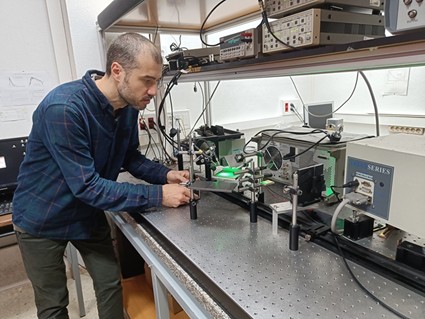
The future applications of TANGO are highly promising. Although the project is currently in an early proof-of-concept phase, it is anticipated that in the medium to long term, innovative optoelectronic devices—such as three-state transistors and high-efficiency solar cells—can be developed.
TANGO could open new lines of research worldwide, positioning Spain and Europe at the forefront of three-band semiconductor technology. According to Ramiro, “on the one hand, the creation of new technologies based on these materials could foster technology transfer in the future. On the other hand, the project will support the training of new PhD students and postdoctoral researchers, who will contribute to Europe’s scientific and technological ecosystem.”
A High-Potential Scientific Career with Strong Leadership
Íñigo Ramiro holds a degree in Telecommunications Engineering from the Technical School of Telecommunications Engineering (ETSIT) at UPM and from the Institut National des Télécommunications (INT, France). He also earned a PhD in Photovoltaic Solar Energy from UPM. His research focuses on the development of quantum materials for optoelectronic applications and on the study of new energy conversion mechanisms.
Throughout his career, he has worked at several internationally renowned research institutions, including the Institute of Solar Energy (IES, Spain), the Institute of Photonic Sciences (ICFO, Spain), and the Materials Research Center (CENIMAT|i3N, Portugal). He is currently a Ramón y Cajal Researcher at UPM.
The ERC, Consolidator Grants, a recognition of scientific excellence
The European Research Council (ERC) Consolidator Grants (CoG) support researchers who have already demonstrated scientific independence, show high leadership potential, and are at the stage of consolidating their own research teams or lines of work.
In total, 328 projects were awarded funding in the 2024 CoG call, with a success rate of 14.4%. Of these, 21 projects are hosted by Spanish institutions, and one by UPM. The funded researchers (grantees) come from 43 different nationalities and will be hosted in institutions across 25 EU member and associated countries.