MOOC’s done by Shubhanshu

During the T4PDC, I completed the following two courses.

MOOC – 1 – Introduction to Personal Branding

This course was provided by the University of Virginia on the Coursera platform.

Following are the key points that I learnt from the course –

  • It helped me understand what personal branding means.
  • Encouraged me to use at least 2 and at maximum 3 social media.
  • Create a mission statement for their personal brand.
  • Become familiar with the basics of digital security and reputation management

The course has encouraged me to start using Twitter in a more efficient way and the following are some point which makes Twitter stand along from other platforms –

  1. Hashtags – With hashtags, it is easy to find particular tweets and also show what is trending
  2. Brand Identity – Being on Twitter can help communicate your brand ethos and personality.
  3. Easy to raise your voice

The 80/20 rule: 80% of what you put out on social media should be content that is of interest to the people who follow you. 20% should be self-promotion.

And one of the most important segments of this MOOC was to find your three cornerstone words and state them in your mission statement. So, my three cornerstone words are Peace, happiness and help and my mission statement is “I want to bring peace and happiness into people’s life by helping them with my Academic and personal knowledge”

MOOC – 2 Circular economy: An introduction

This course was provided by the Delft University of Technology on the edx platform.

Following are the key point I learnt from the course –

  • Develop a general overview of the principles and ideas behind a Circular Economy.
  • Analyse the barriers and opportunities for transitioning to these circular business models.
  • Investigate what it takes to create products that are easy to repair, remanufacture or recycle.
  • Discover how natural systems can provide inspiring solutions to human problems.

The course emphasises shifts to a system where we can regenerate natural systems, design out waste and pollution and keep products and materials in use.

The following are business Values that we get from the circular economy –

  1. Source Value – This helps in cost reduction
  2. Environmental Value – that ultimately reduces the footprints
  3. Customer Value – which increases the customer loyalty
  4. Information Value – help in providing valuable data about the product

I also loved the example of FAIRPHONE who are working very greatly in the extension of product lifespan by –

  1. Making it more durable
  2. keeping it easy to maintain and upgrade
  3. making it repairable

And, the main takeaway for me was the ” inertia Principle” which states that ” Do not repair what is not broken, do not remanufacture something that can be repaired, do not recycle a product that can be remanufactured and replace or treat only the smallest possible part in order to maintain the existing economic”
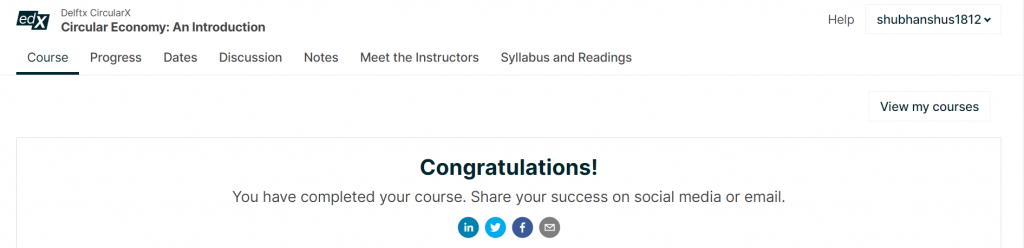
Completion of MOOC course


These two MOOC Courses have also helped to improve my Personal Learning Environment as now I have started using edx also.

Emmanuel’s MOOCs

Course: Introduction to Personal Branding

Though the concept of personal branding isn’t new, the questions remain about how to create one and, more importantly, what it means to maintain and inhabit that brand. In the quest to improve my Professional/career brand, I took a course – “Introduction to Personal Branding“ on Coursera.

The main lessons for me that I would like to share are summarized below:

  1. Branding is holistic, it covers not just Professional but also Personal. The brand should be compatible with your beliefs and values (Your Three Cornerstone Words); those two You’s must be able to exist harmoniously.
  2. Setting up a search alert (e.g., Google search alert) for your name/key words, so that anytime it is mentioned you will be notified.
  3. The 80/20 rule: 80% of what you put out on social media should be content that is of interest to the people who follow you. 20% should be self-promotion.

Course: Circular Economy: An Introduction

A Circular Economy cycles valuable materials and products, produces and transports them using renewable energy. In the living world, one species’ waste is another’s food, and energy is provided by the sun. This is considered the inspiration for the Circular Economy.

The ‘rules’ or ‘principles’ that govern these natural systems and used to inform a Circular Economy; Waste = Food, Build resilience through diversity, Work with energy from renewable sources, and Think as a system.

I also learnt about the different views of the roots of the circular economy, and How can the circular economy provide solutions to the challenges our current linear economy.

I learnt about the three main business processes required to close loops: Acquisition, Reprocessing, and Remarketing. If any of these key processes fails, we do not have a closed loop.

Also, the different business value in a circular economy; sourcing value, environmental value, customer value, and informational value.

The three general barriers for refurbishment: Perception, International trade barriers and other regulatory barriers, and commitment from top management. Closing the loop through refurbishment needs to be a strategic business decision.

The three different categories of product-service business models: Product-oriented, Use-oriented, and Result-oriented. However, the transition from a product-oriented model to a result-oriented model is difficult. Typical barriers are the need to pre-finance the products that are offered as part of the service contract, the need to organize maintenance, repair and acquisition, and the need to change the “sell more, sell faster” culture of the organization.

The smaller the loop, the greater the profitability of the system. The two ways to extend the life of a product are either keeping the product in use for longer period, or by giving a product a second, third, etc., life. A product’s life can be extended by making it durable, easy to maintain and upgrade, and by making it repairable. Refurbishment and remanufacture also extend a product’s life.

The “Inertia Principle“ – Do not repair what is not broken, do not remanufacture something that can be repaired, do not recycle a product that can be remanufactured.

Thinking about remanufacturing upfront, during product design, can make the remanufacturing process more efficient and thus save a great deal of time and money. There is not much scientific knowledge available on the engineering and business aspects of remanufacturing. Remanufacturing is considered more ‘art’ than ‘science’, which is a missed opportunity.

This was a really interesting course and I would recommend it for any circular economy enthusiat.

Utkarsh’s MOOCs

Recently completed two online courses and would like to share a few of my learnings.

Course: “Introduction to Personal Branding

With the shift to the digital world, it is becoming a necessity to promote ourselves digitally and often termed as “Personal Branding”. In short, it is a way to promote ourself which includes our experiences, the combinations of skills, personality, and vision. It is all about telling our story that reflects our actions, attitude, and so on. Personal branding gives us an opportunity to control how people see us and it is very beneficial professionally. Preferably Social media sites or professional networking sites should be a few platforms to promote yourselves where the audience can see you. Consistency and Authenticity should be important while building your personal brand. It is important to keep in mind that your personal branding matches what people say about you. For e.g. if you believe it is important to lift others to get lifted, it should reflect in your branding. I would like to share a few tips which I learned to make a better personal brand: 

  1. Introspection and self-reflection: ensure that you know your audience.
  2. Find yourself, directors, or mentors. Good guidance never hurts.
  3. Personality Test: to help you with a better understanding of yourself.
  4. Align your personal values and skills.

Lastly, it is always a good idea to learn and apply. There are many courses on personal branding and can be accessed through various learning platforms. I did a course on “Coursera” called “Introduction to Personal Branding“. Keep upgrading and keep an open mind to adapt to the changing world. 

Course: “Circular Economy: An Introduction

Our current economy called Linear Economy is all about “Take-Make-Use-Dispose”, which is not a sustainable model. The reason behind not being sustainable is that resources like fossil fuels, food, and water are increasingly hard to get. Biodiversity is declining worldwide and the linear economy depends on cheap energy, cheap materials, and cheap credit. On the other hand, the Circular Economy aims to radically limit the extraction of raw materials and the production of waste. The basic idea of circular economy is to recover and reuse as many of the products and materials as possible, Inna systematic way, over and over again. The circular economy is based on four basic principles:

  1. Waste = Food
  2. Build resilience through diversity
  3. Use energy from renewable resources
  4. Think in systems.

The circular economy can be easily understood by a diagram called Butterfly Diagram. The butterfly diagram represents the flows of products and materials in the circular economy. It has two sides called Biological materials, that is materials that can be safely returned to the biosphere and value to the environment once they have gone through one or more use cycles. And Technical materials, materials that cannot be returned to the biosphere, should continuously cycle through the system so that their value can be (re)captured. 
For businesses to close the loop, three main business processes are useful: acquisition, reprocessing and remarketing. Along with these processes, it is very important to have a value, often termed as “Business value in the circular economy”. The list of these values includes Sourcing value, environmental value, customer value, and information value. Though it is important to have these values and processes integrated into a business, it is a good idea to revise the business model as well. We can distinguish three different categories of product-service business models:

  1. Product-oriented
  2. Use-oriented
  3. Result-oriented.

Offering services in combination with products is a way to add value without using more materials.
Other than the concepts or discussions above, there are many other areas like remanufacturing, how product life extension helps reach circularity and how repairing plays an important role in the field of the circular economy. I did my course in Circular Economy called “Circular Economy: An Introduction“. It is very well structured to give a brief understanding of the concepts. Since it is an online course, it should be helpful to integrate it into your personal learning environment. Keep learning and do share your point of view on the circular economy. 

Utkarsh’s Personal Learning Environment

Wei Qing Tan – MOOCs

Personal Branding by University of Virginia

The first MOOC was short and sweet. I took away 6 main learnings:

1. Get to now yourself, then you can sell yourself. In terms of branding, built it on a niche within a niche.

2. Be established on at least 2 platforms.

3. Know what you stand for and what your mission is. I found the 3 cornerstone words interesting, it helped me reflect on what is important for me to live by.

4. When building a board of directors, have a small team who will respect you, care about your success, and will be open to be honest with you.

5. Always check your social media setting! Do this monthly.

6. Create a routine for your own brand management. 80% of what you post should interest your “followers”, 20% should be about self-promotion, otherwise, you will lose them quick!

Perhaps surprisingly, I decided to sign-up to Twitter after this course. I had only LinkedIn prior, but I thought to broaden my horizon a little after this MOOC. Afterall, I can always remove my data after, right…? This course allowed me to add Twitter and Coursera to my final PLE.

Circular Economy: An Introduction by TU Delft

The circular economy course was very well established and took significantly longer to complete.

My main takeaways from each of the 6 main episodes:

Episode 1: The 4 kex principles of circular economy are: food = waste, build resilience through diversity, use renewable systems, and think in systems.

Episode 2: There are 4 key types of business values in the circular economy: 1) sourcing, 2) environmental, 3) customer, and 4) informational. The latter is one I have never considered before, but it really is a powerful tool that can help companies optimise their product.

Episode 3: Follow the inertia principle to preserve the integrity of the products for as long as possible.

Episode 4: There are 3 general barriers to remanufacturing: 1) remanufactured products are perceived to be inferior to new products, but of course, this is not the case, they are as good as, if not better, than new. This requires a change in mind set from society.

Episode 5: The section was on recycling and nothing ground-breaking was introduced, sorry TU Delft! A rather interesting topic introduced here, however, was biomimicry. I enjoyed learning about how engineers, designers, and scientists study nature to implement solutions to functional problems we experience! E.g., the aerodynamics of Japan’s bullet train was inspired by a bird’s beak!

Episode 6: Systems thinking and its feedback loop to achieve equilibrium. Basically, inflow = outflow = system in equilibrium = circular economy. But of course, this takes time. We can estimate time for circular economy (which is different for different systems) by 3 metrics: 1) population stabilisation time, 2) urban mine stock build-up until demand/person stabilises and 3) product lifespan assumption. The combination of the three gives you the estimated time to reach a circular economy.

This second MOOC really added to my knowledge on circular economy, introducing some new concepts. To my PLE, it added the edX platform, which has many other interesting courses, such as “Water and Climate”, also by TU Delft.

My final PLE is demonstrated below.

MOOCs

MOOC I. Introduction to Personal Branding

The course “Introduction to Personal Branding” by the University of Virginia offers a brief summary of what “personal branding” means, why it is important and how we can take advantage of it.

This course has encouraged me to reflect on myself and my professional future. It is no longer just about what I am trying to say or transmit, is more about how I say it, and where (e.g. to whom or on what social media platform). Getting to know me better, being aware of my goals, and becoming familiar with the basics of digital security are a few of the things that I have learned from the course; which are highly useful to everyone, especially to people entering the job market.

Clara García – MOOC

INTRODUCTION TO PERSONAL BRANDING – University of Virginia

In this MOOC, I found very useful the introduction of concepts that I personally have never reflect about such as reputation, schedules and different types of social media, but the most useful thing for me was the personal work to do to define a personal brand. I found out that first it is important to know yourself, your personality, what statement of life you have, what people inspire you personally, to be able to know which is the best version of yourself that you want to be and the feeling you want to transmit to other people.

In consequence, this MOOC has helped me to know myself better than before. On the Internet I used to act by intuition, not really reflecting on the image I was giving, but knowing that what you publish on Internet, will be there forever. It taught me how to differentiate from others, which are the mean qualities that make me unique and how to be authentic online too. This was also possible thanks to the Myers Briggs personality test, which helped me understand how I am and how to apply it to my digital identity

I have improved my PLE, adding applications such as Coursera and Twitter.

CIRCULAR ECONOMY: AN INTRODUCTION – Delft University of Technology

I find this MOOC very interesting and complete. For me, the most useful part has been all the experiences and interviews with experts about different fields of the circular economy concept. I really made me reflect on all the aspects that are part of the circular economy, including all the stakeholders. It was very motivating also to see the attitude of all these experts working hard to achieve the transformation of the actual system.

As well, the assignments are very interesting due to the fact that they made the participant analyze different problems and be creative to find solutions and answers to those problems. For me, one of the most interesting questions that they analyze is the manufacturer responsibility in the end of use of a product and the conflict between the original manufacturer and the remanufacturer of a product.

I have improved my PLE by adding the application of EDX, but also discovering new platforms of information such as the Ellen MacArthur Foundation and the webs of many other companies I did not know before, based on this model of economy.

My New PLE after cursing both MOOC Courses