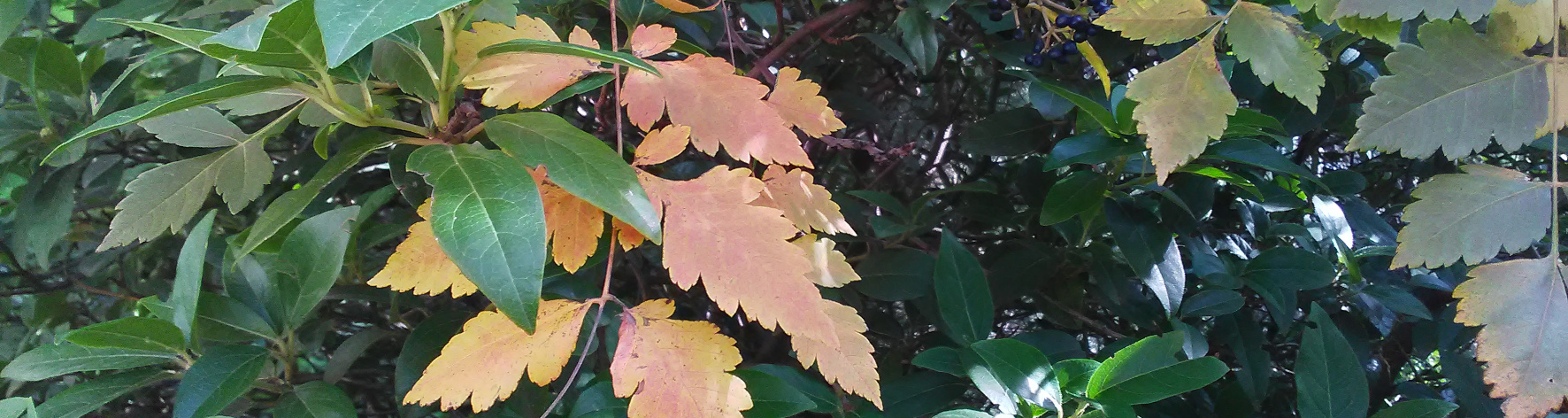


During the last years we were thinking about how digitize this collection and make its data as accessible as possible. Our goal is to follow the FAIR principles as well as the CARE principles. In 2025, a good opportunity has encouraged us to begin that work: the COST action CA23116 – Open Palaeoecological Data –…


The origin of EMMA-Paleo collection
You may have read that the EMMA Herbarium has an associated collection of fossil plant materials. Since it is not yet computerized, the data associated with these remains are not easily accessible. Interested public must search for them in the scientific publications of each work. The origin of these samples is the accumulated work of…
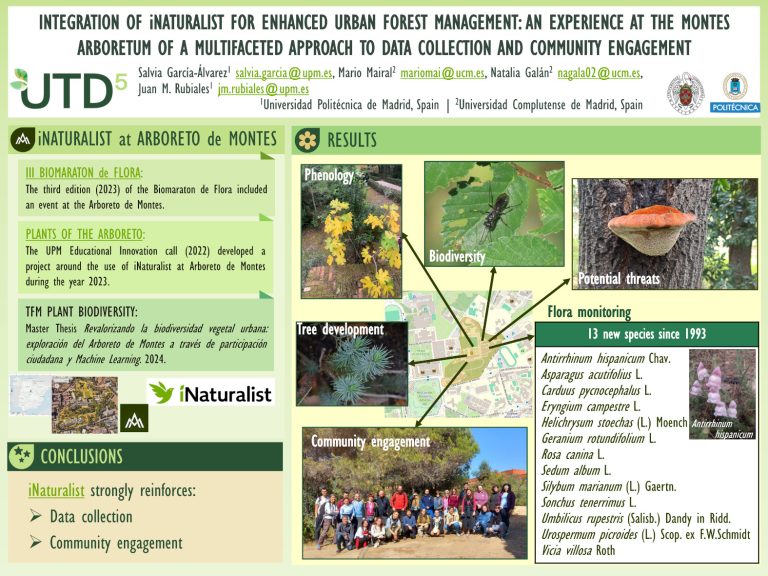
Montes Arboretum at UTD5
The Montes Arboretum is closely linked to the EMMA Herbarium because both are part of the same School, as we have already mentioned in previous entries. Last October 2024, the international Urban Tree Diversity Conference (UTD5) was held in Madrid. The Montes Arboretum was not only one of the spaces hosting participants, but was also…
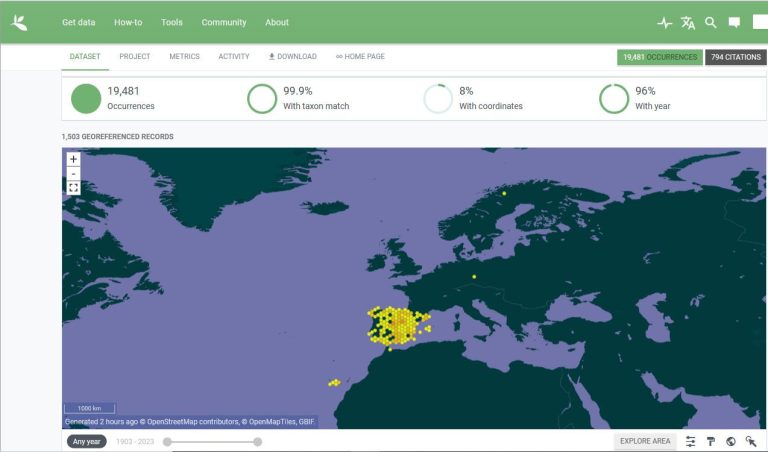
EMMA herbarium provides more than 300 new records available in GBIF
Last July 2024 we updated the dataset of the EMMA herbarium core collection in GBIF.ORG. With each update, errors detected in already published data are corrected, new additions to the collection are introduced and, where possible, the information available on already known records is increased. Dataset of EMMA herbarium in Gbif.org In this case, the…

EMMA-Algae Collection
Really? Seaweed in the Forestry school? Yes, the EMMA herbarium houses a little and interesting collection of algae. All of them were collected on 1905. In other words, they predate the destruction of the EMMA herbarium in 1936. They may have arrived later as a donation or exchange, or they may have survived the catastrophe…

Shawn Abrahams and Makenzie Mabry consult the Brassicaceae of EMMA Herbarium
Although they had to postpone the trip several times due to the COVID-19 pandemic, finally, in October 2022, Shawn Abrahams – postdoctoral researcher at Yale University (Columbia, USA) – and Makenzie Mabry – postdoctoral researcher at Florida Museum of Natural History (USA) – came to visit the EMMA herbarium. They were specifically interested in observing…

Crambe strigosa var. gigantea Ceballos & Ortuño
In the EMMA herbarium there is a specimen of the genus Crambe collected by L. Ceballos and F. Ortuño in 1946 on the island of La Palma (Canary Islands) during their field work for the elaboration of the Mapa Forestal de España that was published in 1966. At that time, Luis Ceballos and Francisco Ortuño…

Galal Fashir y Amani Kobbail visit the EMMA Herbarium
Last July 2022, several people from the Sudan University of Science and Technology (Khartoum, Sudan) visited the Universidad Politécnica de Madrid thanks to the Erasmus+ mobility program for staff in non-European associated countries (Erasmus+ KA-107). Two of them requested to visit the EMMA herbarium: Galal Fashir and Amani Kobbail. On July 20th and 21st, we…

Types in EMMA Herbarium
In Botany, a type specimen – a typus – is the specimen to which a name is permanently attached. This permanent link between the specimen and the name makes able to perform accurate taxonomic revisions because it is always possible to consult the original vegetal material. Exceptionally, instead of a plant fragment, an illustration can…
EMMA labels
These are the usual labels for the EMMA Herbarium. The information accompanying each sheet (location, date, name of the plant, collector, etc.) is printed in one of them to be stored with the plant material. However, in the past, the labels that accompanied each sheet were different. In this post we show you some examples….