During the last years we were thinking about how digitize this collection and make its data as accessible as possible. Our goal is to follow the FAIR principles as well as the CARE principles.

In 2025, a good opportunity has encouraged us to begin that work: the COST action CA23116 – Open Palaeoecological Data – analysing the past building foresight (PalaeOpen). Il will be working until 2028. Its main objective is actually to contribute to the use of palaeoecological data, heavily relying on Neotoma, a database specializing in paleo-pollen and paleo-fauna studies. More information about this ambitious initiative to make accessible and interoperable palaeoecological data can be found at the PalaeOpen website.
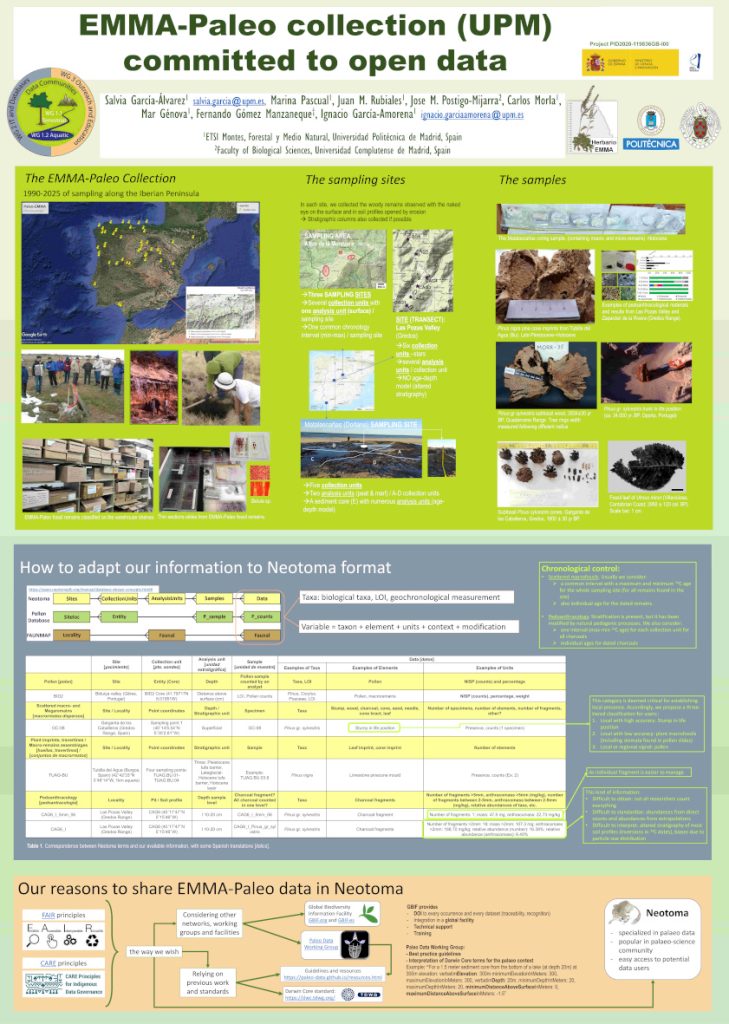
Currently, at the EMMA herbarium we have already started working on two tasks: (a) standardization and harmonization of information to adapt our data to the Neotoma format, and (b) communication with the scientific community to make this process understandable for both those who generated the data and those who could use it. Examples of this work are these two contributions:
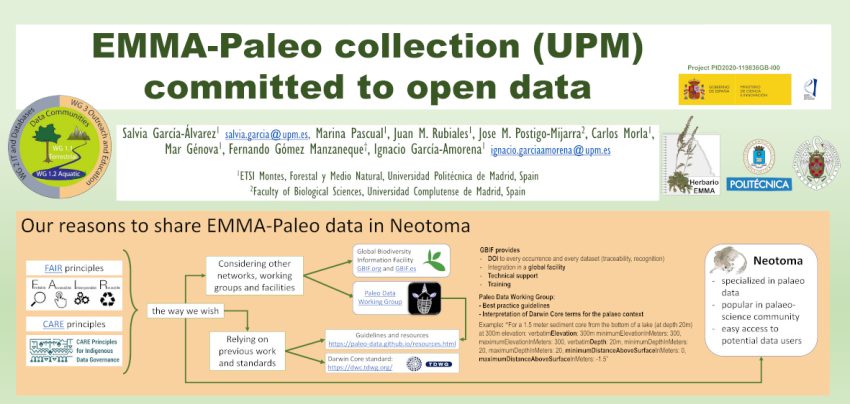
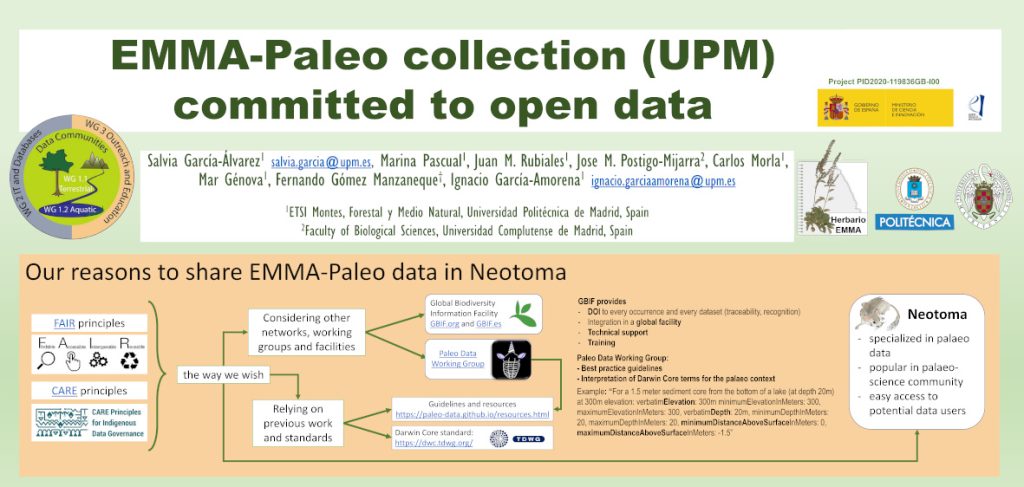
- EMMA-Paleo collection (UPM) committed to open data. 2025. García-Álvarez S, Pascual M, Postigo-Mijarra JM, García-Amorena I. Poster. Event: PalaeOpen 2025: Effective conservation starts with open scientific data at Prague (Czech Republic) on July 2025.


- Adaptación de la colección EMMA-Paleo a la base de datos Neotoma para estudios de biodiversidad. 2025. Pascual M, García-Álvarez S, García-Amorena I. Poster. Event: VI Simposio Anual de Botánica Española: Bases de datos botánicas y biodiversidad (del cuaderno de campo al big data) at Mieres (Asturias, Spain) on November 2025.