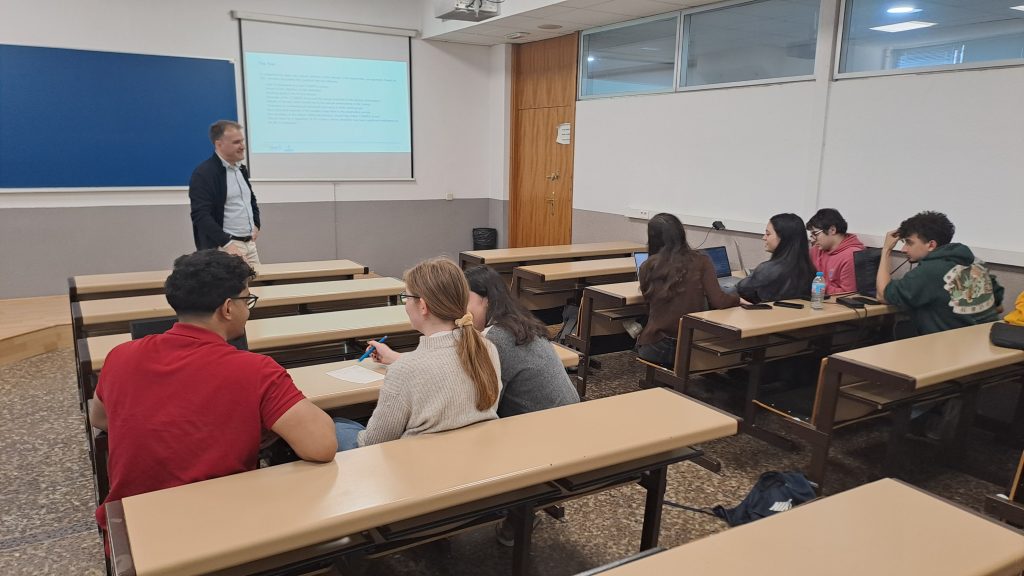
Yesterday I had the opportunity to test the first practical case on AI Ethics developed under the project CAMELIA. In particular, students of the Master’s Degree in Signal Theory and Communications (MSTC) working on the case named “Studying Bias in Predicting Recidivism in the Criminal Justice System” during the “Application projects” class at Universidad Politécnica de Madrid (UPM). Thanks very much to Luis Hernández for the opportunity to test this interesting use case in his class.
In this practical case, students adopted the role of a journalist attempting to investigate potential racial bias in ML models used to predict the risk of recidivism by the US Criminal Justice System. Particularly, we studied whether a proprietary algorithm known as COMPAS (Correctional Offender Management Profiling for Alternative Sanctions) system treats defendants fairly irrespective of their race. After running some fairness tests on a sample dataset stemming from the famous ProPublica investigation on this topic, the students performed a trial to decide on whether to grant a third degree to a defendant potentially suffering from discrimination in COMPAS to further discuss the topic based on the findings of the practical case.
The case regarding COMPAS (Correctional Offender Management Profiling for Alternative Sanctions), the risk assessment algorithm developed by Northpointe (now Equivant), gained widespread attention following ProPublica’s 2016 investigation. Anyhow, the case remains a landmark example in AI ethics discussions, particularly concerning algorithmic bias, transparency, and accountability. It has influenced research, policy discussions, and legal considerations regarding the use of AI in criminal justice and other high-stakes decision-making.
I think that combining real AI ethical issues with hands-on use cases can make a difference in teaching engineering students hard technical skills (in this case notions of interpretable machine learning and bias / fairness tests), and soft skills (AI Ethics, debating, or making a convincing position in a simulated trial). That is what project CAMELIA pursues in UPM.

About Santiago Andrés Azcoitia
- Web |
- More Posts(9)