“Each piece, or part, of the whole nature is always merely an approximation to the complete truth, or the complete truth so far as we know it. In fact, everything we know is only some kind of approximation because we know that we do not know all the laws as yet”
— Richard P. Feynman
In the Complex Fluids Lab, we study interfacial fluid phenomena at the micro/nano scale for developing micro/nano technology. These studies encompass the formation, instability and fragmentation of micro-threads, micro-emulsions, micro-droplets, micro-bubbles, and related phenomena. We adopt an interdisciplinary approach that integrates theory, numerical simulations and experiments by utilizing state-of-the-art equipment including our high-speed microscope visualization set-up. This comprehensive strategy enables us to integrate our cutting-edge fundamental research with innovation to address critical sustainability and healthcare challenges. For instance, key applications include CO2-free hydrogen technology, soft robotics, and drug delivery, among many others. A complete list of Cruz-Mazo’s publications and their citations is available @googlescholar. Our UPM affiliations are:
Department of Mechanical, Chemical, and Industrial Design Engineering, Universidad Politécnica de Madrid, Ronda de Valencia 3, 28012 Madrid, Spain
Thermal Energy for Sustainability group, Universidad Politécnica de Madrid, José Gutiérrez Abascal 2, 28006 Madrid, Spain
CONTACT: Francisco Cruz-Mazo (f.cruz[at]upm[dot]es)
Research topics
FUNDAMENTAL RESEARCH IN MICRO/NANO FLOWS
Fluid dynamics close to the continuum limit
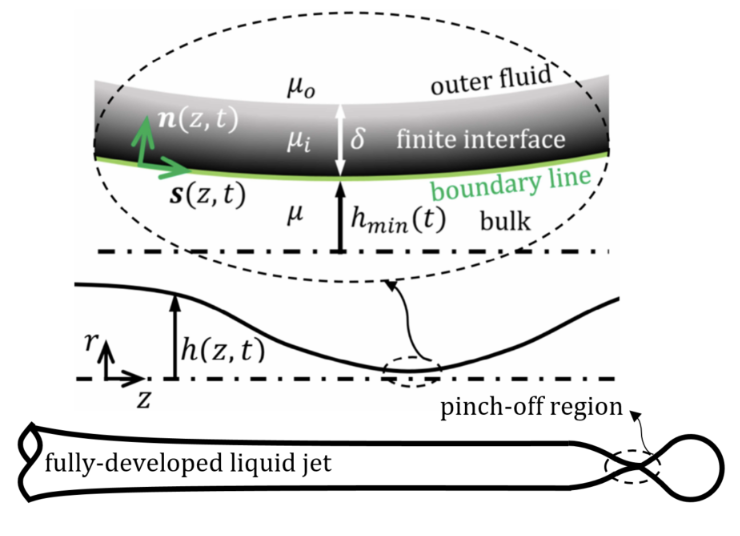
Fluid flows at tiny scales are fascinating. An excellent example is a liquid jet, where, ultimately, a fluid-fluid interface cannot be considered infinitely narrow within fluid fragmentation, as we showed in our work (Cruz-Mazo & Stone (2022) Phys. Rev. Fluids), where we also derive a new set of self-similar equations at the finite scale of an interface. This kind of fundamental knowledge enables proper generation and manipulation of micro/nano fluid entities, such as droplets, bubbles, emulsions, and mixing, for multiple interdisciplinary applications, as described in the following section.
KEY ENABLING TECHNOLOGIES BASED ON MICRO/NANOFLUIDIC METHODS FOR INTERDISCIPLINARY APPLICATIONS
The development of novel customized methods requires collaborative interdisciplinary endeavors that bridge fundamental and applied research. In the Complex Fluids Lab, we currently work and collaborate on the following topics:
Hydrogen technology
Sustainable hydrogen production is one of the ultimate goals of our METAHL-BUBS project funded by our “Generación de Conocimiento” National Research Grant (PID2023-151272OA-I00). We research the modeling and experimental techniques for advanced heating in liquid-metal bubble systems. PIs: Luiz González and F. Cruz-Mazo.

Sample delivery
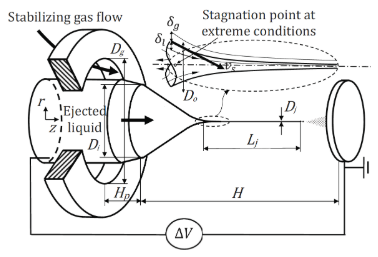
We develop novel biochemical microfluidic devices for biomedical applications, including efficient drug delivery. For instance, liquid ejections at extreme conditions, as shown in our work (Cruz-Mazo et al. (2019) Phys. Rev. E) reaching diameters around 200 nm and speeds exceeding 100 m/s. PI: F. Cruz-Mazo
Hydrodynamic drag reduction
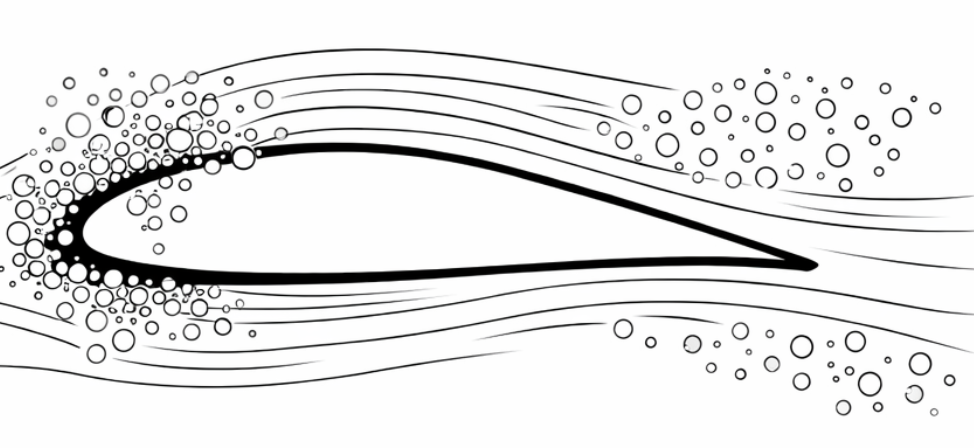
Ocean and naval engineering is the context of one of our collaborations with INTA. We research drag reduction using microbubbles to develop novel methods in this field. PI: Adelaida García-Magariño (INTA)
Soft robotics
We research advanced methods for fluid-structure interactions to achieve ultra-precise kinematic and dynamic features, in the framework of an industrial PhD collaboration with ARQUIMEA.
Meet the team
FRANCISCO CRUZ-MAZO is currently an Associate Professor at Universidad Politécnica de Madrid (UPM), where he teaches fluid mechanics courses and researches both theoretically and experimentally on the fluid dynamics of interfacial flows at the micro- and nanoscale. He leads the Complex Fluids Lab at ETSI Diseño Industrial and is a member of the Thermal Energy for Sustainability (TE4S) group at ETSI Industriales.
SIMING ZHANG is an incoming PhD student sponsored by the China Scholarship Council (CSC), where she researches the dynamics of microbubbles in hydrogen generation. She obtained her Master’s degree from Yanshan University, where she worked on cross-scale flow modeling for jet pipe servo valves using the lattice Boltzmann method and large-eddy simulation, and applied Principal Correlation Decomposition to reveal the linkage between turbulent structures and pressure fluctuations. Her research bridges multiphase flows from hydraulic systems to clean energy applications.
AÑATERVE OVAL is an Industrial PhD student. He works on rheological methods involving fluid-structure interactions for soft-robotics applications, under the joint supervision of Leo González, ETSI Navales (UPM)
ALBERTO ASPAS is a PhD student who works on microbubble-based drag reduction methods for ocean and naval engineering applications under the joint supervision Adelaida García-Magariño, Instituto Nacional de Técnica Aeroespacial (INTA), Centro de Experiencias Hidrodinámicas de El Pardo (CEHIPAR).
TOMMASO ROMAGNO is a visiting MSc student from Politecnico Bari under the joint supervision of Laura Fabbiano. He works on fluid measurement.
UNDERGRADUATE STUDENTS who collaborate and/or carry out their final-year projects (TFG):
- Alicia Bermejo, Beatriz Galán, Moneiba Marrero, Gabriel Toledo, and Nicolás JIménez work on droplet-based phenomena
- Diego Berlanga, Juan de Frutos and Marina Bielsa work on bubble-based phenomena
- Cristina Boned, Carmen García, and Eduardo Viejo work on fluid-structure-based phenomena
Alumni and past members
Alberto González (BSc student 2026) – Miguel Gómez (BSc student 2026) – Miguel Martín (BSc thesis 2026) – Daniel Farfán (MSc thesis 2026) – Pablo Fernández (BSc thesis 2025) – Livio Mösch (Visiting MSc student 2024) – Carlos Martins (BSc thesis 2024) – Carlota Gutiérrez (Undergrad 2024) – Candela Ramos (BSc thesis 2024) – Lucía Suárez (BSc thesis 2024) – Marcos Arroyo (BSc thesis 2024) – Alberto Pavón (BSc thesis 2024) – Mario Gutiérrez (BSc thesis 2024) – Marcos Albarrán (BSc thesis 2024) – Pablo Rodríguez (BSc thesis 2024) – Leire Chapartegui (BSc thesis 2023) – Salvatore Regusa (BSc thesis 2023) – Alberto Díaz (MSc thesis 2023) – Alejandro Álvarez (BSc thesis 2023)
Join us
We encourage you to reach out (f.cruz[at]upm[dot]es) and check the available opportunities for:
- BSc/MSc students: thesis (TFG/TFM), scholarships, stays, etc.
- PhD students: research: academic/industrial PhD thesis.
- Postdoctoral positions: European and National fellowships.
- Research groups: interdisciplinary projects and collaborations
- R&D companies: project-based collaborations and assistance
