Digitalization for sustainable port and maritime logistics
Our group’s research activity aims at enhancing sustainability, efficiency, and strategic decision-making in maritime and logistics sectors, with a particular focus on the Spanish port system and the broader European Blue Economy. We use advanced analytical and artificial intelligence methodologies, such as Bayesian Networks, Multi-Criteria Decision Analysis, Delphi method, Multi-Agent Systems, Digital Twins with BIM/GIS integration, Decision Trees, Genetic Algorithms, and SWOT-CAME analysis. Our core research areas include port variable classification and prediction, sustainable dry port location, digital transformation for smart ports and terminals, optimization of port asset management, risk analysis for emerging energy technologies (e.g., green hydrogen), and the prioritization of Blue Economy sectors. Our research aims to provide data-driven tools and frameworks to address complex, multidisciplinary problems in transport, logistics, and environmental management.
Recent interests and contributions
- Port sustainability and risk management using advanced analytical models. Our group contributes to modeling and predicting port variables to enhance sustainability and manage risks. We apply Bayesian Networks to understand complex interrelationships among economic, social, environmental, and institutional factors in ports, allowing for classification, prediction, and diagnosis of variables, even under high uncertainty. We have extended the proposed methodology to assess sustainability indicators for the marine renewable energy sector in ports, and to analyze the impact of the maritime Emissions Trading System (ETS) on European ports. In this context, we have identified and analyzed influential factors like fuel efficiency and CO2 emissions at berth. Our work provides crucial decision-making tools for strategic planning and risk mitigation in a probabilistic manner.
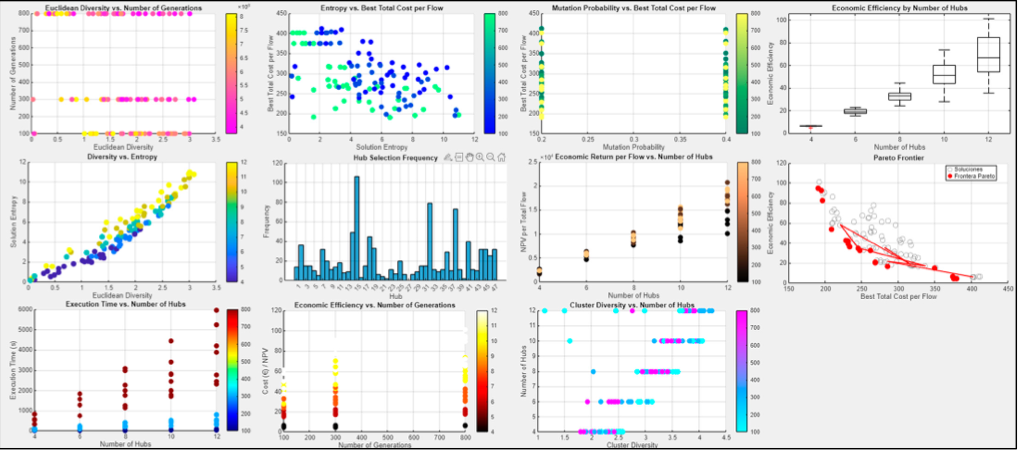
- Dry port location and intermodal logistics optimization. Our group has developed comprehensive methodologies for the optimal and sustainable location of dry ports, and for the optimization of intermodal port-hinterland systems. We combine the DELPHI methodology with Multicriteria Analysis and Geographic Information Systems to identify and weight factors influencing dry port location, considering economic, social, and environmental implications. We use Capacitated Multiple-Allocation Hub Location Problem (CMAHLP) models integrated with genetic algorithms and Social Net Present Value (NPVsocial) to optimize intermodal freight networks, identifying essential inland hubs and supporting sustainable infrastructure planning in Spain.
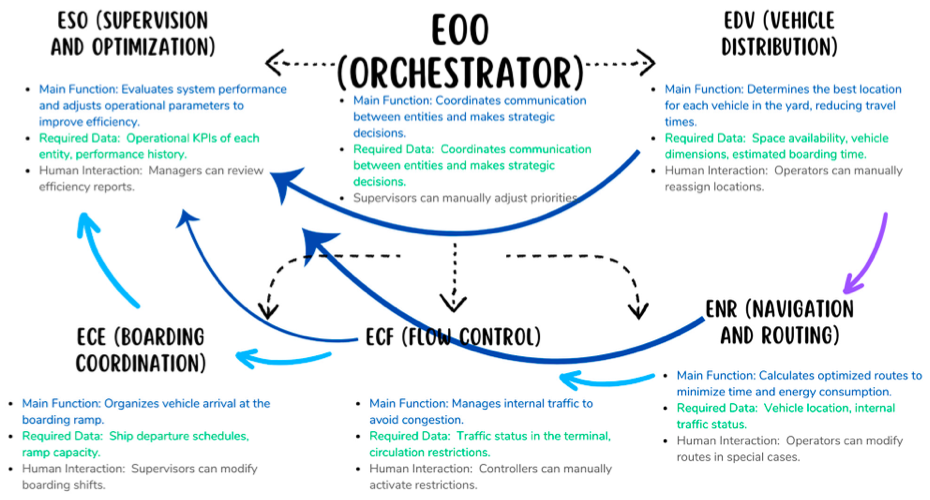
- Digital transformation, smart port concepts, and advanced terminal management. Our group investigates the digital transformation of ports, focusing on “Smart Port” and “Ports 4.0” concepts and advanced management systems. We have developed indicators and rankings for Spanish Smart Ports based on digitalization, ICT, and automation. Some of our contributions include proposals for a Multi-Agent System (MAS) architecture for optimizing Roll-on/Roll-off (Ro-Ro) terminal management by enhancing space allocation, route planning, and traffic control through AI-driven coordination. We have also introduced the “Frankenstein Strategy” for incremental Digital Twin integration with BIM/GIS to optimize port asset management, enabling predictive maintenance and real-time decision-making in line with Industry 4.0 principles.
- Blue economy sector prioritization and green hydrogen risk analysis. Our group conducts research on prioritizing key sectors within the Blue Economy and analyzing risks associated with emerging sustainable technologies in ports. We apply decision tree models to analyze and prioritize Blue Economy sectors (e.g., maritime transport, coastal tourism, fishing, ocean energy) in Spain and Europe, using economic, social, and environmental indicators to support sustainable development strategies. Additionally, we have performed risk analysis for the implementation and operation of green hydrogen and its derivatives in the Spanish port system, combining the SWIFT method with fuzzy number theory to identify, assess, and propose mitigation measures for critical risks such as financial viability and water scarcity.
Groups and laboratories
Scientific-technological services
CIVILis researchers involved
Selected references
- Beatriz Molina Serrano, Nicoleta Gonzalez-Cancelas, Francisco Soler-Flores, Alberto Camarero-Orive. Classification and prediction of port variables using Bayesian Networks. Transport Policy 67, 57–66, 2018. https://doi.org/10.1016/j.tranpol.2017.07.013
- Samir Awad-Núñeza, Nicoletta González-Cancelasa, Alberto Camarero-Orivea. Application of a model based on the use of DELPHI methodology and Multicriteria Analysis for the assessment of the quality of the Spanish Dry Ports location. Procedia – Social and Behavioral Sciences 162, 42–50, 2014. https://doi.org/10.1016/j.sbspro.2014.12.184
- Samir Awad-Núñez, Francisco Soler-Flores, Nicoletta González-Cancelas, Alberto Camarero-Orive. How should the sustainability of the location of dry ports be measured? Transportation Research Procedia 14, 936–944, 2016. https://doi.org/10.1016/j.trpro.2016.05.073
- Javier Vaca-Cabrero, Nicoletta González-Cancelas, Alberto Camarero-Orive. Identifying key indicators for the sustainable development of the Marine Renewable Energy sector in the Blue Economy of Spanish ports using Bayesian networks. Sustainable Futures 9, 100497, 2025. https://doi.org/10.1016/j.sftr.2025.100497
- Javier Vaca-Cabrero, Nicoletta González-Cancelas, Alberto Camarero-Orive. Prioritizing key sectors in the blue economy of Spain and Europe through decision trees. European Transport Studies 2, 100026, 2025. https://doi.org/10.1016/j.ets.2025.100026
- María Alejandra Gómez Paz, Alberto Camarero Orive, Nicoletta González Cancelas. Use of the Delphi method to determine the constraints that affect the future size of large container ships. Maritime Policy & Management 42 (3), 263–277, 2015. https://doi.org/10.1080/03088839.2013.870358
- Nicoletta González-Cancelas, Javier Vaca-Cabrero, Alberto Camarero-Orive. Multi-Agent System for Smart Roll-on/Roll-off Terminal Management: Orchestration and Communication Strategies for AI-Driven Optimization. Appl. Sci. 15 (11), 6079, 2025. https://doi.org/10.3390/app15116079
- Daniel García Nielsen, Alberto Camarero-Orive, Javier Vaca-Cabrero, Nicoletta González-Cancelas. Risk Analysis on the Implementation and Operation of Green Hydrogen and Its Derivatives in the Spanish Port System. Future Transp. 5 (2), 37, 2025. https://doi.org/10.3390/futuretransp5020037
- Javier Vaca-Cabrero, Nicoletta González-Cancelas, Alberto Camarero-Orive, Jorge Quijada-Alarcón. Bayesian Networks Applied to the Maritime Emissions Trading System: A Tool for Decision-Making in European Ports. Inventions 10 (2), 28, 2025. https://doi.org/10.3390/inventions10020028
- Nicoletta González-Cancelas, Javier Vaca-Cabrero, Alberto Camarero-Orive. The Role of the Fishing Sector in the Blue Economy: Prioritization, Environmental Challenges, and Sustainable Strategies in Europe, with a Focus on Spain. J. Mar. Sci. Eng. 13 (3), 621, 2025. https://doi.org/10.3390/jmse13030621
- Nicoletta González-Cancelas, Juan José Guil López, Javier Vaca-Cabrero, Alberto Camarero-Orive. Toward Smart and Sustainable Port Operations: A Blue Ocean Strategy Approach for the Spanish Port System. J. Mar. Sci. Eng. 13 (5), 872, 2025. https://doi.org/10.3390/jmse13050872
- José Moyano Retamero, Alberto Camarero Orive. Optimizing Intermodal Port–Inland Hub Systems in Spain: A Capacitated Multiple-Allocation Model for Strategic and Sustainable Freight Planning. J. Mar. Sci. Eng. 13 (7), 1301, 2025. https://doi.org/10.3390/jmse13071301
- Alberto Camarero Orive, José Ignacio Parra Santiago, María Magdalena Esteban-Infantes Corral, Nicoletta González-Cancelas. Strategic Analysis of the Automation of Container Port Terminals through BOT (Business Observation Tool). Logistics 4 (1), 3, 2020. https://doi.org/10.3390/logistics4010003
- Alberto Rodrigo González, Nicoletta González-Cancelas, Beatriz Molina Serrano, Alberto Camarero Orive. Preparation of a Smart Port Indicator and Calculation of a Ranking for the Spanish Port System. Logistics 4 (5), 9, 2020. https://doi.org/10.3390/logistics4020009
- Nicoletta González-Cancelas, Pedro Martínez Martínez, Javier Vaca-Cabrero, Alberto Camarero-Orive. Optimization of Port Asset Management Using Digital Twin and BIM/GIS in the Context of Industry 4.0: A Case Study of Spanish Ports. Processes 13 (3), 705, 2025. https://doi.org/10.3390/pr13030705
- Javier Vaca-Cabrero, Javier Domínguez Rastrojo, Nicoletta González-Cancelas, Alberto Camarero-Orive. Enhancing Sustainability in Port Infrastructure Through Innovation: A Case Study of the Spanish Port System. Sustainability 17 (6), 2593, 2025. https://doi.org/10.3390/su17062593
- Nicoletta González-Cancelas, Jean Pierre Celso Palacios Calzada, Javier Vaca-Cabrero, Alberto Camarero-Orive. Optimizing Sustainable Port Logistics in Spanish Ports with Emerging Technologies. Sustainability 17 (8), 3392, 2025. https://doi.org/10.3390/su17083392