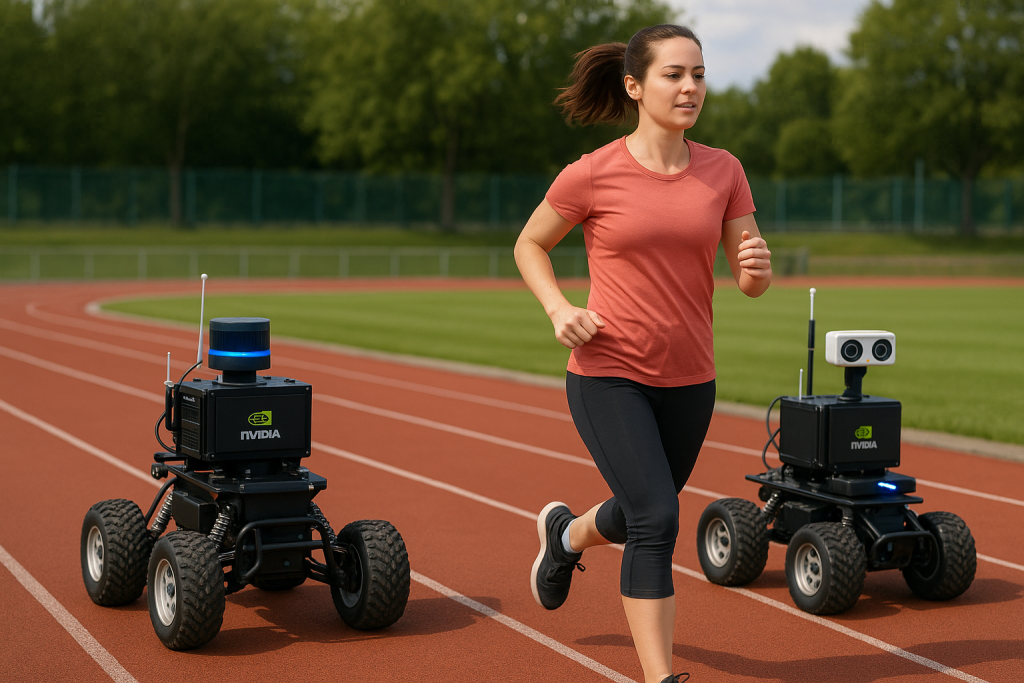
This project builds on the foundations of ROBOGait to develop an advanced multi-robot, multi-sensor gait analysis system capable of monitoring people while they walk or run. The system is designed to operate with at least two robots, while remaining scalable to larger robotic teams.
Our goal is to create an integrated platform that can capture, synchronize, and fuse data from multiple robots and sensors into a single unified dataset. From this dataset, the system extracts clinically and athletically relevant gait parameters such as stride length, inter-ankle distance, joint motion signals, and other key biomechanical indicators.
To improve the precision and reliability of these measurements, the project incorporates artificial intelligence techniques trained with data from ground-truth motion capture systems, including Vicon®, OptiTrack®, and validated manual annotation. The resulting platform is intended to deliver meaningful, practical insights in a format that is genuinely useful for therapists, clinicians, and sports professionals.
Project Objectives
The project focuses on several key research and development goals:
- Multi-robot data fusion and synchronization: Design robust algorithms capable of combining and synchronizing data collected simultaneously from multiple robots and heterogeneous sensors.
- AI-enhanced signal quality and parameter estimation: Improve the quality of gait signals and extracted parameters through machine learning approaches based on convolutional neural networks (CNNs) and recurrent neural networks (RNNs), including LSTM and Bi-LSTM architectures.
- Digital twin and patient simulation: Develop a digital twin environment that enables safe and efficient testing of control algorithms without requiring real patients, including the creation of a realistic patient avatar for simulation.
- Outdoor ground-truth acquisition for sports analysis: Design a solution based on a high-frequency, high-resolution static camera system to provide reliable outdoor ground-truth data for sports-oriented gait analysis.
- Therapist-friendly human-robot interface: Create a new therapist-robot interaction interface tailored for non-technical users, with a strong focus on usability, accessibility, and acceptance within clinical environments.
- Enhancement of ROBOGait robotic platforms: Upgrade and refine the robotic platforms originally developed in the ROBOGait project to improve performance, adaptability, and real-world usability.

“Proyecto PID2023-150967OB-I00 financiado por MICIU/AEI/10.13039/501100011033 y por FEDER, UE”