Project
The transport sector is responsible for one quarter of greenhouse gas emissions in Europe, and passenger cars account for more than 75% of this activity. Although electric vehicles (EVs) reduce emissions during their use, their dependence on the electrical grid introduces additional challenges, especially when this energy does not come from renewable sources.
In this context, the integration of photovoltaic solar energy in vehicles (VIPV) emerges as an innovative solution to extend driving range, reduce charging frequency, and lower the carbon footprint of transport. With a typical roof surface area (1.7–2 m²) equipped with solar cells, up to 3,400 km/year of solar-powered driving can be achieved, contributing to more sustainable mobility.
Why is this project necessary??
There is currently no photovoltaic module specifically designed to meet the demanding requirements of the automotive sector: light weight, reliability, aesthetics, mechanical strength, and competitive cost.
Conventional modules are flat, heavy (due to the use of glass), and unable to withstand the dynamic conditions experienced by a vehicle. For VIPV technology to be viable, it is essential to develop hybrid structures that integrate solar cells into metal body components while maintaining the vehicle’s safety and functionality.
How do we approach it?
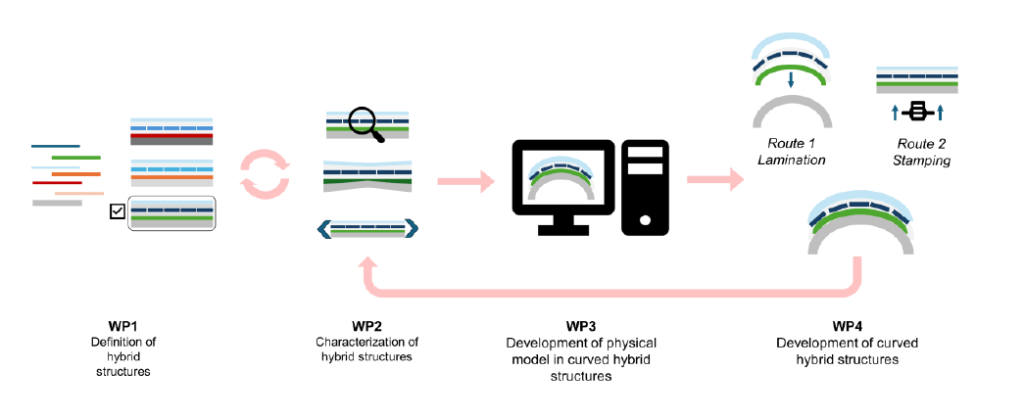
The Hybrid Structures for Integration of Photovoltaic Cells in Car Bodies (HyPVCar-CM) project, reference SYG-2024/ECO-1016, adopts an integrated approach that combines materials science, mechanical engineering, and photovoltaic technology. Solutions will be investigated to integrate solar cells into steel and aluminum, optimizing both design and manufacturing processes, from defining multilayer architectures to validating representative curved prototypes.
The overall objective is to establish the scientific and technological foundations for the reliable and cost-effective integration of photovoltaic cells into the metal bodywork of electric vehicles, contributing to transport decarbonization and energy independence.
Specific objectives.
- Define hybrid structures for VIPV.
Development of multilayer architectures including protective layers, encapsulants, electrical insulation, and metallic substrates. - Characterize mechanical and functional properties.
Macro- and microscale testing to assess tensile strength, fatigue, impact resistance, corrosion, and electrical performance after integration. - Develop a physical model for integration on curved surfaces.
Advanced finite element simulations to optimize lamination and stamping processes. - Validate representative prototypes.
Fabrication and testing of curved metal parts with integrated solar cells, subjected to accelerated tests equivalent to 1,000 km of driving.
| HyPVCar-CM Project Data | |
|---|---|
| Project duration | 36 months |
| Start date | January 1, 2026 |
| Reference | SYG-2024/ECO-1016 |
| Funding received | €758,000.00 |