Wastewater treatment
Our research group primarily focuses on environmental remediation, in particular water and wastewater treatment, using and extending various techiques including Advanced Oxidation Processes (AOPs). Our work addresses both chemical pollutants, such as micropollutants (MPs) and pharmaceutically active compounds (PhACs), and biological contaminants, including bacteria, viruses, antibiotic-resistant bacteria (ARB), and antibiotic resistance genes (ARGs). We study various AOPs, including UV-based treatments, solar photo-Fenton, and Sulfate Radical-based AOPs (SR-AOPs), alongside the development of novel heterogeneous catalysts. Our research spans contexts from municipal and hospital wastewaters in developed countries like Switzerland to sustainable solutions for developing countries. Additionally, our group explores innovative applications such as photocatalytic hydrogen fuel production from H2S using MWCNT-based nanocomposites. A significant focus is placed on elucidating mechanisms, including radical and non-radical degradation pathways, and optimizing operational parameters for practical application.
Recent interests and contributions
- Advanced oxidation processes for micropollutant removal in municipal wastewater. Our group studies the efficacy of Advanced Oxidation Processes (AOPs) for degrading micropollutants (MPs) and effluent organic matter (EfOM) in municipal wastewater. We have assessed UV, UV/H2O2, solar irradiation, Fenton, and solar photo-Fenton as tertiary treatments following secondary methods like activated sludge (AS), moving bed bioreactor (MBBR), and coagulation-flocculation (CF). One of our key findings is that AOP efficiency increased in the order CF < AS < MBBR, with UV/H2O2 after biological treatment (especially MBBR) yielding the highest elimination levels for MPs. Our research suggests that micropollutant degradation is significantly facilitated by the reduction of the overall organic load. Detailed degradation kinetics were also determined for various pollutants like Carbamazepine and Diclofenac.
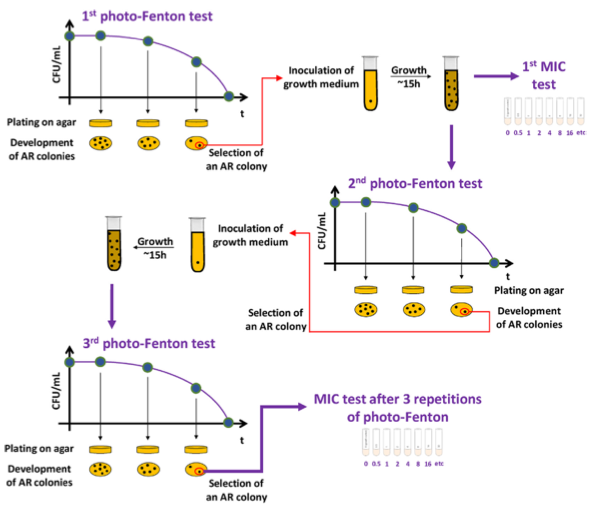
- Solar photo-Fenton disinfection of antibiotic-resistant bacteria and genes. Addressing the global threat of antibiotic resistance, our group has studied the elimination of antibiotic-resistant bacteria (ARB) and antibiotic resistance genes (ARGs) using solar light and solar photo-Fenton processes. We systematically analyzed various bacterial strains, including Staphylococcus aureus, Escherichia coli, and Klebsiella pneumoniae, with differing resistance patterns and cellular structures (Gram-positive/Gram-negative). A contribution of our group is the finding that antibiotic resistance does not imply resistance to oxidative treatment, as disinfection times were similar for both susceptible and resistant strains. Furthermore, bacterial structure did not significantly impact treatment effectiveness. Our group also reported that photo-Fenton was effective in reducing ARGs more rapidly than solar light alone, without inducing the development of bacteria with higher drug-resistance.
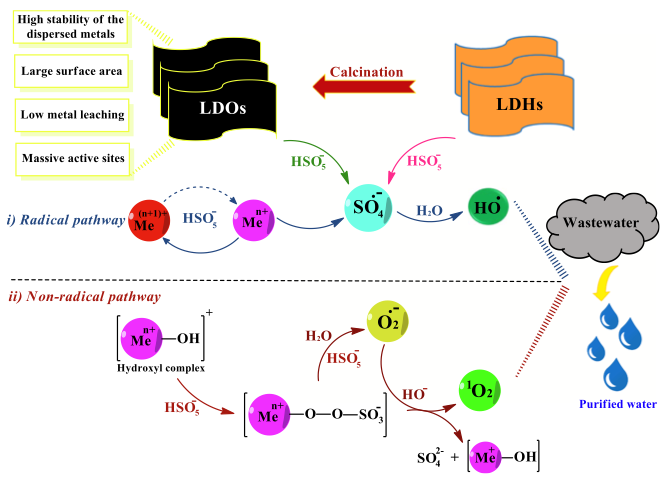
- Heterogeneous catalysis and sulfate radical-based AOPs (SR-AOPs) for industrial wastewater treatment. Our group’s research emphasizes the application of Sulfate Radical-based Advanced Oxidation Processes (SR-AOPs) for treating diverse industrial wastewaters (IWW), including landfill leachate, petrochemical, pharmaceutical, pulp/paper, and textile effluents. A contribution is the development and evaluation of various heterogeneous catalysts, such as metal oxides, carbon-based materials, and perovskites, for activating peroxymonosulfate (PMS) and peroxydisulfate (PDS). We have studied both radical (sulfate and hydroxyl radicals) and non-radical (e.g., singlet oxygen, electron transfer) degradation pathways, aiming to tailor catalyst properties for specific pollutant degradation in complex IWW matrices.
- Photocatalytic hydrogen production from hydrogen sulfide. Our group has developed nanocomposite photocatalysts for producing hydrogen fuel from alkaline H2S feed. Our work centers on fabricating MWCNT-based pn-nanocomposite photocatalysts, such as MWCNT/CoMn2O4-ZnO. Our group has elucidated the photocatalytic mechanism involving electron-hole pair generation, reactant adsorption, and subsequent redox conversion. We have demonstrated that incorporating MWCNTs significantly improves performance by increasing surface area, improving light absorption, and facilitating charge separation. Optimized catalyst compositions, such as a 1:1 molar ratio of CoMn2O4-ZnO, achieved maximum hydrogen evolution, further boosted by MWCNT addition (approximately 1.6 times) and potentially by external magnetic fields.
Groups and laboratories
Environment Coast and Ocean Research Laboratory (ECOREL)
Scientific-technological services
CIVILis researchers involved
Selected references
- Stefanos Giannakis, Franco Alejandro Gamarra Vives, Dominique Grandjean, Anoys Magnet, Luiz Felippe De Alencastro, César Pulgarin. Effect of advanced oxidation processes on the micropollutants and the effluent organic matter contained in municipal wastewater previously treated by three different secondary methods. Water Research 84, 295–306, 2015. https://doi.org/10.1016/j.watres.2015.07.030
- Stefanos Giannakis, Truong-Thien Melvin Le, Jose Manuel Entenza, Cesar Pulgarin. Solar photo-Fenton disinfection of 11 antibiotic-resistant bacteria (ARB) and elimination of representative AR genes. Evidence that antibiotic resistance does not imply resistance to oxidative treatment. Water Research 143, 334–345, 2018. https://doi.org/10.1016/j.watres.2018.06.062
- Stefanos Giannakis, Siting Liu, Anna Carratalà, Sami Rtimi, Masoud Talebi Amiri, Michaël Bensimon, César Pulgarin. Iron oxide-mediated semiconductor photocatalysis vs. heterogeneous photo-Fenton treatment of viruses in wastewater. Impact of the oxide particle size. Journal of Hazardous Materials 339, 223–231, 2017. https://doi.org/10.1016/j.jhazmat.2017.06.037
- Stefanos Giannakis, María Inmaculada Polo López, Dorothee Spuhler, José Antonio Sánchez Pérez, Pilar Fernández Ibáñez, César Pulgarin. Solar disinfection is an augmentable, in situ-generated photo-Fenton reaction—Part 2: A review of the applications for drinking water and wastewater disinfection. Applied Catalysis B: Environmental 198, 431–446, 2016. https://doi.org/10.1016/j.apcatb.2016.06.009
- Stefanos Giannakis, María Inmaculada Polo López, Dorothee Spuhler, Jose Antonio Sánchez Pérez, Pilar Fernández Ibáñez, César Pulgarin. Solar disinfection is an augmentable, in situ-generated photo-Fenton reaction—Part 1: A review of the mechanisms and the fundamental aspects of the process. Applied Catalysis B: Environmental 199, 199–223, 2016. https://doi.org/10.1016/j.apcatb.2016.06.009
- Stefanos Giannakis, Kun-Yi Andrew Lin, Farshid Ghanbari. A review of the recent advances on the treatment of industrial wastewaters by Sulfate Radical-based Advanced Oxidation Processes (SR-AOPs). Chemical Engineering Journal 406, 127083, 2021. https://doi.org/10.1016/j.cej.2020.127083
- Mona Kohantorabi, Gholamreza Moussavi, Stefanos Giannakis. A review of the innovations in metal- and carbon-based catalysts explored for heterogeneous peroxymonosulfate (PMS) activation, with focus on radical vs. non-radical degradation pathways of organic contaminants. Chemical Engineering Journal 411, 127957, 2021. https://doi.org/10.1016/j.cej.2020.127957
- Majid Ghanimati, Mohsen Lashgari, Paula Oulego, Stefanos Giannakis. MWCNT-based environmental nanocomposite photocatalyst and magnetic activity promotion to produce hydrogen fuel using H2S. Journal of Environmental Chemical Engineering 13, 115636, 2025. https://doi.org/10.1016/j.jece.2025.115636
- Stefanos Giannakis, Truong-Thien Melvin Le, Jose Manuel Entenza, Cesar Pulgarin. Solar photo-Fenton disinfection of 11 antibiotic-resistant bacteria (ARB) and elimination of representative AR genes. Evidence that antibiotic resistance does not imply resistance to oxidative treatment. Water Research 143, 334–345, 2018. https://doi.org/10.1016/j.watres.2018.06.062
- Stefanos Giannakis, Sami Rtimi, Cesar Pulgarin. Light-Assisted Advanced Oxidation Processes for the Elimination of Chemical and Microbiological Pollution of Wastewaters in Developed and Developing Countries. Molecules 22, 1070, 2017. https://doi.org/10.3390/molecules22071070