Environmental fluid mechanics and subsurface modeling
Our research group focuses on modeling complex fluid flow and coupled deformation processes in porous and fractured geological media. Our work spans fundamental investigations into physical phenomena and their application to critical challenges in geosciences, environmental science, and various engineering sectors. A cornerstone of our methodology involves the development and application of advanced numerical techniques, particularly phase-field models and fully coupled hydromechanical simulations, to address highly nonlinear and multiscale interactions within subsurface systems.
A central tenet of our research is the exploration of the intricate feedback loops between fluid dynamics and rock mechanics. This includes investigating how these coupled processes govern the initiation and propagation of brittle and fluid-driven fractures, the mechanisms of induced seismicity, and the long-term hydromechanical response of subsurface reservoirs. The group’s contributions range from conducting pore-scale simulations, proposing Darcy-scale models to describe unstable multi-phase flow patterns (such as gravity fingering and convective mixing) and elucidating universal scaling laws and pattern formation in contexts like geological CO2 sequestration and methane hydrate dynamics, to addressing practical challenges in underground hydrogen storage, enhanced geothermal systems, and the structural safety of civil engineering structures like dams.
Our approach is characterized by rigorous high-resolution numerical simulations designed to capture detailed physical processes and complex spatio-temporal behaviors. This is consistently reinforced by validation against experimental data and analytical solutions. Key concepts frequently integrated into our models include rock heterogeneity, multi-rate mass transfer in fractured systems, and rate-and-state friction laws for fault behavior, enabling the creation of robust and realistic predictive tools for a wide array of subsurface processes. This robust scientific framework provides crucial insights for both mitigating environmental risks and optimizing energy resource development.
Recent interests and contributions
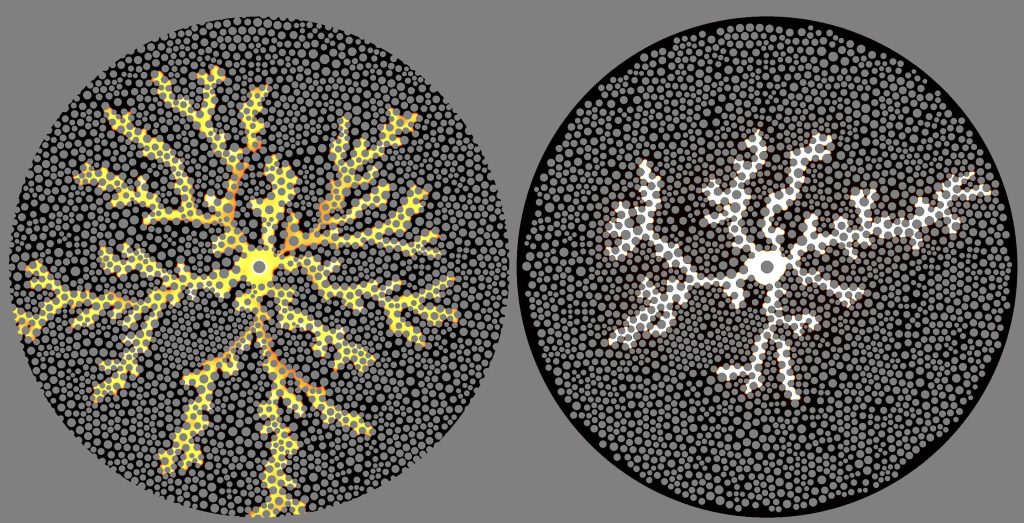
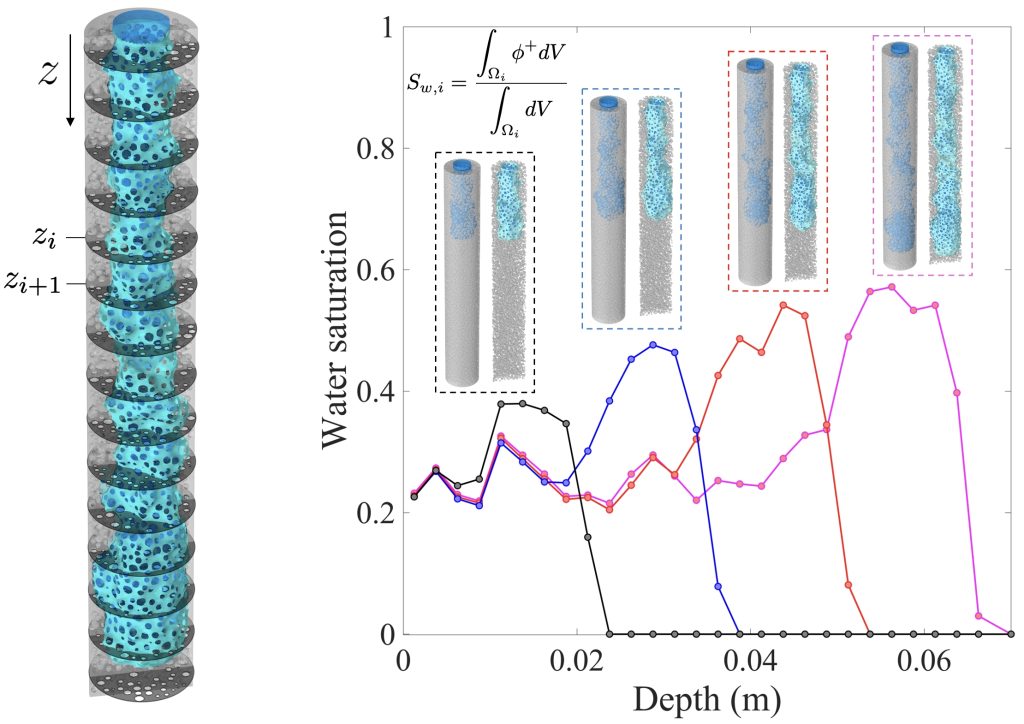
- Fluid flow and pattern formation in porous media. Our research group has significantly advanced the understanding of complex fluid flow and pattern formation in porous media, particularly in multi-phase and multi-component systems. We have developed novel models for unstable unsaturated flow, predicting gravity fingering, saturation overshoot, and finger characteristics. Our high-resolution 3D simulations of convective mixing, relevant to CO2 sequestration, elucidated cellular network structures and universal scaling laws governing their dynamics. Our group also developed pore-scale diffuse-interface models for liquid-vapor flow and phase change, detailing pressure fluctuations under varying wetting conditions. A recent innovation is fugacity-based diffuse-interface models for multicomponent multiphase (MCMP) flow, which integrate various equations of state to capture intricate thermodynamic and hydrodynamic behaviors for applications like CO2 sequestration and hydrogen storage. We have also modeled methane gas migration and hydrate crust formation, revealing “crustal fingering” patterns.
- Fracture mechanics and hydraulic fracturing. Our group has contributed to fracture mechanics, particularly fluid-driven fracture propagation in porous and elastic media, using advanced phase-field models. We have developed robust phase-field formulations for brittle fracture, validated experimentally and applied to civil engineering problems like concrete dams, considering hydraulic forces within fractures. We have developed an immersed-fracture formulation for fluid-driven fracture in elastic media, achieving full coupling between elastic deformation, fracture apertures, and fluid flow, validated with analytical solutions. Our group has also investigated fluid-driven fracture propagation in heterogeneous media, using Monte Carlo simulations to analyze how variable mechanical properties influence fracture trajectories and branching. These models were extended to poroelastic media, describing fluid flow via the Reynolds lubrication equation and the medium with Biot poroelasticity, enabling detailed studies of fracture propagation, arrest, and branching under complex fluid injection/extraction.
- Induced seismicity and fault mechanics. Our research group is very active in modeling induced seismicity and fault mechanics, focusing on the complex interplay between fluid flow, rock deformation, and frictional fault behavior. We have developed fully coupled hydromechanical simulations with fault rheology described through rate-and-state friction laws, revealing diverse stick-slip patterns, from stable sliding to large coseismic events. We have developed monolithically coupled, implicit, and time-adaptive finite element models for dynamic earthquake sequences in poroviscoelastic media, providing the first dynamic simulations of ruptures in rate-and-state faults. Our research highlighted that stressing-rate effects in frictional strength evolution lead to delayed fault weakening and reactivation under fluid injection, significantly impacting seismic hazard assessment. Our group has studied supershear earthquake ruptures in poroelastic media, linking poroelastic coupling with rupture speed transitions. Furthermore, we have studied rupture directivity in injection-induced earthquakes, identifying the influence of tectonic stress ratios and injection parameters on rupture asymmetry, and characterized earthquake nucleation in poroelastic media.
- Flow and deformation in fractured/heterogeneous porous media (upscaling/non-equilibrium). Our group has made contributions to understanding flow and deformation in fractured and heterogeneous porous media, particularly through advanced upscaling and non-equilibrium modeling. We have developed a multirate mass transfer approach for double-porosity poroelasticity, specifically designed to incorporate non-equilibrium effects and spatial variability in hydraulic properties. This approach accurately describes the observed scalings for coupled flow and deformation, outperforming classical dual-porosity models which assume local equilibrium within matrix blocks. Our work specifically investigated anomalous pressure diffusion and deformation in two- and three-dimensional heterogeneous fractured media, using outcrop analogs like the Bristol Channel geometry. We demonstrated that heterogeneity leads to strong tailing in mechanical displacements and subsidence due to pressure depletion, with power-law scalings not predicted by conventional theories. This research provides quantitative understanding for interpreting land subsidence, drawdown, and flow rate data in reservoirs and aquifers.

Groups and laboratories
Hydroinformatics and Water Management Group
Scientific-technological services
CIVILis researchers involved
Selected references
- L. Cueto-Felgueroso, R. Juanes. Nonlocal Interface Dynamics and Pattern Formation in Gravity-Driven Unsaturated Flow through Porous Media. Physical Review Letters 101 (24): 244504, 2008. https://doi.org/10.1103/PhysRevLett.101.244504
- L. Cueto-Felgueroso, R. Juanes. A phase field model of unsaturated flow. Water Resources Research 45: W10409, 2009. https://doi.org/10.1029/2009WR007945
- B. Jha, L. Cueto-Felgueroso, R. Juanes. Fluid Mixing from Viscous Fingering. Physical Review Letters 106: 194502, 2011. https://doi.org/10.1103/PhysRevLett.106.194502
- Xiaojing Fu, Luis Cueto-Felgueroso, Ruben Juanes. Pattern formation and coarsening dynamics in three-dimensional convective mixing in porous media. Philosophical Transactions of the Royal Society A 371: 20120388, 2013. https://doi.org/10.1098/rsta.2012.0388
- X. Fu, L. Cueto-Felgueroso, D. Bolster, R. Juanes. Rock dissolution patterns and geochemical shutdown of CO2–brine–carbonate reactions during convective mixing in porous media. Journal of Fluid Mechanics 764: 296–315, 2015. https://doi.org/10.1017/jfm.2014.647
- David Santillán, Juan Carlos Mosquera, Luis Cueto-Felgueroso. Phase-field model for brittle fracture. Validation with experimental results and extension to dam engineering problems. Engineering Fracture Mechanics 178: 109–125, 2017. https://doi.org/10.1016/j.engfracmech.2017.04.020
- David Santillán, Ruben Juanes, Luis Cueto-Felgueroso. Phase field model of fluid-driven fracture in elastic media: Immersed-fracture formulation and validation with analytical solutions. Journal of Geophysical Research: Solid Earth 122: 2565–2589, 2017. https://doi.org/10.1002/2016JB013572
- Luis Cueto-Felgueroso, David Santillán, Juan Carlos Mosquera. Stick-slip dynamics of flow-induced seismicity on rate and state faults. Geophysical Research Letters 44: 4098–4106, 2017. https://doi.org/10.1002/2016GL072045
- David Santillán, Juan-Carlos Mosquera, Luis Cueto-Felgueroso. Fluid-driven fracture propagation in heterogeneous media: Probability distributions of fracture trajectories. Physical Review E 96 (5): 053002, 2017. https://doi.org/10.1103/PhysRevE.96.053002
- D. Santillán, R. Juanes, L. Cueto-Felgueroso. Phase field model of hydraulic fracturing in poroelastic media: Fracture propagation, arrest, and branching under fluid injection and extraction. Journal of Geophysical Research: Solid Earth 123: 2127–2155, 2018. https://doi.org/10.1002/2017JB014740
- X. Fu, L. Cueto-Felgueroso, R. Juanes. Nonequilibrium thermodynamics of hydrate growth on a gas–liquid interface. Physical Review Letters 120: 144501, 2018. https://doi.org/10.1103/PhysRevLett.120.144501
- P. Pampillón, D. Santillán, J. C. Mosquera, L. Cueto-Felgueroso. Dynamic and quasi-dynamic modeling of injection-induced earthquakes in poroelastic media. Journal of Geophysical Research: Solid Earth 123: 5730–5759, 2018. https://doi.org/10.1029/2018JB015533
- Luis Cueto-Felgueroso, Xiaojing Fu, Ruben Juanes. Pore-scale modeling of phase change in porous media. Physical Review Fluids 3: 084302, 2018. https://doi.org/10.1103/PhysRevFluids.3.084302
- L. Cueto-Felgueroso, C. Vila, D. Santillán, J. C. Mosquera. Numerical modeling of injection–induced earthquakes using laboratory–derived friction laws. Water Resources Research 54: 9833–9859, 2018. https://doi.org/10.1029/2017WR022363
- S. Andrés, D. Santillán, J. C. Mosquera, L. Cueto-Felgueroso. Delayed weakening and reactivation of rate-and-state faults driven by pressure changes due to fluid injection. Journal of Geophysical Research: Solid Earth 124: 11,917–11,937, 2019. https://doi.org/10.1029/2019JB018109
- X. Fu, J. Jimenez-Martinez, T. P. Neumann, J. W. Carey, L. Cueto-Felgueroso, R. Juanes. Crustal fingering: A new mode of methane gas migration in the hydrate stability zone. Proceedings of the National Academy of Sciences of the USA 117 (50): 31442–31449, 2020. https://doi.org/10.1073/pnas.2011064117
- Sandro Andrés, Marco Dentz, Luis Cueto-Felgueroso. Multirate Mass Transfer Approach for Double-Porosity Poroelasticity in Fractured Media. Water Resources Research 57 (8): e2021WR029804, 2021. https://doi.org/10.1029/2021WR029804
- P. Pampillón, D. Santillán, J. C. Mosquera, L. Cueto-Felgueroso. The role of pore fluids in supershear earthquake ruptures. Scientific Reports 13: 398, 2023. https://doi.org/10.1038/s41598-022-27159-x
- S. Andrés, M. Dentz, L. Cueto‐Felgueroso. Anomalous pressure diffusion and deformation in two and three‐dimensional heterogeneous fractured media. Water Resources Research 60: e2023WR036529, 2024. https://doi.org/10.1029/2023WR036529
- S. Andrés et al. Rupture directivity and poroelastic coupling in earthquakes induced by fluid injection. Engineering Fracture Mechanics 322: 111123, 2025. https://doi.org/10.1016/j.engfracmech.2025.111123
- Luis Cueto-Felgueroso, Andrés Soage, Luis F. Ayala. Fugacity-based diffuse-interface model of multicomponent multiphase flow. Computer Methods in Applied Mechanics and Engineering 445: 118171, 2025. https://doi.org/10.1016/j.cma.2025.118171
- Guillermo Giacomi, Marco Dentz, Luis Cueto-Felgueroso. Two-dimensional numerical simulations to assess the impact of rock heterogeneity and capillary trapping on hydrogen storage in deep aquifers. Journal of Energy Storage 129: 117170, 2025. https://doi.org/10.1016/j.est.2025.117170
- D. Santillán, C. Vila, J. C. Mosquera, L. Cueto-Felgueroso. Nucleation patterns of fluid-induced earthquakes in poroelastic media. Geomechanics for Energy and the Environment 43: 100713, 2025. https://doi.org/10.1016/j.gete.2025.100713