Testing, monitoring and advanced numerical analysis of structures
Our research group primarily focuses on the dynamic behavior, degradation, and control of civil engineering structures, employing a combination of advanced numerical modeling, experimental observations, and practical application-oriented studies. Core areas of activity include structural health monitoring and the assessment of degradation mechanisms, particularly focusing on corrosion-induced failures in external grouted post-tensioning tendons in bridges. Our group develops and validates non-linear finite element (FE) modeling approaches to predict the mechanical behavior and failure risk, considering factors like re-anchoring, steel plasticity, and initial stressing forces.
Another research line in our group is active vibration control (AVC) for lightweight structures susceptible to human-induced vibrations, such as footbridges and floors. We have developed innovative control strategies like Dynamics Inversion (DI) techniques and algorithms such as Velocity Feedback with Dynamics Inversion (VFDI) and Broadband Force Cancellation (BBFC), often validated through full-scale experimental campaigns. These efforts aim to enhance force tracking, improve stability, and achieve significant vibration attenuation.
The group also studies the impact resistance of reinforced concrete (RC) beams, in particular concerning shear strength and failure modes. We use advanced experimental techniques like Digital Image Correlation (DIC) and High-Speed Video (HSV) to determine time-dependent sectional forces and analyze dynamic shear force-bending moment (M-V) interaction diagrams. We have also proposed strengthening methods using High-Performance Fiber-Reinforced Cement Composites (HPFRCCs) to mitigate fragmentation and enhance structural integrity under impact.
Finally, the group explores the dynamic response of high-speed railway bridges, focusing on the influence of different track typologies (ballasted vs. ballastless) on bridge deflections and accelerations under train loads. This comprehensive activity demonstrates a commitment to advancing the safety, durability, and performance of critical civil infrastructure.


Recent interests and contributions
- Degradation and failure assessment of post-tensioning tendons. Our group has studied corrosion-induced failure in external grouted post-tensioning tendons, a critical issue compromising bridge safety. We have developed and validated a non-linear finite element (FE) modeling approach to accurately simulate the mechanical behavior and risk of failure in such tendons under varying corrosion conditions. Some of our key contributions include analyzing the influence of steel plasticity, large deformations, and the re-anchoring effect on stress redistribution and tendon degradation. Through parametric studies, we have evaluated the critical number of broken strands required for tendon failure, considering factors like the number of corroded strands, corrosion degree, and initial stressing force. Our work provides valuable insights for bridge inspections, enabling engineers to assess failure risk and determine necessary repair actions.
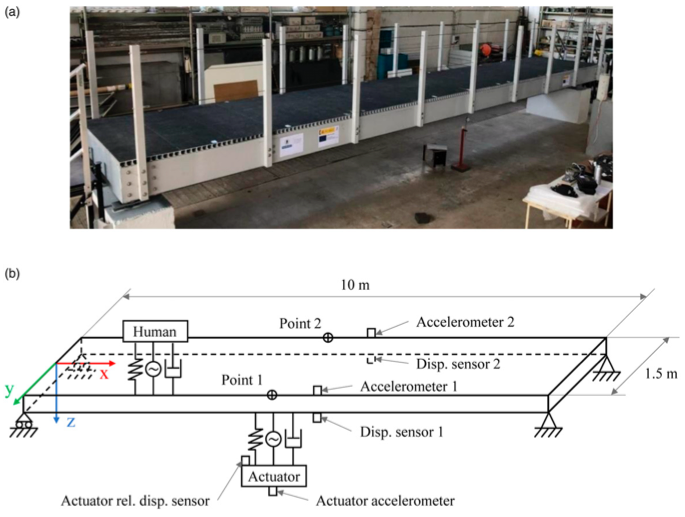
- Active vibration control of lightweight structures. Our group has contributed to mitigating human-induced vibrations in slender, lightweight structures like footbridges and long-span floors using active vibration absorbers (AVAs). We introduce and implement Dynamics Inversion (DI) techniques to improve the force control of electrodynamic proof-mass actuators (PMAs). The proposed techniques improve force tracking and vibration attenuation. We have developed the Velocity Feedback with Dynamics Inversion (VFDI) and the Broadband Force Cancellation (BBFC) algorithms. Experimental validation on a glass fiber reinforced polymer (GFRP) footbridge demonstrated that VFDI significantly reduced peak accelerations and root mean square (RMS) values compared to classical velocity feedback. We have also incorporated Integral Resonant Control (IRC) combined with actuator dynamics inversion for robust control and high stability margins.
- Impact resistance and strengthening of reinforced concrete beams. Our group has studied the impact resistance of reinforced concrete (RC) beams, particularly focusing on shear strength and complex shear-bending interaction under impact loads. An important contribution of our work is the development and application of an experimental methodology using Digital Image Correlation (DIC) supported by High-Speed Video (HSV) to determine the time-dependent evolution of sectional forces (bending moments and shear forces) and crack patterns during impact events. We have derived dynamic shear force-bending moment (M-V) interaction diagrams, demonstrating that impact response differs significantly from quasi-static conditions and proposing dynamic amplification factors (DAF) to characterize rate sensitivity. Furthermore, our group has studied the use of High-Performance Fiber-Reinforced Cement Composites (HPFRCCs) as strengthening and anti-spalling layers, proving that embedded steel bars and higher fiber amounts enhance debris retention and impact resistance.
- Dynamic response of high-speed railway bridges. Our group uses numerical simulation to study the dynamic behavior of short-span high-speed (HS) railway bridges, with a specific focus on the influence of different track typologies on structural response. Our work explicitly models the track-bridge interaction, including all components from rails to the bridge girder, to assess dynamic deflections and accelerations under moving train loads. We have compared conventional ballasted track with two ballastless track systems: a monolithic continuous slab and independent short slabs. Our results suggest that ballastless track systems can significantly reduce dynamic deflections and accelerations in the bridge girder, particularly for critical train speeds exceeding 300 km/h, compared to ballasted track. Our research provides insights into the limited influence of the track-bridge interaction degree on the bridge girder’s dynamic effects.

Groups and laboratories
Scientific-technological services
Bending tests on beams (Ensayos de flexión en vigas)
Static measurements in structural tests (Medidas estáticas en ensayos estructurales)
Compression tests on structural elements (Ensayos de compresión en elementos estructurales)
Impact tests on structures (Ensayos de impacto en estructuras)
(DynApp) – DynApp: A mobile application for advanced dynamic analysis
CIVILis researchers involved
Selected references
- Belén Vecino, Carlos M.C. Renedo, Jaime H. García-Palacios, Iván M. Díaz. Degradation modelling of external grouted post-tensioning tendons: Numerical assessment under corrosion conditions. Engineering Structures 327, 119620, 2025. https://doi.org/10.1016/j.engstruct.2025.119620
- José Ramírez-Senent, Jaime H. García-Palacios, Iván M. Díaz. Implementation of dynamics inversion algorithms in active vibration control systems: Practical guidelines. Control Engineering Practice 141, 105746, 2023. https://doi.org/10.1016/j.conengprac.2023.105746
- José Ramírez-Senent, Iván M. Díaz, Jaime H. García-Palacios, Javier F. Jiménez Alonso. Application of dynamics inversion techniques to the force control of electrodynamic actuators used for active vibration absorption. Journal of Physics: Conference Series 2647, 172004, 2024. https://doi.org/10.1088/1742-6596/2647/17/172004
- Iván M. Díaz, Emiliano Pereira, Paul Reynolds. Integral resonant control scheme for cancelling human-induced vibrations in light-weight pedestrian structures. Structural Control and Health Monitoring 19 (1), 55–69, 2012. https://doi.org/10.1002/stc.423
- C. M. Casado, I. M. Díaz, J. de Sebastián, A. V. Poncela, A. Lorenzana. Implementation of passive and active vibration control on an in-service footbridge. Structural Control and Health Monitoring 20 (1), 70–87, 2013. https://doi.org/10.1002/stc.471
- José Ramírez-Senent, Christian Gallegos-Calderón, Jaime H. García-Palacios, Iván M. Díaz. Active control of human-induced vibrations on lightweight structures via electrodynamic actuator dynamics inversion. Journal of Vibration and Control 30 (1–2), 88–103, 2024. https://doi.org/10.1177/10775463221140983
- Gonzalo S.D. Ulzurrun, Carlos Zanuy. Dynamic shear force-bending moment interaction diagrams in RC beams under impact. Engineering Structures 308, 118021, 2024. https://doi.org/10.1016/j.engstruct.2024.118021
- Carlos Zanuy, Alejandro García-Sainz. Evaluation of Impact-Critical RC Beams Strengthened with a Bottom Layer of HPFRCC. Structural Engineering International 33 (1), 41–51, 2023. https://doi.org/10.1080/10168664.2021.1965944
- G.S.D. Ulzurrun, C. Zanuy. Time-Variation of Shear Forces Affecting the Impact Resistance of Reinforced Concrete Beams. Hormigón y Acero 75 (302–303), 65–78, 2024. https://doi.org/10.33586/hya.2022.3088
- Elena Pilar Martínez, Gonzalo S.D. Ulzurrun, Carlos Zanuy. Influence of Track Typology on the Dynamic Response of Short-Span High-Speed Railway Bridges. Hormigón y Acero 74 (301), 7–20, 2023. https://doi.org/10.33586/hya.2023.3120