Hydropower and energy transition
The group’s research focuses on optimizing the operation and management of hydropower systems, particularly pumped-storage hydropower plants (PSHPs), within evolving electricity markets and in the context of increasing renewable energy penetration. Our group addresses the need for hydropower to provide flexibility and ancillary services to power grids that are increasingly dominated by variable renewable energy sources like wind and solar.
We develop sophisticated optimization models and methodologies for making strategic and operational decisions of hydropower systems and for performingshort- and medium-term scheduling, bidding strategies, and economic viability assessments. These models account for various market conditions, technical constraints, operational different types of uncertainties, and the unique characteristics of different hydropower plants and technologies, including variable-speed units and hydraulic short-circuit configurations.
Furthermore, our group develops dynamic simulation models of hydropower systems and uses these models to analyze the dynamic response of the system under particular operating conditions and to define real-time control strategies for an effective provision of flexibility and ancillary services. investigates the dynamic response and control of hydropower systems, including governor tuning and frequency control in isolated grids, and the impact of environmental constraints on operational flexibility and revenue. Our work provides insights into enhancing hydropower’s contribution to grid stability and sustainability.
Recent interests and contributions
- Hydropower generation scheduling. Our group has contributed to developing advanced models for optimizing the operation of PSHPs hydropower systems in liberalized electricity markets. We focus on jointly optimizing participation in both energy and ancillary services markets to maximize revenue, especially with the increasing penetration of renewable energy sources and on particular plant configurations such as hydro units sharing common penstocks and with head-dependent production functions. We evaluate the economic viability of different flexible PSHP hydropower configurationsdesigns, such as variable-speed units and hydraulic short-circuit operation, demonstrating their potential to significantly increase income by providing load-frequency controlbalancing services and other regulation services. We also study the impact of uncertainties in market prices and water inflowswind power forecasts on optimal scheduling decisions and revenues. Lastly, we are working on the application of AI to assist optimization solvers in solving hydro- and hydro-thermal scheduling problems, demonstrating their usefulness in reducing the computation time to get optimal generation schedules.
- Hydropower plant modernization and enhanced flexibility. We study the modernization of existing hydropower plants to improve their energy generation and operational flexibility. We quantify the benefits of practices like dam heightening, reduction of head losses in waterways, turbine and generator replacement, construction of re-regulation reservoirs, implementation of sophisticated operation strategies, and digitalization, estimating potential increases in annual energy generation and revenue. Our work extends to emerging technologies that provide greater flexibility, such as variable-speed drives, hydraulic short-circuit operation, and the integration of hydropower with other fast-acting energy storage systems like batteries, supercapacitor or flywheels. These innovations aim to meet the demands of modern grids for balancing and ancillary services.
- Operational and economic impact of hydropower operationenvironmental constraints. We study the operational and economic consequences of environmental regulations on hydropower plant operation. We have developed revenue-driven optimization models, often using mixed-integer linear programming and dynamic programming, to assess the impact of constraints such as e.g. minimum environmental flows, maximum ramping rates, and mandatory run-of-river operation. Our studies quantify how these environmental measures influence the water value, reduce operational flexibility and, consequently, the annual revenue of hydropower producers. Our results suggest that hydropower revenues are quite sensitive to the presence and magnitude of these constraints across different water year types, providing important information for policy-making and negotiations between plant owners and environmental authorities.
- Dynamic response and frequency control of hydropower systems. We analyze the dynamic response of hydropower plants, especially those having uncommon configurations (e.g. long conduits, especial surge tank geometries), under particular operating conditions (e.g. the provision of balancing services, load rejection). We have developed and compared governor tuning criteria, incorporating effects like penstock elasticity, which are crucial for stability, particularly in isolated power systems.
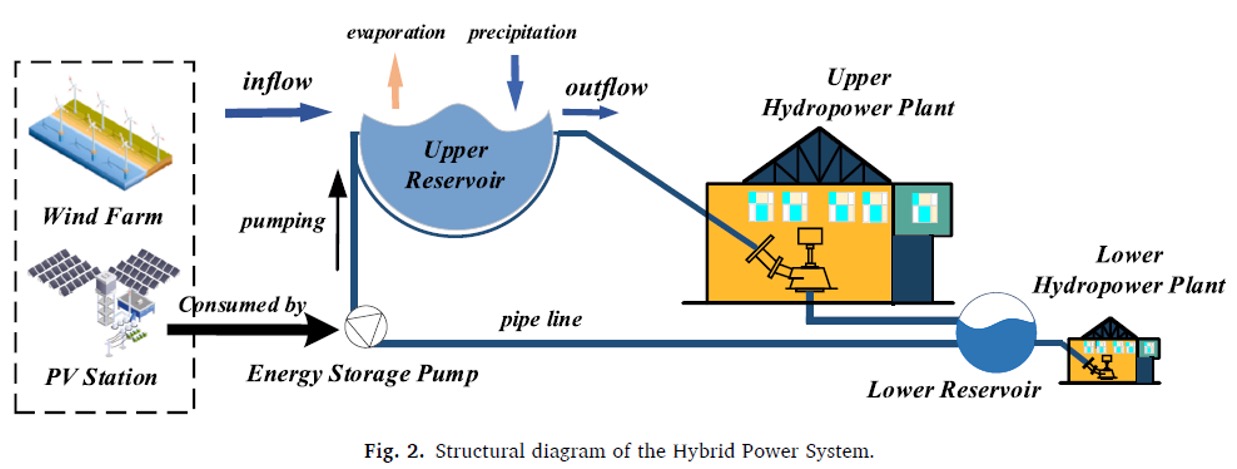
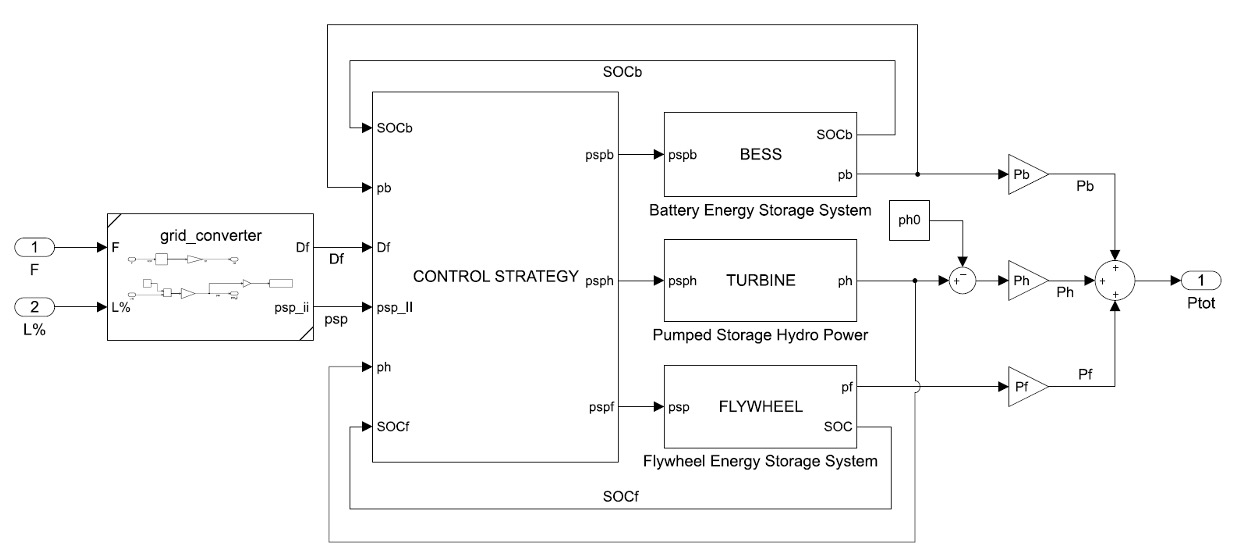
- Hybrid hydropower plants. We study the coordinated operation of hydropower systems with renewable generation technologies and fast-acting storage systems, such as batteries, flywheels and supercapacitors. We work on the design of hierarchical control systems for the optimal distribution of control effort allocated to the hybrid hydropower plant so as to guarantee the provision of a quality frequency control while minimizing the wear in various hydropower plant components (penstock, turbine regulating system and turbine runner) and the aging of the storage devices. We also develop optimization models for making operational decisions of hybrid hydropower plants participating in energy and balancing markets aimed to maximize the revenue and the lifetime of the plant’s elements.
Groups and laboratories
Hydroinformatics and Water Management Group
Scientific-technological services
CIVILis researchers involved
Selected references
- Pérez-Díaz, J.I., Chazarra, M., García-González, J., Cavazzini, G., Stoppato, A. Trends and challenges in the operation of pumped-storage hydropower plants. Renewable and Sustainable Energy Reviews 44, 767–784, 2015. https://doi.org/10.1016/j.rser.2015.01.029
- Yang, W., Zhao, Z., Pérez-Díaz, J.I., Hunt, J.D., Vagnoni, E., Nøland, J.K., Quaranta, E., Wang, R., Li, X., Cheng, Y. Pumped storage hydropower operation for supporting clean energy systems. Nature Reviews Clean Technology 1, pages 454–473, 2025. https://doi.org/10.1038/s44359-025-00057-x
- Pérez-Díaz, J.I. Optimal short-term operation schedule of a hydropower plant in a competitive electricity market. Energy Conversion and Management 51 (12), 2955–2966, 2010. https://doi.org/10.1016/j.enconman.2010.06.038
- Sarasúa, J.I., Pérez-Díaz, J.I., Wilhelmi, J.R., Sánchez-Fernández, J.Á. Dynamic response and governor tuning of a long penstock pumped-storage hydropower plant equipped with a pump-turbine and a doubly fed induction generator. Energy Conversion and Management 106, 151–164, 2015. https://doi.org/10.1016/j.enconman.2015.09.030
- Quaranta, E., Aggidis, G., Boes, R.M., Comoglio, C., De Michele, C., Patro, E.R., Georgievskaia, E., Harby, A., Kougias, I., Muntean, S., Pérez-Díaz, J., Romero-Gomez, P., Rosa-Clot, M., Schleiss, A.J., Vagnoni, E., Wirth, M., Pistocchi, A. Assessing the energy potential of modernizing the European hydropower fleet. Energy Conversion and Management 246, 114655, 2021. https://doi.org/10.1016/j.enconman.2021.114655
- Pérez-Díaz, J.I., Wilhelmi, J.R. Assessment of the economic impact of environmental constraints on short-term hydropower plant operation. Energy Policy 38 (12), 7960–7970, 2010. https://doi.org/10.1016/j.enpol.2010.07.037
- Guisández, I., Pérez-Díaz, J.I., Wilhelmi, J.R. Assessment of the economic impact of environmental constraints on the annual operation of a hydropower plant. Energy Policy 61, 1332–1343, 2013. https://doi.org/10.1016/j.enpol.2013.05.104
- Chazarra, M., Pérez-Díaz, J.I., García-González, J., Praus, R. Economic viability of pumped-storage power plants participating in the secondary regulation service. Applied Energy 216, 224–233, 2018. https://doi.org/10.1016/j.apenergy.2018.02.025
- Xiong, H., Egusquiza, M., Østergaard, P.A., Pérez-Díaz, J.I., Sun, G., Egusquiza, E., Patelli, E., Xu, B., Duan, H., Chen, D., Luo, X. Multi-objective optimization of a hydro-wind-photovoltaic power complementary plant with a vibration avoidance strategy. Applied Energy 301, 117459, 2021. https://doi.org/10.1016/j.apenergy.2021.117459
- Pérez-Díaz, J.I., Jiménez, J. Contribution of a pumped-storage hydropower plant to reduce the scheduling costs of an isolated power system with high wind power penetration. Energy 109, 92–104, 2016. https://doi.org/10.1016/j.energy.2016.04.014
- Pérez-Díaz, J.I., Wilhelmi, J.R., Sánchez-Fernández, J.Á. Short-term operation scheduling of a hydropower plant in the day-ahead electricity market. Electric Power Systems Research 80 (11), 1535–1542, 2010. https://doi.org/10.1016/j.epsr.2010.06.017
- Kougias, I., Aggidis, G., Avellan, F., Deniz, S., Lundin, U., Moro, A., Muntean, S., Novara, D., Pérez-Díaz, J.I., Quaranta, E., Schild, P., Theodossiou, N. Analysis of emerging technologies in the hydropower sector. Renewable and Sustainable Energy Reviews 113, 109257, 2019. https://doi.org/10.1016/j.rser.2019.109257
- Fernández-Muñoz, D., Pérez-Díaz, J.I., Guisández, I., Chazarra, M., Fernández-Espina, Á. Fast frequency control ancillary services: An international review. Renewable and Sustainable Energy Reviews 120, 109662, 2020. https://doi.org/10.1016/j.rser.2019.109662
- Chazarra, M., Pérez-Díaz, J.I., García-González, J. Optimal Joint Energy and Secondary Regulation Reserve Hourly Scheduling of Variable Speed Pumped Storage Hydropower Plants. IEEE Transactions on Power Systems 33 (1), 103–115, 2018. https://doi.org/10.1109/TPWRS.2017.2699920