Geotechnical engineering and rock mechanics
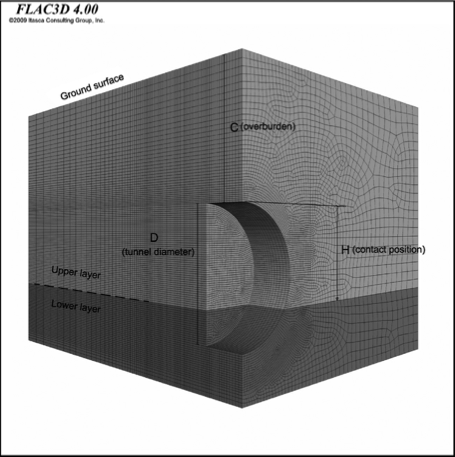
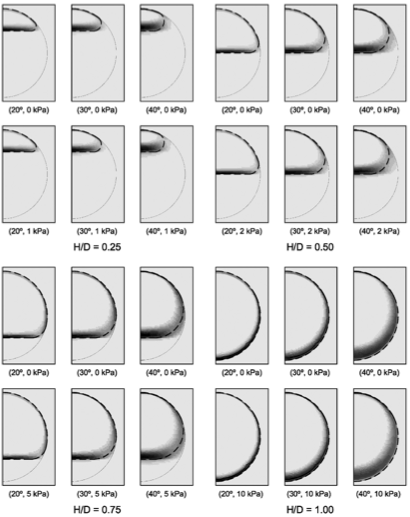
Our group studies complex geotechnical problems using advanced numerical simulations, analytical models, and laboratory experiments. A significant part of our work focuses on the behavior of geomaterials and infrastructure under various loading conditions, including static, and time-dependent effects (e.g. cyclic loading). We develop sophisticated computational tools, and validate them against experimental observations. These models include Discrete Element Method (DEM) simulations with Rate Process Theory (RPT) for rock creep, and two-stage elastoplastic models (COMPILE) for soil-pile-structure interaction under tunnelling and deep excavations. Our group contributes to tunnel face stability analysis using upper-bound limit analysis with non-linear failure criteria and consideration of layered grounds and partial collapse. We also investigate innovative applications of Artificial Neural Networks (ANN) for rock slope stability assessment, energy-based formulations for pore pressure generation in soils, and integrated methodologies for evaluating soil stiffness degradation using various laboratory tests. This comprehensive approach aims to enhance the understanding, prediction, and design of geotechnical structures in challenging environments.
Recent interests and contributions
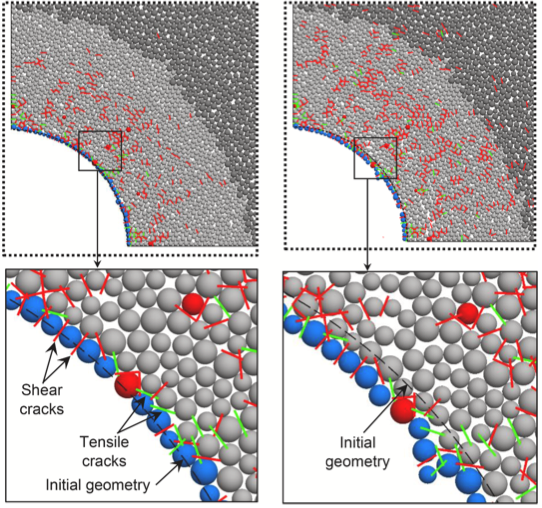
- Numerical modeling of rock-concrete interfaces and rock creep. We have used Distinct Element Method (DEM) simulations to analyze the shear behavior of rock-concrete interfaces under different boundary conditions and joint roughness. The modeling results are validated against experimental data. We have proposed a novel DEM-Rate Process Theory (RPT) methodology to simulate rock creep in deep tunnels, capturing all creep stages and including tertiary creep and rock damage evolution. This approach is extended to Rock Shear Creep (RSC) under direct shear tests, investigating the influence of shear and normal stresses and micro-crack propagation, demonstrating good agreement with experimental trends.
- Tunnel stability and face collapse mechanisms. We have developed and validated advanced limit analysis mechanisms for tunnel face stability. This includes extending rotational collapse mechanisms to layered grounds, capable of assessing partial collapse and considering variable soil properties. We have also generalized these mechanisms to incorporate non-linear failure criteria like the Hoek-Brown model for heavily fractured rock masses, developing design charts and validating predictions with 3D numerical simulations. Our work contributes to improving the accuracy and computational efficiency of tunnel stability predictions.
- Soil-pile-structure interaction under various loading conditions. Part of our research focuses on the interaction of piles, pile groups, and piled structures with soil under active (vertical loads) and passive (tunnelling, deep excavations) conditions. We have used the COMPILE two-stage elastoplastic model to investigate the impact of layered soils, non-linear soil behavior (yielding, stiffness degradation), and superstructure stiffness on displacements and internal forces. This includes 3D simulations of twin tunnelling effects on existing piles, analyzing “cut” and “adjacent” piles, negative skin friction, and bearing capacity reduction.
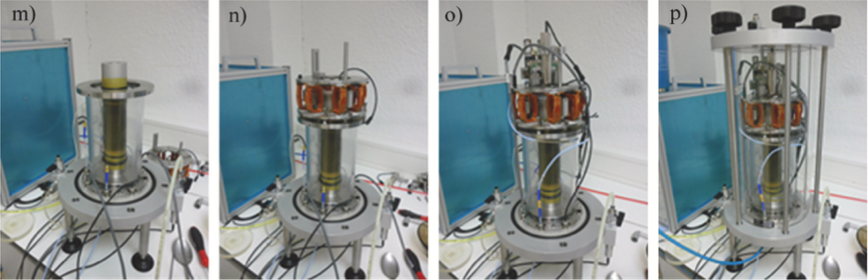
- Advanced material characterization and stability analysis in geomechanics. We have proposed an energy-based formulation for pore pressure generation in saturated soils, integrating static and cyclic stresses and validating with cyclic simple shear tests for fine-grained soils. We have also developed an integrated methodology for evaluating soil stiffness degradation using combined resonant column, cyclic triaxial, and cyclic simple shear tests on mine tailings, proposing empirical functions for wider applicability. Besides physics-based modeling, we have applied Artificial Neural Networks (ANN) for rock slope stability assessment considering non-linear Hoek-Brown failure, dilatancy, and groundwater levels. The ultimate bearing capacity of anisotropic rock masses is also determined using modified Hoek-Brown and Mohr-Coulomb criteria.
Groups and laboratories
Rock Mechanics and Geotechnical Engineering
Scientific-technological services
Computation of Tunnel Face Collapse Pressure
Tunnel Face Collapse Pressure for Layered Grounds
CIVILis researchers involved
Selected references
- Gutiérrez-Ch J.G., Senent S., Melentijevic S., Jimenez R. Distinct element method simulations of rock-concrete interfaces under different boundary conditions. Engineering Geology 240, 123–139, 2018. https://doi.org/10.1016/j.enggeo.2018.04.017
- Franza A., Zheng C., Marshall A.M., Jimenez R. Investigation of soil–pile–structure interaction induced by vertical loads and tunnelling. Computers and Geotechnics 139, 104386, 2021. https://doi.org/10.1016/j.compgeo.2021.104386
- Gutiérrez-Ch J.G., Senent S., Zeng P., Jimenez R. DEM simulation of rock creep in tunnels using Rate Process Theory. Computers and Geotechnics 142, 104559, 2022. https://doi.org/10.1016/j.compgeo.2021.104559
- Zheng C., Franza A., Jimenez R. Analysis of floating and end-bearing pile foundations affected by deep-excavations. Computers and Geotechnics 153, 105075, 2023. https://doi.org/10.1016/j.compgeo.2022.105075
- Senent S., Jimenez R. A tunnel face failure mechanism for layered ground, considering the possibility of partial collapse. Tunnelling and Underground Space Technology 47, 182–192, 2015. https://doi.org/10.1016/j.tust.2014.12.014
- Senent S., Mollon G., Jimenez R. Tunnel face stability in heavily fractured rock masses that follow the Hoek–Brown failure criterion. International Journal of Rock Mechanics & Mining Sciences 60, 440–451, 2013. https://doi.org/10.1016/j.ijrmms.2013.01.004
- Gutiérrez-Ch J.G., Senent S., Graterol E.P., Zeng P., Jimenez R. Rock shear creep modelling: DEM – Rate process theory approach. International Journal of Rock Mechanics & Mining Sciences 161, 105295, 2023. https://doi.org/10.1016/j.ijrmms.2022.105295
- Galindo R., Viana da Fonseca A., Ríos S., Patiño H. Energy-based formulation for generation of pore pressure due to a combination of static and cyclic stresses. Engineering Geology 346, 107887, 2025. https://doi.org/10.1016/j.enggeo.2024.107887
- Simic-Silva P-T., Martínez-Bacas B., Galindo-Aires R., Simic D. 3D simulation for tunnelling effects on existing piles. Computers and Geotechnics 124, 103625, 2020. https://doi.org/10.1016/j.compgeo.2020.103625
- Millán M.A., Galindo R. Artificial neural network for rock slope stability assessment considering nonlinear failure criterion, dilatancy, and groundwater. Engineering Applications of Artificial Intelligence 159, 111556, 2025. https://doi.org/10.1016/j.engappai.2025.111556
- Serrano A., Olalla C., Galindo R.A. Ultimate bearing capacity of an anisotropic discontinuous rock mass based on the modified Hoek–Brown criterion. International Journal of Rock Mechanics & Mining Sciences 83, 24–40, 2016. https://doi.org/10.1016/j.ijrmms.2015.12.014
- Galindo R.A., Serrano A., Olalla C. Ultimate bearing capacity of rock masses based on modified Mohr-Coulomb strength criterion. International Journal of Rock Mechanics & Mining Sciences 93, 215–225, 2017. https://doi.org/10.1016/j.ijrmms.2016.12.017
- Patiño H., Molina-Gómez F., Galindo R., Viana da Fonseca A. Integrated evaluation of stiffness degradation by combining Resonant-Column, Cyclic Triaxial and Cyclic Simple Shear Tests: Application to Riotinto mine tailings. Geomechanics for Energy and the Environment 41, 100652, 2025. https://doi.org/10.1016/j.gete.2025.100652
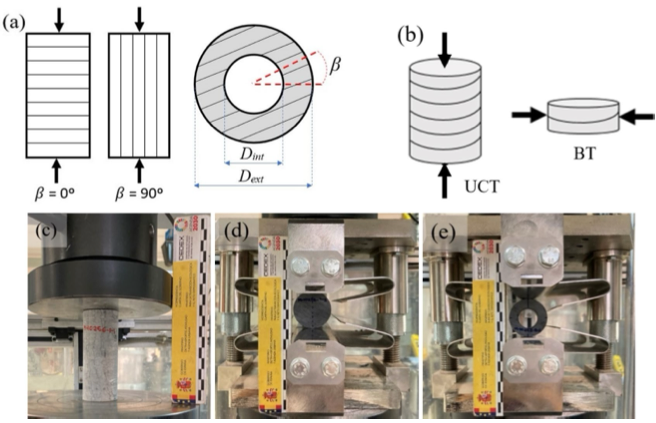
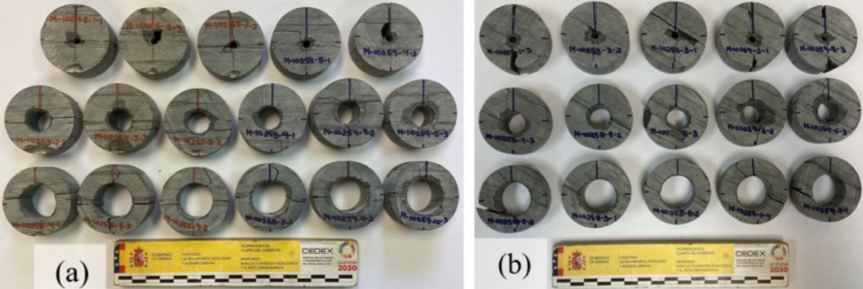
- Santos de Alencar A., Muñiz-Menéndez M., Galindo R. Ring test: a new interpretation to estimate tensile strength of rock. Rock Mechanics and Rock Engineering 57, 8911–8921, 2024. https://doi.org/10.1007/s00603-024-03894-7