Flood forecasting and hydroclimatic extremes
Our research group works on hydrological and hydraulic engineering, with a strong emphasis on flood risk assessment, forecasting, and mitigation in the context of climate change and urbanization. We use advanced numerical models for physics-based flow modeling and hydrological models (e.g., Iber, RIBS, COSMO4SUB), stochastic rainfall generators (STORAGE), and statistical methodologies, to analyze complex hydrological processes. Our work involves simulating extreme precipitation and runoff events, which are then used to assess the safety of critical infrastructure like raft foundations and dams. We also use advance modeling and statistics to develop real-time flood forecasting and early warning systems. We investigate the anthropogenic impacts on flood dynamics, such as those caused by urbanization and changes in land use. Our research uses real world data, climate projections, and multi-objective calibration techniques to provide valuable insights for risk reduction strategies and policy-making.
Recent interests and contributions
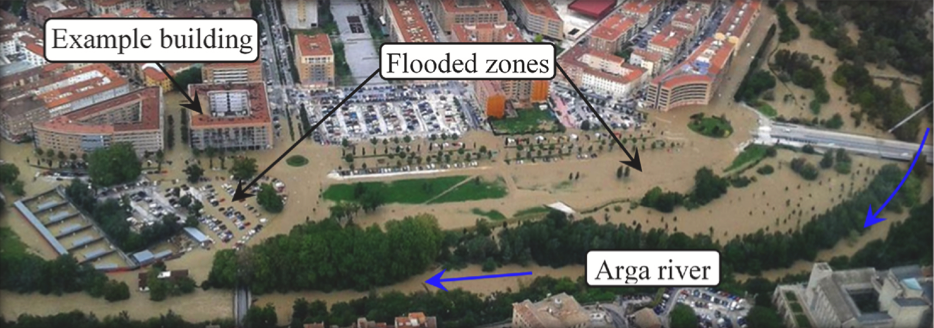
- Flood risk assessment and mitigation measures for urban infrastructure. Our group investigates how river floods impact urban structures, specifically the mobilization of pore water pressure (PWP) beneath raft foundations. We have developed finite difference schemes to simulate various flooding scenarios, incorporating real river flood events and different river regimes. A key contribution is the assessment of various mitigation measures, including levees/floodwalls, waterproof diaphragm walls, and drainage systems. Our results suggest that combining measures or using drains may significantly reduce PWP mobilization, with drains offering a cost-effective and feasible solution due to manageable outflow discharges.
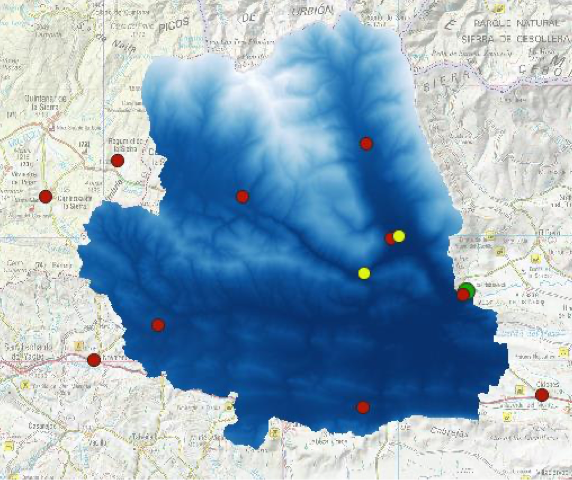
- Flood forecasting and early warning systems. We develop probabilistic flood forecasting tools to improve early warning systems. Our methodology involves calibrating distributed hydrological models, such as the Real-time Interactive Basin Simulator (RIBS), for specific river basins (e.g., the Francolí River basin in Spain). We integrate rainfall field forecasts generated by analog-based meteorological methods as input data to simulate rainfall-runoff processes. One of our contributions is the provision of a probability distribution of possible response flows. Our results suggest that longer antecedent precipitation periods generally increase forecast accuracy.
- Hydrological dam safety and climate change impact. Our group studies hydrological dam safety, focusing on the projected impacts of climate change on extreme rainfall and flood events. We have proposed a methodology that uses a stochastic rainfall generator (STORAGE) to simulate long, high-resolution precipitation time series under current and future climate conditions. Our workflow is designed to include various emission scenarios (RCP 4.5 and 8.5). These simulated rainfall series are then transformed into runoff using continuous hydrological models (COSMO4SUB), and a Volumetric Evaluation Method (VEM) is applied to simulate spillway gate operations, determining maximum reservoir water levels and outflow hydrographs. Our results suggest that future peak outflows at dams, like the Eugui Dam, may be lower due to drier initial soil moisture content, leading to higher infiltration.
- Urbanization and land use change impacts on fluvial floods. We have investigated how human-induced changes, particularly urbanization and altered land use, influence river flood dynamics. We use a paired-catchment approach to compare urban and non-urban catchments, assessing the evolution of impervious surfaces using high-resolution Copernicus products. We have employed a suite of statistical methods (Pettitt, Mann-Kendall, Poisson regression, multiple linear regression) to detect trends in flood magnitude and frequency, linking them to both climatic and anthropogenic factors. Our work provides insights into how increased imperviousness contributes to changes in flood behavior, highlighting the significance of both factors in understanding flood risk in areas like Poland.
Groups and laboratories
Hydroinformatics and Water Management Group
Scientific-technological services
CIVILis researchers involved
Selected references
- Eliana Paola Graterol, José G. Gutiérrez-Ch, Luis Mediero, Salvador Senent. Numerical analysis of mitigation measures to reduce the pore water pressure beneath a raft foundation during real river floods. International Journal of Disaster Risk Reduction 129, 105768, 2025. https://doi.org/10.1016/j.ijdrr.2025.105768
- Daniel Carril-Rojas, Carlo Guzzon, Luis Mediero, Javier Fernández-Fidalgo, Luis Garrote, Maria Carmen Llasat, Raul Marcos-Matamoros. A Flood Forecasting Method in the Francolí River Basin (Spain) Using a Distributed Hydrological Model and an Analog-Based Precipitation Forecast. Hydrology 12 (8), 220, 2025. https://doi.org/10.3390/hydrology12080220
- Enrique Soriano, Luis Mediero, Andrea Petroselli, Davide Luciano De Luca, Ciro Apollonio, Salvatore Grimaldi. Assessment of the Impact of Climate Change on Dam Hydrological Safety by Using a Stochastic Rainfall Generator. Hydrology 12 (6), 153, 2025. https://doi.org/10.3390/hydrology12060153
- Marco Lompi, Enrica Caporali, Luis Mediero, Bernardo Mazzanti. Improving flash flood risk assessment using a simple approach for extreme rainfall scaling and storms transposition. Journal of Flood Risk Management 15 (3), e12796, 2022. https://doi.org/10.1111/jfr3.12796
- Juan-Carlos Ciscar, Ana Iglesias, Luc Feyen, László Szabó, Denise Van Regemorter, Bas Amelung, Robert Nicholls, Paul Watkiss, Ole B. Christensen, Rutger Dankers, Luis Garrote, Clare M. Goodess, Alistair Hunt, Alvaro Moreno, Julie Richards, Antonio Soria. Physical and economic consequences of climate change in Europe. Proceedings of the National Academy of Sciences 108 (3), 11721–11726, 2011. https://doi.org/10.1073/pnas.1011612108
- Daniel Carril-Rojas, Luis Mediero. Bivariate Analysis with Synthetic Hydrograph Shapes for Hydrological Dam Safety Assessment. Environmental Sciences Proceedings 25, 2, 2023. https://doi.org/10.3390/ECWS-7-14175
- Nelson Venegas-Cordero, Luis Mediero, Mikołaj Piniewski. Urbanization vs. climate drivers: investigating changes in fluvial floods in Poland. Stochastic Environmental Research and Risk Assessment 38, 2841–2857, 2024. https://doi.org/10.1007/s00477-024-02717-z