Coastal engineering and sustainable port infrastructure
The ECOREL-UPM research group focuses on maritime, coastal, and port engineering. The group is committed to generating new knowledge and advancing the United Nations’ Sustainable Development Goals (SDGs). The group’s vision is to be at the forefront for innovative and excellent solutions. Our activities span diverse research areas, including offshore energy solutions, with emphasis on reliable, cost-effective foundations and support structures for large monopiles; coastal research focused on conservation and exploitation, in particular seabed–structure interaction, developing practical guidance to predict and mitigate scour around offshore foundations; port infrastructure with new designs and materials, optimizing energy systems and operational strategies to cut carbon footprints in line with the European Green Deal and environment and Climate Change to minimize human impact; digital asset management, applying BIM (and related digital-twin workflows) to streamline inspections, maintenance, and lifecycle planning of port structures. Together, these lines deliver science-based tools and methodologies that may help owners and operators de-risk designs, improve performance, and accelerate the transition to smarter, cleaner coastal infrastructure.
Recent interests and contributions
- Offshore wind energy: foundations and support structures. Our group has contributed to the design of foundations, sub structures, and support structures for offshore wind turbines, with a particular focus on monopiles. Monopiles constitute over 80% of current installations. We have identified critical challenges related to the large diameters (over 2m) of modern monopiles, where traditional design formulas might be unsuitable. We have developed novel, simple formulas to estimate the length and weight of large steel monopiles, based on a comprehensive database of 30 European offshore wind farms. Our work also addresses design uncertainties, including lifetime, return periods, and load combinations, to name a few.
- Carbon footprint reduction and smart ports. This research line addresses the need for ports to decarbonize, in alignment with global sustainability goals like the European Green Deal and SDGs. Our work has focused on optimizing smart energy infrastructure within port Energy Management Systems (EMSs) to effectively reduce carbon footprints (CF). We have proposed an innovative methodology for accurate CF calculation in seaports, detailing new boundaries and emission scopes (1, 2, and 3). Through sensitivity analysis applied to power alternative scenarios, we have identified practical and feasible renewable energy strategies for ports, exemplified by a case study of the Port of Valencia.
- Scour phenomenon and protection in offshore wind farms. Our research group investigates various methods for predicting maximum scour depth and extension around monopile foundations in offshore wind farms, particularly in shallow waters. We emphasize the importance of incorporating climate-specific parameters, such as the dimensionless wave height (H0), into design methodologies. Our group has proposed formulations to define the extent of scour protections based on wave conditions in transitional waters. Our contributions include gathering extensive data from operational European offshore wind farms to characterize scour phenomena and inform the design of protection systems, such as riprap, classifying foundations by H0 values.
- Application of BIM in port infrastructure maintenance. Our group has pioneered a new method for managing port infrastructure conservation by integrating traditional maintenance approaches with Building Information Modeling (BIM). Recognizing the nascent stage of BIM in port maintenance, our work offers a practical framework to leverage BIM as a central database for inspections, graphical documentation, and repair histories within a 3D georeferenced model. The proposed methodology was validated through a practical case study, involving the modeling of sections of the Outer Port of A Coruña’s main and spur breakwaters in Revit, and proposing an extension to existing element classification systems to include “pathologies” specific to marine civil works.
Groups and laboratories
Laboratorio de Puertos y Costas, ECOREL-UPM
Environment Coast and Ocean Research Laboratory (ECOREL)
Scientific-technological services
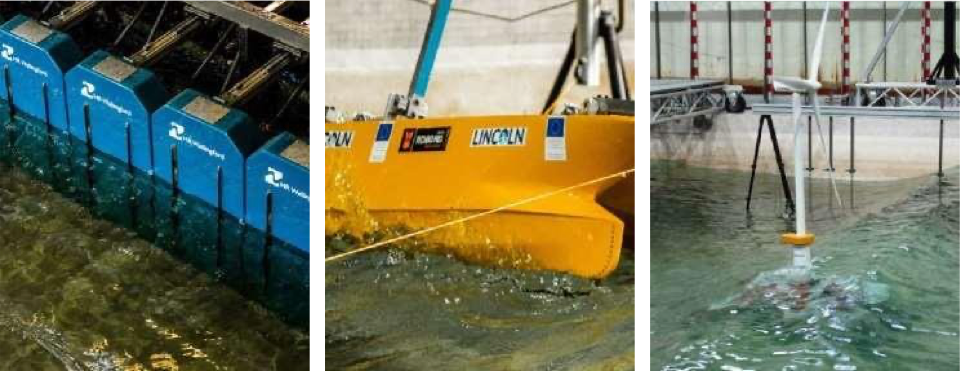
Research facilities of the Environment Coast and Ocean Research Laboratory. ECOREL-UPM
CIVILis researchers involved
Selected references
- Negro, V.; López-Gutiérrez, J.-S.; Esteban, M.D.; Alberdi, P.; Imaz, M.; Serraclara, J.-M. Monopiles in offshore wind: Preliminary estimate of main dimensions. Ocean Engineering 133, 253–261, 2017. https://doi.org/10.1016/j.oceaneng.2017.02.011
- Esteban, M.D.; Diez, J.J.; López-Gutiérrez, J.S.; Negro, V. Why offshore wind energy? Renewable Energy 36 (3), 444–450, 2011. https://doi.org/10.1016/j.renene.2010.07.009
- Matutano, C.; Negro, V.; López-Gutiérrez, J.S.; Esteban, M.D. Scour prediction and scour protections in offshore wind farms. Renewable Energy 57, 358–365, 2013. https://doi.org/10.1016/j.renene.2013.01.048
- Negro, V.; López-Gutiérrez, J.-S.; Esteban, M.D.; Matutano, C. Uncertainties in the design of support structures and foundations for offshore wind turbines. Renewable Energy 63, 125–132, 2014. https://doi.org/10.1016/j.renene.2013.08.041
- Issa Zadeh, S.B.; Esteban Perez, M.D.; López-Gutiérrez, J.-S.; Fernández-Sánchez, G. Optimizing Smart Energy Infrastructure in Smart Ports: A Systematic Scoping Review of Carbon Footprint Reduction. Journal of Marine Science and Engineering 11 (10), 1921, 2023. https://doi.org/10.3390/jmse11101921
- Issa-Zadeh, S.B.; Esteban, M.D.; López-Gutiérrez, J.-S.; Garay-Rondero, C.L. Unveiling the Sensitivity Analysis of Port Carbon Footprint via Power Alternative Scenarios: A Deep Dive into the Valencia Port Case Study. Journal of Marine Science and Engineering 12 (8), 1290, 2024. https://doi.org/10.3390/jmse12081290
- Valdepeñas, P.; Esteban Pérez, M.D.; Henche, C.; Rodríguez-Escribano, R.; Fernández, G.; López-Gutiérrez, J.-S. Application of the BIM Method in the Management of the Maintenance in Port Infrastructures. Journal of Marine Science and Engineering 8 (12), 981, 2020. https://doi.org/10.3390/jmse8120981
- Portillo Juan, N.; Negro Valdecantos, V.; Esteban, M.D.; López Gutiérrez, J.S. Review of the Influence of Oceanographic and Geometric Parameters on Oscillating Water Columns. Journal of Marine Science and Engineering 10 (2), 226, 2022. https://doi.org/10.3390/jmse10020226
- Issa Zadeh, S.B.; López Gutiérrez, J.S.; Esteban, M.D.; Fernández-Sánchez, G.; Garay-Rondero, C.L. A Framework for Accurate Carbon Footprint Calculation in Seaports: Methodology Proposal. Journal of Marine Science and Engineering 11 (5), 1007, 2023. https://doi.org/10.3390/jmse11051007
- Esteban, M.D.; López-Gutiérrez, J.-S.; Negro, V.; Neves, M.G. Coastal Engineering: Sustainability and New Technologies. Journal of Marine Science and Engineering 11 (8), 1562, 2023. https://doi.org/10.3390/jmse11081562
- Oliver, J.M.; Esteban, M.D.; López-Gutiérrez, J.-S.; Negro, V.; Neves, M.G. Optimizing Wave Overtopping Energy Converters by ANN Modelling: Evaluating the Overtopping Rate Forecasting as the First Step. Sustainability 13 (3), 1483, 2021. https://doi.org/10.3390/su13031483
- Issa Zadeh, S.B.; López Gutiérrez, J.S.; Esteban, M.D.; Fernández-Sánchez, G.; Garay-Rondero, C.L. Scope of the Literature on Efforts to Reduce the Carbon Footprint of Seaports. Sustainability 15 (11), 8558, 2023. https://doi.org/10.3390/su15118558