Economics and finance for sustainable infrastructure
Our research primarily focuses on the economic analysis and performance optimization of Public-Private Partnerships (PPPs) and outsourced public services, particularly within the transport infrastructure sector. Our work addresses complex issues such as financial valuation, real options theory, comprehensive risk management, and the design of efficient contractual arrangements. We conduct ex-post evaluations of PPP projects, assessing whether projects traditionally deemed “failures” (e.g., bankrupt concessions) are truly detrimental from broader societal or public sector perspectives. Our analysis often reveals unexpected benefits in these PPP projects. We also investigate the influence of procurement procedures on transaction costs, and advocate for methods that minimize these costs and enhance market competition. Furthermore, we explore optimal payment mechanisms and incentive schemes in PPP contracts and outsourced services, using agency theory to balance risk transfer and performance incentives effectively. On the more theoretical side, we develop real options theories for valuing contractual flexibility and quantitative analysis for empirical validation, contributing to a deeper understanding of PPP dynamics and outcomes across various contexts.
Recent interests and contributions
- Real options approach for valuation and risk management in PPPs. Our group applies real options theory to value flexibility and manage risk in highway concessions and other infrastructure PPPs. We demonstrate how options embedded in concession contracts, such as minimum traffic guarantees or the right of early reversion, can be systematically valued. By modeling traffic volume as a stochastic underlying asset, our methodology provides a risk-neutral procedure to quantify these options, offering critical insights for both public authorities and concessionaires in decision-making and contract design. The proposed approach helps design more transparent and efficient concession agreements by quantifying the value of contractual flexibility.
- Analysis of transaction costs and procurement procedures in PPPs. This research line focuses on the transaction costs in PPPs, and how different procurement procedures impact these costs. The group’s empirical work contrasts “Open” and “Negotiated” tendering procedures, revealing that Open procedures result in significantly lower ex-ante transaction costs for both public and private sectors. We argue that high transaction costs, often associated with PPPs, may largely be a consequence of lengthy and complex negotiations inherent in negotiated procedures, rather than an intrinsic feature of PPPs. Our research illustrates the need to minimize these costs to ensure Value for Money (VfM) and fosters competition. It may also question the widespread, often unjustified, use of negotiated procedures.
- Design of optimal payment mechanisms and incentives in PPPs/public services. Our group has contributed to the optimal design of payment mechanisms and incentive systems in transport PPPs and the broader outsourcing of public services. Using agency theory, we have proposed models for payment structures that combine fixed components with variable payments linked to service quality and user numbers. The proposed payment structures aim at efficiently managing of demand and performance risks. A key finding is the identification of conditions under which outsourcing a public service becomes economically unfeasible, particularly when there is high uncertainty in measuring service quality. Our work suggests that a nuanced approach is warranted, demonstrating that optimal contracts under imperfect information should include a distribution of cost savings between the public authority and the contractor, rather than sole reliance on performance or usage-based payments.
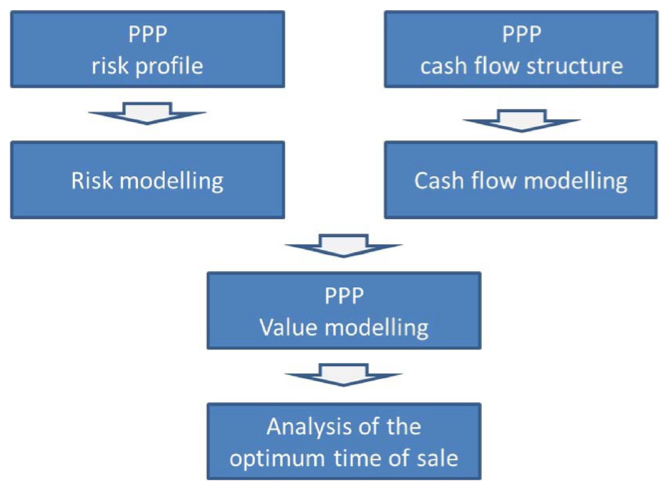
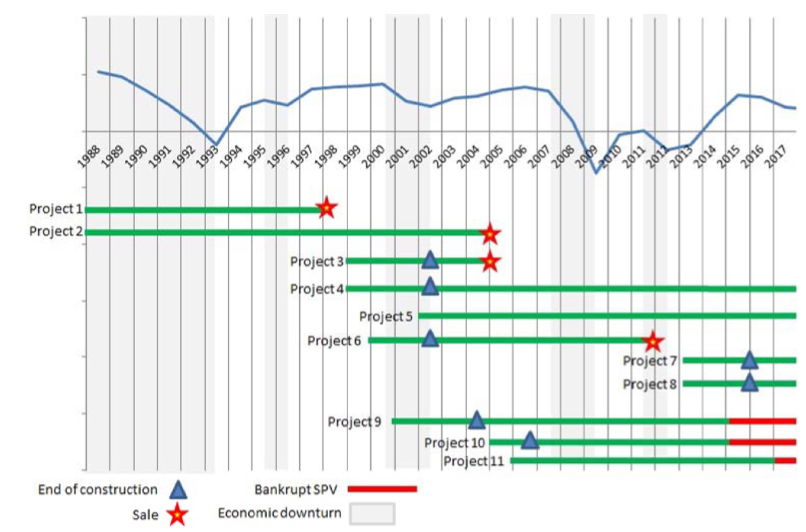
- Ex-post evaluation of PPP project performance. We have conducted comprehensive ex-post analyses of PPP projects, including those conventionally considered failures. With these studies, we wish to offer a broader assessment of their success or failure from the perspective of society and the public sector. Our study of the bankrupt R-3 and R-5 toll motorways in Spain concluded that, despite the concessionaire’s financial distress, the project was still beneficial to society and saved the granting authority significant costs by effectively transferring materialized risks to the private sector. We advocate for systematic ex-post evaluations to capture the full, long-term impact of PPPs beyond immediate financial returns to private investors. Our work also explores how private infrastructure sponsors manage their PPP portfolios, questioning the rationality and optimal timing of asset rotation strategies against economic cycles.
Groups and laboratories
Economics, Financing and Sustainable Management of Infrastructure
Scientific-technological services
CIVILis researchers involved
Selected references
- Vicente Alcaraz Carrillo de Albornoz, Antonio Sánchez Soliño, Antonio Lara Galera, José Miguel Isabel Álvarez. Bankrupt PPPs: Is it really so bad? Case study of R-3 and R-5 toll motorways in Spain. Transport Policy 114, 78–87, 2021. https://doi.org/10.1016/j.tranpol.2021.09.007
- Antonio Sánchez Soliño & Pilar Gago de Santos. Transaction Costs in Transport Public–Private Partnerships: Comparing Procurement Procedures. Transport Reviews: A Transnational Transdisciplinary Journal 30 (3), 389–406, 2010. https://doi.org/10.1080/01441640903037941
- Antonio Sánchez Soliño, Antonio L. Lara Galera, Fernando Cabero Colín. Valuation of the option of early reversion in road concessions. European Journal of Transport and Infrastructure Research 18 (2), 239–249, 2018. https://doi.org/10.18757/ejtir.2018.18.2.3232
- Antonio L. Lara Galera and Antonio Sánchez Soliño. A Real Options Approach for the Valuation of Highway Concessions. Transportation Science 44 (3), 416–427, 2010. https://doi.org/10.1287/trsc.l090.0299
- Antonio Sánchez Soliño and Vicente Alcaraz Carrillo de Albornoz. Improving the payment mechanism in transport public–private partnerships. Public Money & Management 41, 246–254, 2019. https://doi.org/10.1080/09540962.2019.1684013
- Antonio Sánchez Soliño and Pilar Gago de Santos. Influence of the Tendering Mechanism in the Performance of Public-Private Partnerships: A Transaction Cost Approach. Public Performance & Management Review 40 (1), 97–118, 2016. https://doi.org/10.1080/15309576.2016.1177558
- Samuel Carpintero, Jose Manuel Vassallo, and Antonio Sánchez Soliño. Dealing with Traffic Risk in Latin American Toll Roads. Journal of Management in Engineering 30 (1), 05014016, 2014. https://doi.org/10.1061/(ASCE)ME.1943-5479.0000266
- Vicente Alcaraz Carrillo de Albornoz, Juan Molina Millán, and Antonio Sánchez Soliño. Managing a Portfolio of Public–Private Partnerships: Concessionaire Perspective. Journal of Management in Engineering 34 (1), 05017008, 2018. https://doi.org/10.1061/(ASCE)ME.1943-5479.0000651
- Antonio Sánchez Soliño. Sustainability of Public Services: Is Outsourcing the Answer? Sustainability 11 (24), 7231, 2019. https://doi.org/10.3390/su11247231