Safety and monitoring of hydraulic infrastructure
Our research aims at enhancing dam safety and structural integrity through a multidisciplinary approach. Our work spans predictive modeling of dam behavior using advanced machine learning techniques, empirical comparisons, and data analysis to detect anomalies and anticipate failures, particularly those linked to displacements and leakage. A significant focus is on numerical simulations, employing a variety of numerical approaches, from the classical Finite Element Method (FEM) to sophisticated coupled fluid-structure interaction models (Eulerian fluid dynamics with Particle Finite Element Method – PFEM) to analyze complex phenomena like dam cracking in arch dams and overtopping-induced failure in rockfill dams. This includes studying the impact of cracks on monitoring data, evaluating numerical model simplifications, and simulating seepage and mass sliding. Furthermore, we investigate the thermal response of concrete dams, developing methodologies for solar radiation treatment and hydration models to assess thermal stresses and cracking risks during construction and operation. Our activities also involve experimental validation using physical and quasi-prototype scale models to test novel protection technologies for embankment dams against erosion.
Recent interests and contributions
- Machine learning for dam behavior modeling and prediction. We have extensively contributed to dam behavior prediction using advanced machine learning (ML) techniques. We have benchmarked various ML algorithms, including Random Forests (RF), Boosted Regression Trees (BRT), Neural Networks (NN), Support Vector Machines (SVM), and Multivariate Adaptive Regression Splines (MARS), demonstrating their superior accuracy over conventional statistical models like Hydrostatic-Seasonal-Time (HST) for dam modeling. Our research identified BRT, NN, and RF as the most accurate models for predicting dam displacements and leakage. A key finding was the importance of optimizing the training set size by removing early-life dam data, which significantly improves model fit and prediction accuracy. This work highlights ML’s potential to enhance dam safety assessment.
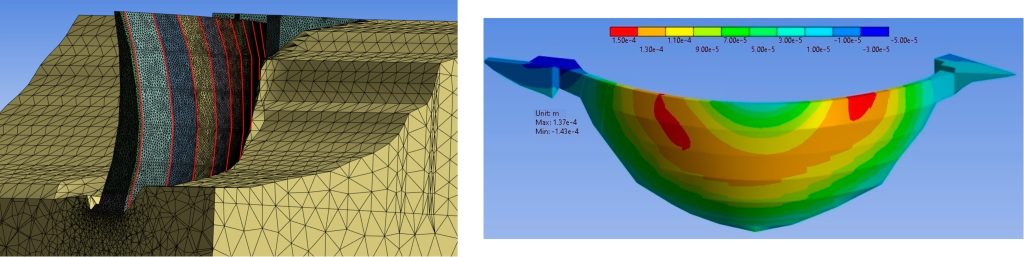
- Numerical modeling of dam cracking and structural analysis. Our group has developed and validated advanced Finite Element (FE) methodologies for simulating cracks in arch dams and analyzing their impact on monitoring data. We have investigated how crack length, depth, and the precision and placement of monitoring devices influence the detectability of cracks. A notable contribution is a methodology that accounts for open transverse contraction joints in conjunction with cracking, crucial for realistic modeling of dam behavior during construction and operation. Our work involved evaluating common numerical model simplifications, providing insights into their effects on computational cost and accuracy, and thus guiding the selection of appropriate modeling strategies for structural integrity assessments.
- Thermal behavior and stress analysis in dams. Our group has significantly advanced the understanding and modeling of the thermal response of concrete dams. We have developed a detailed methodology for accurately computing thermal loads in arch dams, specifically addressing the complex, non-uniform distribution of solar insolation due to factors like shading, dam curvature, and orientation. The proposed methodology was successfully validated by comparing simulated concrete temperature fields with observed data from embedded thermometers in real dams. Our research also explored the thermal evolution of Roller-Compacted Concrete (RCC) gravity dams during construction, comparing adiabatic and non-adiabatic hydration models and incorporating comprehensive heat exchange mechanisms at boundaries, which is vital for assessing and mitigating cracking risks.
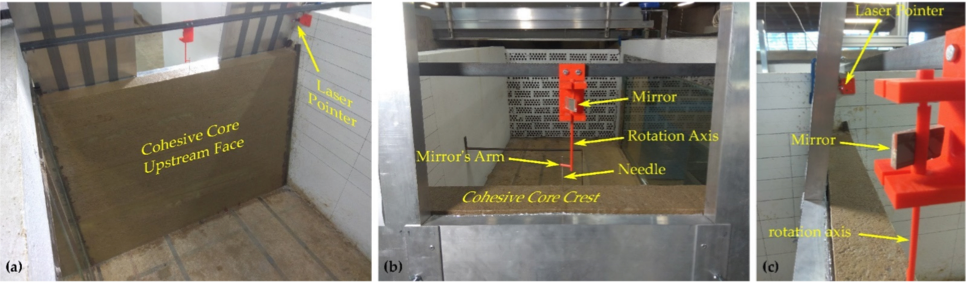
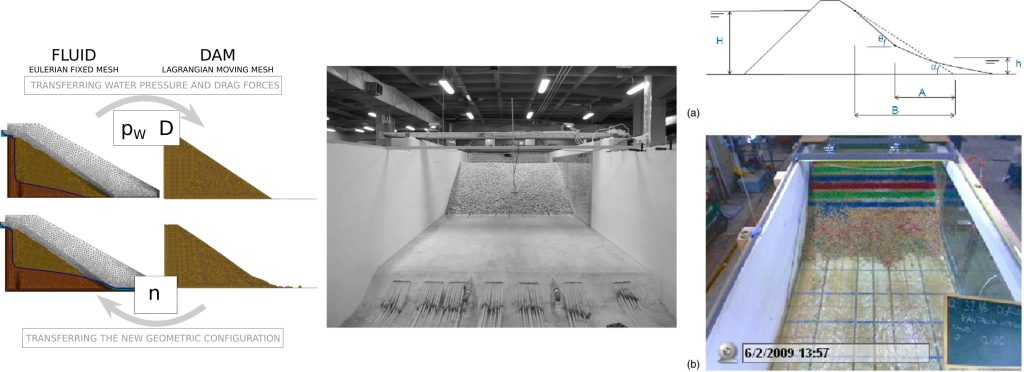
- Overtopping and failure mechanisms in rockfill dams. Our group has made substantial contributions to understanding overtopping and failure mechanisms in rockfill dams through both experimental and numerical studies. We developed and validated a numerical technique that couples an Eulerian fluid dynamic model with a Particle Finite Element Method (PFEM) structural model to simulate the dynamic evolution of seepage and mass sliding failures. Our experimental research involved studying the structural failure of cohesive cores using sand-bentonite mixtures, analyzing displacement and breach formation. Furthermore, we have conducted quasi-prototype scale testing of wedge-shaped blocks (ACUÑA) for armoring embankment dams against overflowing erosion, identifying their resistance limits, unexpected failure modes, and extraction forces, providing critical data for dam protection designs.
Groups and laboratories
Dam Safety Research Group – SERPA
Hydroinformatics and Water Management Group
Scientific-technological services
Permeability testing of very coarse granular materials
Hydraulic tests on prototype erosion protection systems
Protection of dams against overtopping (ACUÑA)
Improving dam safety (POLILAB)
CIVILis researchers involved
Selected references
- F. Salazar, M.A. Toledo, E. Oñate, R. Morán. An empirical comparison of machine learning techniques for dam behaviour modelling. Structural Safety 56, 9–17, 2015. https://doi.org/10.1016/j.strusafe.2015.05.001
- André Conde, Miguel Á. Toledo, Eduardo Salete. Impact of Arch Dam Cracking on Monitoring Data. Appl. Sci. 15 (3), 1096, 2025. https://doi.org/10.3390/app15031096
- André Conde, Eduardo Salete, Miguel Á. Toledo. Numerical Modeling of Cracked Arch Dams. Effect of Open Joints during the Construction Phase. Infrastructures 9 (3), 48, 2024. https://doi.org/10.3390/infrastructures9030048
- Antonia Larese, Riccardo Rossi, Eugenio Oñate, Miguel Ángel Toledo, Rafael Morán, Hibber Campos. Numerical and Experimental Study of Overtopping and Failure of Rockfill Dams. International Journal of Geomechanics 15, 04014060, 2015. https://doi.org/10.1061/(ASCE)GM.1943-5622.0000345
- D. Santillán, E. Salete, D. J. Vicente, M. Á. Toledo. Treatment of Solar Radiation by Spatial and Temporal Discretization for Modeling the Thermal Response of Arch Dams. Journal of Engineering Mechanics 140, 05014001, 2014. https://doi.org/10.1061/(ASCE)EM.1943-7889.0000801
- Cristian Ponce-Farfán, David Santillán, Miguel Á. Toledo. Thermal Simulation of Rolled Concrete Dams: Influence of the Hydration Model and the Environmental Actions on the Thermal Field. Water 12 (3), 858, 2020. https://doi.org/10.3390/w12030858
- Ricardo Monteiro-Alves, Rafael Moran, Miguel Á. Toledo, Javier Peraita. Structural Failure of the Cohesive Core of Rockfill Dams: An Experimental Research Using Sand-Bentonite Mixtures. Water 14 (23), 3966, 2022. https://doi.org/10.3390/w14233966
- Francisco Javier Caballero, Miguel Ángel Toledo, Rafael Moran, Javier Peraita. Quasi-Prototype Size Testing of Wedge-Shaped Block for Armoring Embankment Dams and Levees. Water 15 (4), 662, 2023. https://doi.org/10.3390/w15040662