Computational mechanics of fluids, solids and structures
Our research focuses on advanced numerical modeling for complex geotechnical and material behavior, particularly involving large deformations, coupled multi-phase systems, and dynamic phenomena. Our core activity revolves around developing, extending, and validating meshfree numerical schemes such as Local Maximum Entropy (LME), Optimal Transportation Meshfree (OTM), Smoothed Particle Hydrodynamics (SPH), and Material Point Method (MPM). We then apply these numerical schemes to various applications in civil and environmental engineering.
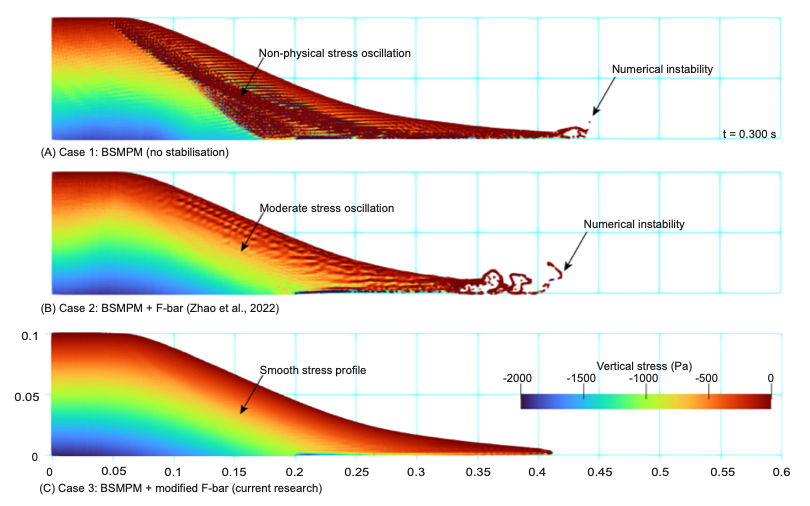
A significant contribution of our research lies in overcoming numerical instabilities like volumetric locking and stress oscillations through novel B-bar and F-bar based algorithms, and stabilization techniques for explicit solutions. We apply these methodologies to a wide range of problems, including dynamic consolidation in saturated soils, unconfined seepage, rapid landslides (debris flows, rock avalanches), dynamic fracture in concrete, and large penetration in foundations. We aim to provide robust and accurate tools for understanding and predicting these critical engineering challenges.
Recent interests and contributions
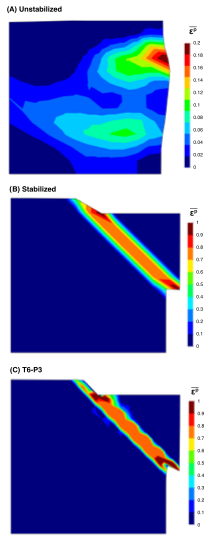
- Development and stabilization of meshfree numerical schemes. We have significantly contributed to advancing meshfree numerical schemes, particularly Local Maximum Entropy (LME) and Optimal Transportation Meshfree (OTM) methods, and more recently the B-spline Material Point Method (MPM). We have developed and implemented B-bar and F-bar based algorithms to effectively mitigate numerical instabilities like volumetric locking and non-physical stress oscillations, especially crucial for simulations involving nearly incompressible materials and large deformations. These stabilization techniques enhance the accuracy and robustness of their models across various geotechnical problems.
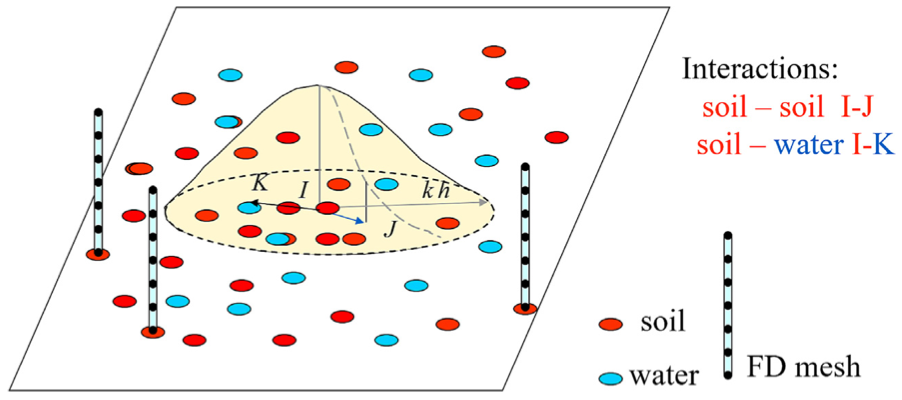
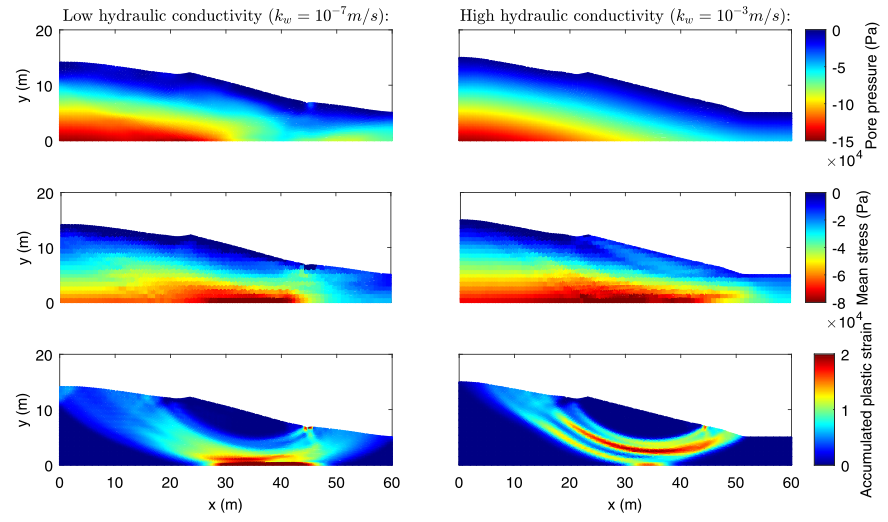
- Modeling of coupled soil-fluid problems and porous media. Some of our main contributions are related to simulating coupled soil fluid behavior in saturated porous media, primarily using Biot’s equations in u-w, u-pw, and u-w-pw formulations. We have developed methodologies to solve dynamic consolidation problems in saturated soils, unconfined seepage, and consolidation with sinks, validating their approaches against analytical and finite element solutions. Our work addresses the complexities of fluid-solid interaction, pore-water pressure evolution, and permeability effects in scenarios ranging from quasi-static to high-frequency dynamic loading.
- Simulation of large deformation geotechnical phenomena. We have also main important contributions to simulating geotechnical problems involving large deformations and strains, such as landslides, debris flows, granular column collapse, and shallow foundation penetration. We have extended classical meshfree frameworks to simulate these processes, including the OTM and the implicit B-spline MPM, which allows us to accurately capture these highly nonlinear behaviors. Our main contributions include incorporating finite strain constitutive models (e.g., Drucker-Prager, Nor-Sand), remapping algorithms for shape function updates, and master-slave contact algorithms to enhance realism in our simulations.
- Dynamic fracture and impact analysis in materials. We have developed and applied advanced numerical techniques to model dynamic fracture propagation, particularly in high-strength concrete under impact loading. A key contribution is the development of an eigensoftening algorithm, an extension of the eigenerosion approach, which accurately captures the gradual failure process in materials exhibiting softening behavior. This methodology has been validated against experimental data from three-point bending tests, effectively predicting impact forces, loading-line displacements, strain histories, and quantifying rate-dependent fracture properties and energy partition.
Groups and laboratories
Scientific-technological services
Static and dynamic computational simulation of structures and mechanisms
CIVILis researchers involved
Selected references
- Pedro Navas, Rena C. Yu, Susana López-Querol, Bo Li. Dynamic consolidation problems in saturated soils solved through u–w formulation in a LME meshfree framework . Computers and Geotechnics 79, 55–72, 2016. https://doi.org/10.1016/j.compgeo.2016.05.021
- Pedro Navas, Rena C. Yu, Bo Li, Gonzalo Ruiz. Modeling the dynamic fracture in concrete: an eigensoftening meshfree approach . International Journal of Impact Engineering 113, 9–20, 2018. https://doi.org/10.1016/j.ijimpeng.2017.11.004
- Saeid Moussavi Tayyebi, Manuel Pastor, Miguel Martin Stickle, Ángel Yagüe, Diego Manzanal, Miguel Molinos, Pedro Navas. SPH numerical modelling of landslide movements as coupled two-phase flows with a new solution for the interaction term . European Journal of Mechanics / B Fluids 96, 1–14, 2022. https://doi.org/10.1016/j.euromechflu.2022.06.002
- Manuel Pastor, Saeid M. Tayyebi, Miguel M. Stickle, Ángel Yagüe, Miguel Molinos, Pedro Navas, Diego Manzanal. A depth integrated, coupled, two-phase model for debris flow propagation . Acta Geotechnica 16, 2409–2433, 2021. https://doi.org/10.1007/s11440-020-01114-4
- Pedro Navas, Susana López-Querol, Rena C. Yu, Bo Li. B-bar based algorithm applied to meshfree numerical schemes to solve unconfined seepage problems through porous media . International Journal for Numerical and Analytical Methods in Geomechanics 40 (6), 962–984, 2016. https://doi.org/10.1002/nag.2472
- Mian Xie, Pedro Navas, Susana López-Querol. An implicit locking-free B-spline Material Point Method for large strain geotechnical modelling . International Journal for Numerical and Analytical Methods in Geomechanics 47, 2741–2761, 2023. https://doi.org/10.1002/nag.3599
- Pedro Navas, Susana López-Querol, Rena C. Yu, Manuel Pastor. Optimal transportation meshfree method in geotechnical engineering problems under large deformation regime . International Journal for Numerical Methods in Engineering 115 (10), 1217–1240, 2018. https://doi.org/10.1002/nme.5841
- Pedro Navas, Lorenzo Sanavia, Susana López-Querol, Rena C. Yu. Explicit meshfree solution for large deformation dynamic problems in saturated porous media . Acta Geotechnica 13, 227–242, 2018. https://doi.org/10.1007/s11440-017-0612-7
- Pedro Navas, Miguel M. Stickle, Angel Yagüe, Diego Manzanal, Miguel Molinos, Manuel Pastor. Stabilized explicit u — pw solution in soil dynamic problems near the undrained-incompressible limit . Acta Geotechnica 18, 1199–1213, 2023. https://doi.org/10.1007/s11440-022-01642-1
- Mian Xie, Pedro Navas, Susana López-Querol. A stabilised semi-implicit double-point material point method for soil–water coupled problems . Computational Particle Mechanics, 2025. https://doi.org/10.1007/s40571-025-01027-7