Applied geology, hydrogeology and hydrogeochemistry
Our research group is active in two primary, interconnected scientific domains: advanced analytical methods for element speciation and comprehensive hydrogeological studies for water resource management. In the realm of analytical chemistry, a significant focus is on arsenic speciation in diverse matrices, ranging from biological samples like rice, chicken, fish, hair, and nails to environmental samples like soil and sediment. Our group specializes in developing and optimizing rapid, simple, and novel extraction techniques, notably utilizing enzymatic ultrasonic probes in conjunction with advanced detection systems like HPLC-ICP-MS. Our work consistently aims to reduce sample treatment time from hours to minutes, minimize the use of organic solvents, and ensure the preservation of species integrity during extraction. A key motivation for this research is to understand human exposure to toxic arsenic species, particularly through the food chain, and its implications for public health and epidemiological studies in contaminated regions like the Ganga Plain.
Concurrently, our group extensively researches hydrogeological systems, focusing on karst aquifers and thermal springs. This involves detailed studies on groundwater flow, recharge area delimitation, and the dynamics of complex deep aquifers through numerical modeling. We investigate the influence of geological structures, such as fault zones, on groundwater circulation and the impact of seismic activity on spring behavior, including flow changes and water quality. Furthermore, our group develops methodologies for assessing underground renewable reserves for large regions, emphasizing the critical role of aquifers in inter-annual water supply regulation, especially in drought-prone areas. This interdisciplinary approach aims to inform sustainable management practices for vital groundwater resources.
We also study groundwater–infrastructure interactions, and perform regional-to-global water resources assessment. We have analyzed tunnel drainage in Miocene evaporites, linking altered flow paths to rapid karstification risks and framing tunnel behavior through saturation indices for key salts (thenardite, mirabilite, epsomite, glauberite, halite). This situates hydrogeochemical imbalance as a design and maintenance concern for linear works in soluble rocks. We have also tracked the redox-driven evolution of groundwater along a calcareous–peat aquifer pair, emphasizing pyrite oxidation, nitrate attenuation/denitrification, sulphate generation, and the role of organic-rich sediments—providing a natural analogue for aquifer self-purification. We have proposed a practical methodology to estimate natural recharge in karst aquifers worldwide from precipitation and lithology, and explores climate-change sensitivity of recharge. Collectively, our research topics connect process-level hydrogeochemistry to risk in civil works and to strategic accounting of groundwater resources.
Recent interests and contributions
- Hydrogeology and hydrogeochemistry in civil engineering. We have analyzed tunnel drainage in Miocene evaporites, linking altered flow paths to rapid karstification risks. This study introduces an engineering-oriented use of activities and saturation indices to diagnose dissolution capacity under high-conductivity brines, documenting undersaturation with respect to several salts and showing how drainage and infiltration perturbations can accelerate evaporite mass loss near the El Regajal tunnel, informing preventive and monitoring measures. By tracking the redox-driven evolution of groundwater along a calcareous–peat aquifer pair, we have contributed a nine-year, full-scale dataset that couples hydrochemistry with conceptual modeling to quantify how pyrite oxidation and peat-mediated processes drive nitrate reduction and sulphate enrichment, supported by targeted isotopic and field analyses—offering guidance for natural attenuation and for engineered analogues (e.g., wetlands). We have studied natural recharge in karst aquifers worldwide, proposing an operational lithology–precipitation approach to compute karst recharge (≈4.38 million hm³/yr), arguing karst accounts for ~34.5% of global groundwater resources and indicating ~10% recharge reduction under a 2050 scenario—delivering decision-ready numbers and maps for water planning.
- Development of rapid and novel arsenic speciation methods. Our research group has made advances in developing rapid and innovative methods for arsenic speciation, particularly in complex matrices like food and environmental samples. We have introduced and optimized an enzymatic ultrasonic probe-based extraction technique that drastically reduces sample treatment time from several hours to only a few minutes. This method avoids the use of hazardous organic solvents and multiple extraction steps, thereby diminishing potential sources of error and the generation of hazardous waste. It successfully quantifies major arsenic species (As(III), As(V), MMA, DMA) and ensures species integrity without transformation during extraction. This approach was validated for various matrices, including rice, chicken, fish, and soil, significantly enhancing sample throughput for routine analysis, quality control, and widespread applications.
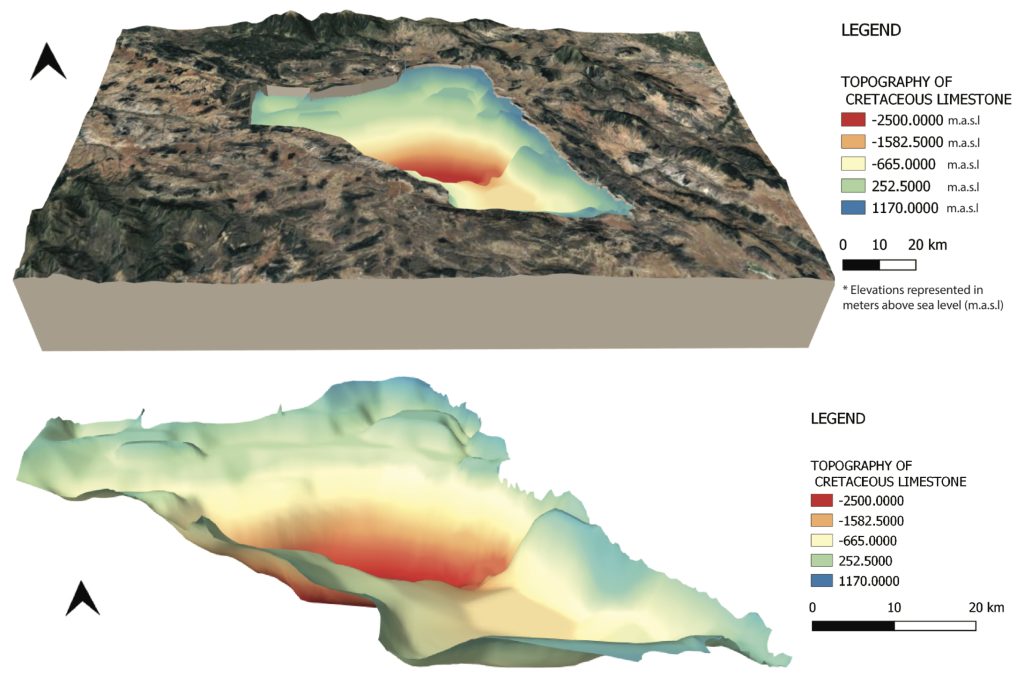
- Advanced hydrogeological modeling of thermal karst systems. An important contribution of our group is the first-time successful numerical modeling of the Alhama de Aragón and Jaraba thermal karst system. Our work elucidated the previously unclear origin and hydrogeological functioning of these significant thermal springs in Spain. By integrating diverse geological, hydrogeological, and isotopic data, our group developed a 3D numerical flow model that validated a new conceptual model, confirming the recharge areas and flow paths. The modeling demonstrated how temperature and depth influence hydraulic conductivity, and that while faults exist, they have a minor influence on the overall flow pattern at this large scale, primarily acting as barriers rather than conduits in this specific system. This provides a robust framework for the sustainable management and conservation of these critical thermal water resources.
- Methodology for assessing regional groundwater renewable reserves. Our group developed a novel theoretical mathematical method for assessing underground renewable groundwater reserves across broad regions. This methodology relies on analyzing the distribution functions of water contributions from springs, categorized by flow rates and lithological groups. It establishes a fundamental relationship between spring flow rates and hydrodynamic volumes, enabling the integration of these volumes based on discharge characteristics. This approach is crucial for quantifying the inter-annual regulatory capacity of aquifers, especially in arid or semi-arid regions prone to droughts. By providing a systematic way to estimate these reserves, the contribution helps water managers develop proactive strategies for sustainable water supply regulation and mitigate the impacts of hydrological variability and climate change.
- Understanding earthquake-induced hydrogeological changes. Our research group has contributed to understanding hydrogeological changes induced by earthquakes, particularly along fault zones. Our studies reveal that springs in areas of moderate seismicity consistently experience a flow decrease, often accompanied by increased turbidity. This sensitivity is linked to the degree of aquifer confinement and changes in aquifer parameters like permeability through elastic deformation or micro-fracturing. A notable finding is the demonstration that historical seismic activity can cause significant displacement of major spring discharge points along fault planes, as evidenced by the case of the Vozmediano spring, which began operating 19,159 years ago after a previous discharge point was altered. These insights are vital for assessing seismic risk and its impact on water supply reliability.
Groups and laboratories
Applied Geology and Hydrogeology
Scientific-technological services
CIVILis researchers involved
Selected references
- Ignacio Menéndez Pidal, Jose Antonio Mancebo Piqueras, Eugenio Sanz Pérez, Clemente Sáenz Sanz. Influence of Hydrogeochemistry on Tunnel Drainage in Evaporitic Formations: El Regajal Tunnel Case Study (Aranjuez, Spain). Sustainability 13 (3): 1505, 2021. https://doi.org/10.3390/su13031505
- Eugenio Sanz, Catalina Bezares, Carlos Pascual, Ignacio Menéndez Pidal, Cristina Fonolla. Hydrogeochemical Evolution of an Aquifer Regulated by Pyrite Oxidation and Organic Sediments. Water 13 (17): 2444, 2021. https://doi.org/10.3390/w13172444
- Eugenio Sanz Pérez, Juan Carlos Mosquera-Feijóo, Joaquín Sanz de Ojeda, Ignacio Menéndez-Pidal. A Procedure to Estimate Global Natural Recharge in Karst Aquifers. Water 17 (N/A): 1779, 2025. https://doi.org/10.3390/w17121779
- Sanz, E., Muñoz-Olivas, R., Cámara, C. A rapid and novel alternative to conventional sample treatment for arsenic speciation in rice using enzymatic ultrasonic probe. Analytica Chimica Acta 535 (2): 227–235, 2005. https://doi.org/10.1016/j.aca.2004.12.021
- Sanz, E., Muñoz-Olivas, R., Cámara, C. Evaluation of a focused sonication probe for arsenic speciation in environmental and biological samples. Journal of Chromatography A 1097 (1–2): 1–8, 2005. https://doi.org/10.1016/j.chroma.2005.08.012
- Sanz, E., Muñoz-Olivas, R., Cámara, C., Kumar Sengupta, M., Ahamed, S. Arsenic speciation in rice, straw, soil, hair and nails samples from the arsenic-affected areas of Middle and Lower Ganga plain. Journal of Environmental Science and Health, Part A 42 (1): 1–11, 2007. https://doi.org/10.1080/10934520701564178
- Sanz de Ojeda, J., Elorza Tenreiro, F.J., Sanz Pérez, E. Improvement of the thermal spring protection area through numerical modelling and interdisciplinary studies. Hydrology and Earth System Sciences Discussions 2024 (preprint): 1–44, 2024. https://doi.org/10.5194/hess-2024-82
- Sanz, E., Menéndez Pidal, I., Escavy, J.I., Sanz de Ojeda, J. Hydrogeological Changes along a Fault Zone Caused by Earthquakes in the Moncayo Massif (Iberian Chain, Spain). Sustainability 12 (21): 9034, 2020. https://doi.org/10.3390/su12219034
- Sanz de Ojeda, J., Sanz-Pérez, E., Mosquera-Feijóo, J.C. A Method for the Assessment of Underground Renewable Reserves for Large Regions: Its Importance in Water Supply Regulation. Water 16 (19): 2736, 2024. https://doi.org/10.3390/w16192736
- Sanz De Ojeda, J., Elorza, F.J., Sanz, E. Flow Numerical Modelling in Thermal Karst Systems: The Case of Alhama de Aragón and Jaraba Springs. Water 16 (22): 3240, 2024. https://doi.org/10.3390/w16223240